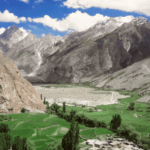
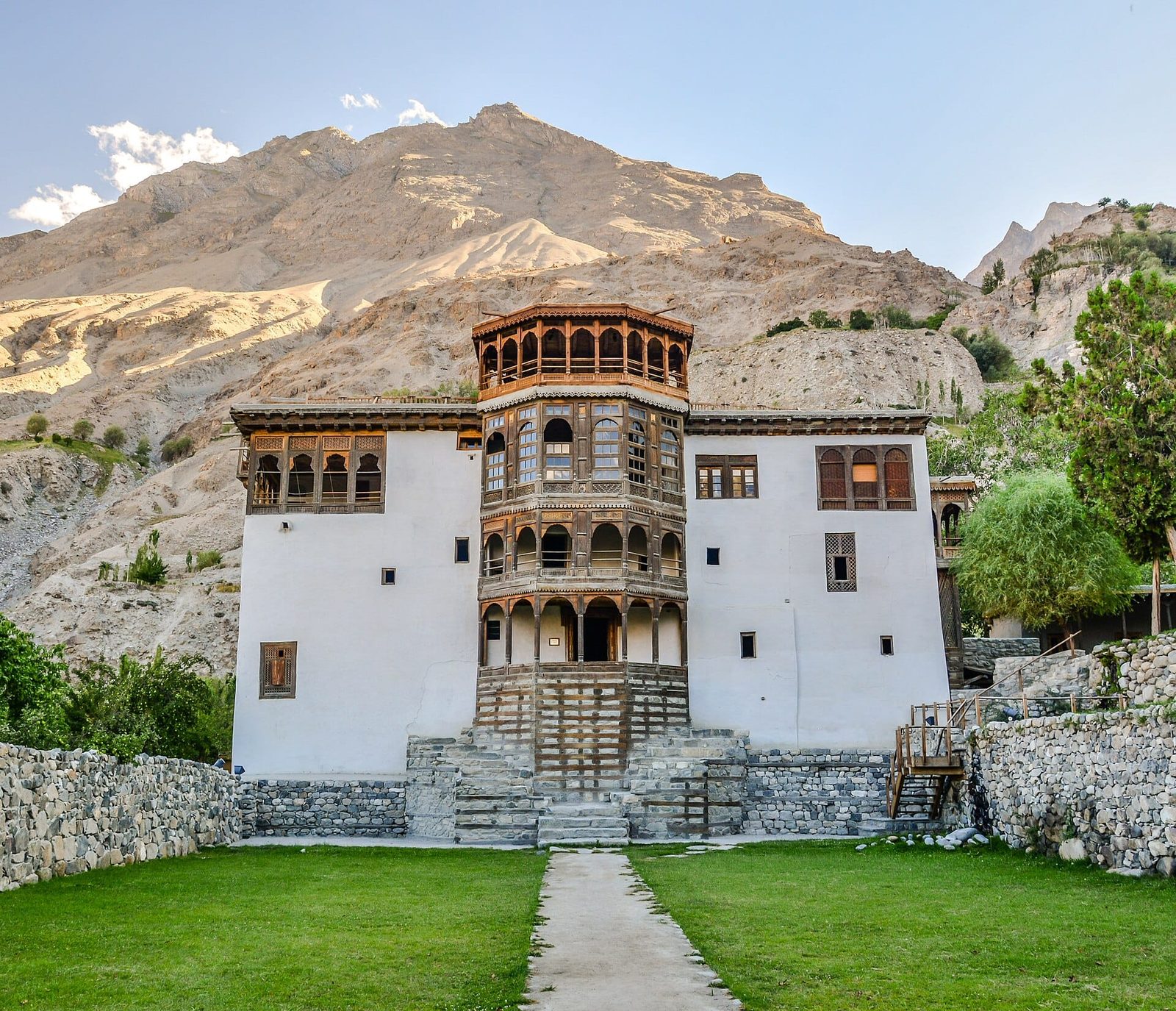
The Khaplu Valley is the old royal heart of eastern Baltistan. Its main town sits along the Shyok River at roughly 2,600 m, about 103 km east of Skardu. That is a two-to-three-hour drive. You come here for two things above all. First, the restored 1840 Khaplu Palace, now a heritage hotel and museum. Second, the Chaqchan Mosque, built in 1370 and one of the oldest in the region. It is an easy, low-altitude cultural trip, suitable for almost anyone and needing no trekking at all. Moreover, the road in is open roughly May to October. Khaplu is also the doorway to the Hushe Valley and the giants beyond it: Masherbrum, K6, K7 and Chogolisa.
We run Khaplu out of Skardu with our own Balti team, and we’ll be straight with you: this is not an expedition, it’s a heritage and valley trip. The walking is light and the altitude is gentle. The reward lies elsewhere — in the architecture and the apricot orchards. Above all, it is the slower rhythm of a valley that was its own kingdom within living memory. Many travellers pair a night or two here with the harder mountain work further up. As a result, the Khaplu Valley makes a fine soft landing before the high routes, or a recovery after them.
Key Takeaways
- Where: Khaplu, capital of Ghanche District, eastern Gilgit-Baltistan, on the Shyok River ~103 km east of Skardu.
- Altitude: ~2,600 m — low by Karakoram standards, so no acclimatisation concerns.
- Getting there: a paved road from Skardu, roughly 2–3 hours by jeep or car.
- Headline sights: Khaplu Palace (built 1840, restored 2005–2011) and Chaqchan Mosque (1370).
- Best season: May–October; June–September is greenest and warmest.
- Difficulty: easy. A cultural and scenic trip, not a trek — good for families and first-time visitors.
Where the Khaplu Valley is, and why it matters
Khaplu sits in the far east of Baltistan, where the Shyok River runs down from the eastern Karakoram before it meets the Indus near Skardu. The town is the administrative capital of Ghanche District. Until 1972 it was also the seat of one of old Baltistan’s princely states. Historically that made it the second-largest kingdom in the region after Skardu itself. In fact, that history is the whole point of a visit. This was a frontier of trade and faith, where routes from Ladakh, Kashmir and Central Asia met, and you can read that meeting in the buildings.
For us, Khaplu does two jobs. It is a destination in its own right for travellers who want heritage and calm over altitude and effort. And it is the logistical gateway to the Hushe Valley and Masherbrum, the Charakusa Valley below K6 and K7, and the Hushe-side finish of the Gondogoro La crossing. If you are heading up to those, you pass through here.
The route: a two-to-three day Khaplu Valley trip, step by step
Most people do Khaplu as a comfortable two- or three-day loop out of Skardu. Here is how we usually run it.
- Day 1 — Skardu to Khaplu (~103 km, 2–3 hrs). A scenic drive east along the Shyok. Check in near or at the palace, then an afternoon walking the old town and its orchards.
- Day 2 — Khaplu Palace and Chaqchan Mosque. A slow morning at the palace and its museum, then down to the 1370 mosque in the old quarter. Afternoon free for the bazaar, the river, or a short drive toward Hushe.
- Day 3 (optional) — Hushe Valley day trip. Drive up the Hushe road for the first proper view of Masherbrum, then return to Skardu, or push on if you are continuing to a trek.
It can be compressed into a long single day from Skardu if time is short. However, you lose the best of it — the Khaplu Valley rewards an unhurried pace.
The buildings: a palace, a 650-year-old mosque, and the giants behind them
Khaplu Palace (Yabgo Khar)
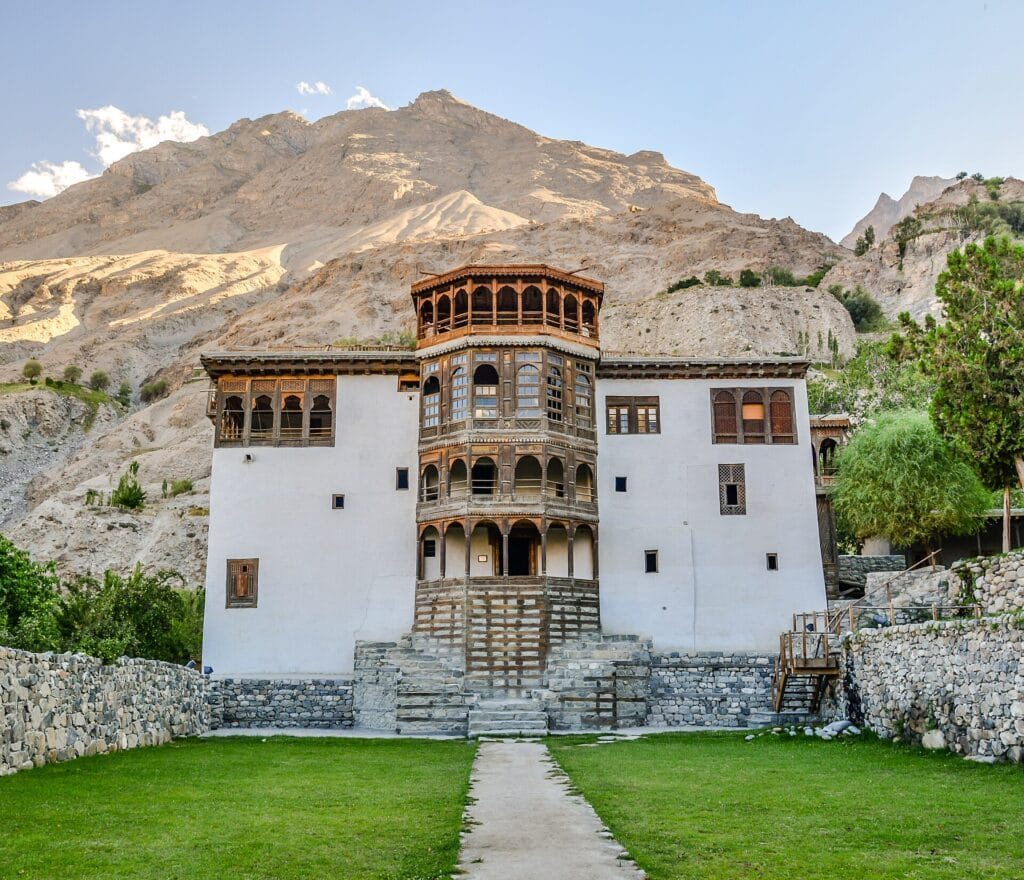
The palace was built in 1840 by the Yabgo Raja Daulat Ali Khan. Before that, the seat of government had stood in the older fort above. The Dogra conquest of the region pushed it down into the valley. It is a four-storey structure of timber, mud brick and clay, and its design carries Tibetan, Kashmiri, Ladakhi, Balti and Central Asian influences — exactly the crossroads that Khaplu was. The last raja to live in it, Fatah Ali Khan, died in 1983. Between 2005 and 2011 the Aga Khan Trust for Culture restored the building under its Historic Cities Programme, and it now runs as a heritage hotel and museum of Baltistan’s history and culture. You do not have to stay there to visit the museum.
Chaqchan Mosque
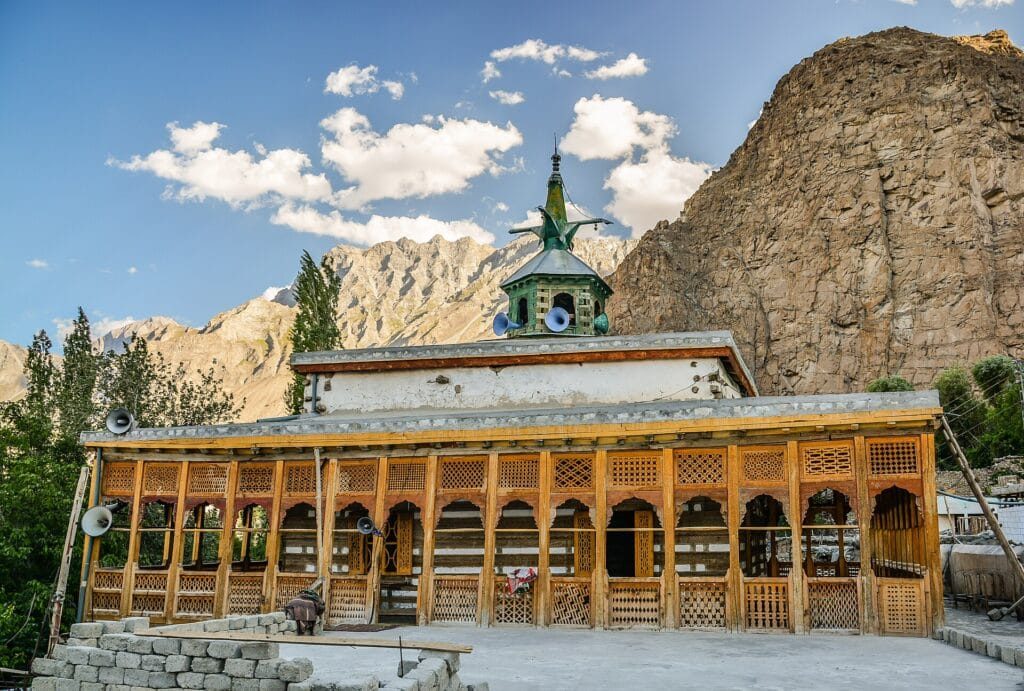
A short way into the old town stands the Chaqchan Mosque, dated to 1370. It is one of the oldest mosques in Baltistan. It was raised while the valley’s people were converting from Tibetan Buddhism to Islam. Its construction is tied to the spread of Islam through the region, and sources differ on the exact hand behind it. Architecturally it blends Tibetan, Mughal and Persian styles, with stacked-wood walls daubed with clay — an old, weatherproof method built for hard Baltistan winters. It is a working mosque, so dress modestly and ask before entering or photographing.
The giants up the valley
Of course, Khaplu’s skyline belongs to the Hushe Valley peaks just beyond it. For a sense of scale, here is how the nearby giants stack up against the valley floor.
The road into the Khaplu Valley: a schematic profile
The drive climbs gently from Skardu to Khaplu, then higher again only if you continue up to Hushe. In any case, there is no real altitude challenge on the Khaplu Valley trip itself.
When to visit the Khaplu Valley
In short, the Khaplu Valley is a summer-and-shoulder destination. The valley greens up from spring, peaks in the warm months, and turns gold in autumn before the road quietens for winter.
| Months | Conditions | Verdict |
|---|---|---|
| Apr–May | Spring, blossom and apricot bloom, cool nights, road opening up | Good — quiet and pretty |
| Jun–Sep | Warm days (~15–30°C), green valley, all sights and Hushe accessible | Best |
| Oct | Autumn gold, crisp and clear, fewer visitors | Good — beautiful light |
| Nov–Mar | Cold, snow possible, road and services limited | Hard — off-season |
How hard is the Khaplu Valley, really?
Honestly: easy. At ~2,600 m there are no altitude problems for healthy travellers, and the sightseeing is gentle walking on town paths and around the palace and mosque. This is one of the few Baltistan trips a family with children or an older traveller can do comfortably. The only real demands are the drive — a few hours of mountain road each way — and basic respect for a living cultural and religious site. If you continue up into Hushe for trekking, the difficulty changes entirely; treat that as a separate, serious undertaking. For a primer on the region as a base, see our Skardu travel guide.
Safety — the real risk here is the road, not the altitude. The main hazard on a Khaplu trip is the mountain driving: long stretches above the Shyok, occasional rockfall, and weather that can change fast. We use experienced local drivers who know the road in every season. In addition, we carry a satellite phone on trips beyond mobile coverage. We also keep an evacuation plan with established helicopter-rescue contacts for the wider Baltoro and Baltistan region. Make sure your travel insurance covers high-altitude road travel and emergency evacuation.
Permits & access. Khaplu and the lower Hushe road sit in an open zone — no special trekking permit is needed for the heritage visit itself. If you continue to a mountaineering objective above (Masherbrum, K6/K7, Chogolisa) you will need the appropriate climbing permit and NOC, which we arrange. Every foreign visitor needs a valid Pakistan visa; for treks and expeditions that is a Trekking & Mountaineering visa rather than a plain tourist visa. See our Pakistan visa guide for trekkers for the current process.
Getting to the Khaplu Valley, and what it costs
Khaplu is reached by road from Skardu — roughly 2–3 hours by jeep or car on a mostly paved route along the Shyok. Skardu itself is reached by daily flights from Islamabad (weather-dependent) or overland by road; we cover both options in detail in how to get to Skardu. Many travellers fold Khaplu into a wider Baltistan loop alongside Deosai National Park or a Hushe trek.
On cost, we keep pricing personal rather than posting a number that goes stale the week we publish it. What you pay depends on group size, whether you stay in the heritage hotel or a simpler guesthouse, how many days you take, and what you add on. Tell us your dates and group and we’ll quote you a fair price, no corners cut on guides, transport or safety.
We run this valley. Our 3-day Khaplu & Hushe Valley Tour pairs the palace and the 700-year-old Chaqchan Mosque with Hushe village under Masherbrum, from $420 per person with transport from Skardu, rooms, meals and a local guide. Tea in a Balti kitchen included; the Khaplu Palace hotel upgrade is on request.
Frequently asked questions
How far is Khaplu from Skardu, and how long does the drive take?
Khaplu is about 103 km east of Skardu. That is roughly a 2–3 hour drive by jeep or car along the Shyok River, on a mostly paved road.
Do I need to trek to visit Khaplu?
No. In fact, Khaplu is a low-altitude cultural and valley trip at about 2,600 m. The sightseeing is gentle walking around the town, the palace and the mosque — no trekking required. Trekking only comes in if you continue up the Hushe Valley.
How old is Khaplu Palace, and can I visit it?
The palace was built in 1840 and restored by the Aga Khan Trust for Culture between 2005 and 2011. It now runs as a heritage hotel and, at the same time, a museum of Baltistan’s history. You can visit the museum and grounds without staying there.
When is the best time to visit Khaplu?
May to October, with June to September the warmest and greenest. Spring brings blossom and autumn brings golden colour; winter is cold with limited road access and services.
Is Khaplu suitable for families and older travellers?
Yes. Because it is low, gentle and reached by road, Khaplu is one of the more accessible Baltistan trips. It suits families with children. Likewise, it suits older travellers who want the scenery and heritage without the effort of a trek.
Plan your Khaplu trip with a local Balti team
We’re a local Balti team based in Skardu, not a broker. Therefore your trip is run by our own people and our own logistics. Tell us your dates and group size and we’ll put together a Khaplu and Hushe itinerary that fits.
WhatsApp us on +92 312 9921574 or email info@karakoramventure.com. Local hands, real safety, fair price.
Sources & attribution: elevation, history and access details drawn from Wikipedia (Khaplu, Khaplu Palace, Chaqchan Mosque, Shyok River) and established regional travel references. Figures are approximate and provided in good faith; confirm current road and visa conditions before travel.