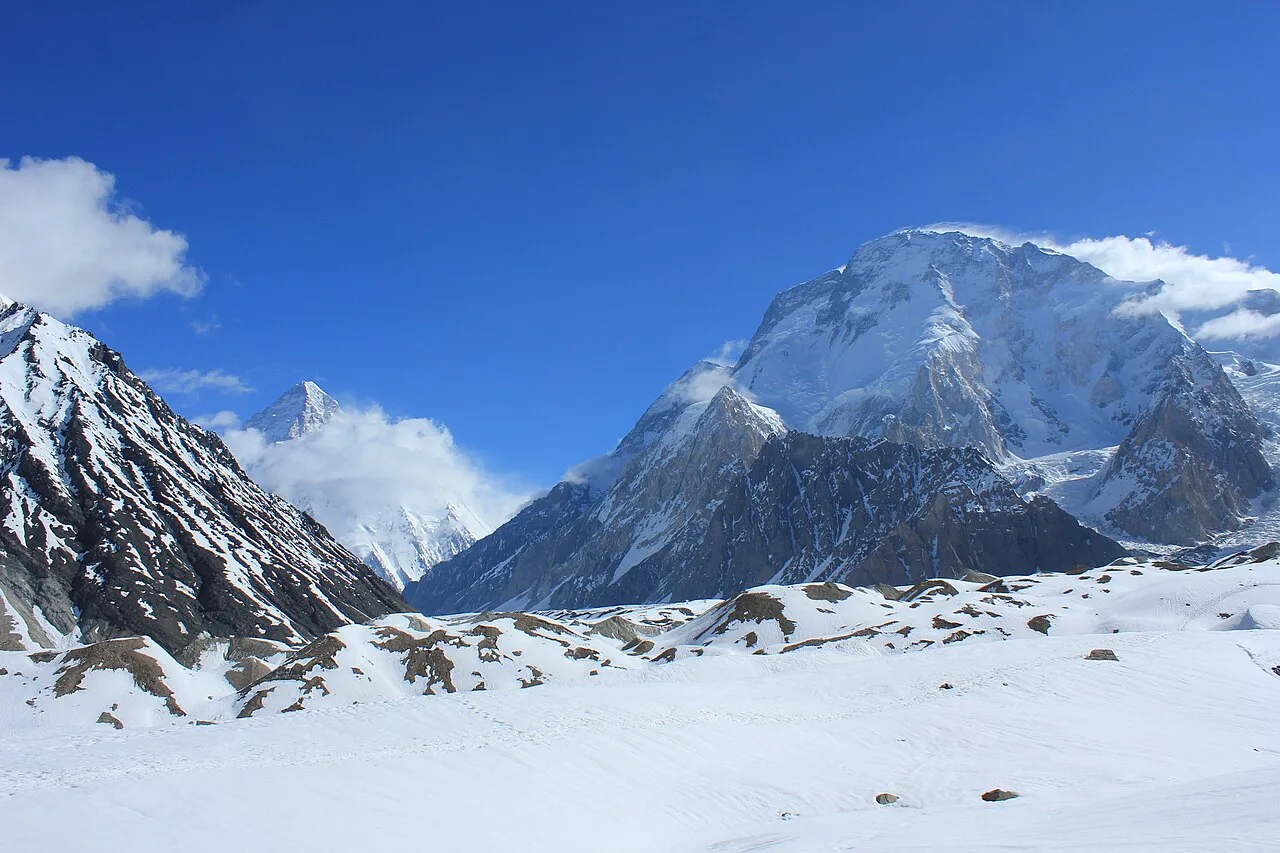
Broad Peak (8,051 m / 26,414 ft) is the world’s 12th-highest mountain and the most achievable of Pakistan’s five 8,000-metre giants for a fit, experienced climber — but “achievable” is not the same as safe. It shares the Baltoro Glacier and Concordia approach with K2, sits barely eight kilometres from it, and is climbed by a direct West Spur route with fixed ropes on its hardest sections. The catch is the summit day: a long, exposed traverse above 7,800 metres that has killed strong mountaineers and turns back many more at the false summit. Plan on roughly 40–50 days, a real acclimatisation plan, and a team that knows this glacier. We’re a Balti outfit based in Skardu — these are the valleys we work in.
Key Takeaways
- Height: 8,051 m (26,414 ft) — 12th-highest peak on earth, on the Pakistan–China border in the Karakoram.
- Normal route: the West Spur, ~4,850 m base camp to summit via four high camps; fixed ropes on the steep sections.
- First ascent: 9 June 1957, by an Austrian team in pure alpine style — no oxygen, no high-altitude porters.
- Trip length: roughly 40–50 days, including a 6–7 day trek in via Askole, the Baltoro and Concordia.
- Season: mid-June to August; the summit window is usually a few days in July.
- Honest read: often called the “easiest” 8,000er, but the summit traverse is long and dangerous — it demands prior high-altitude experience.
The mountain: a mile-wide summit beside K2
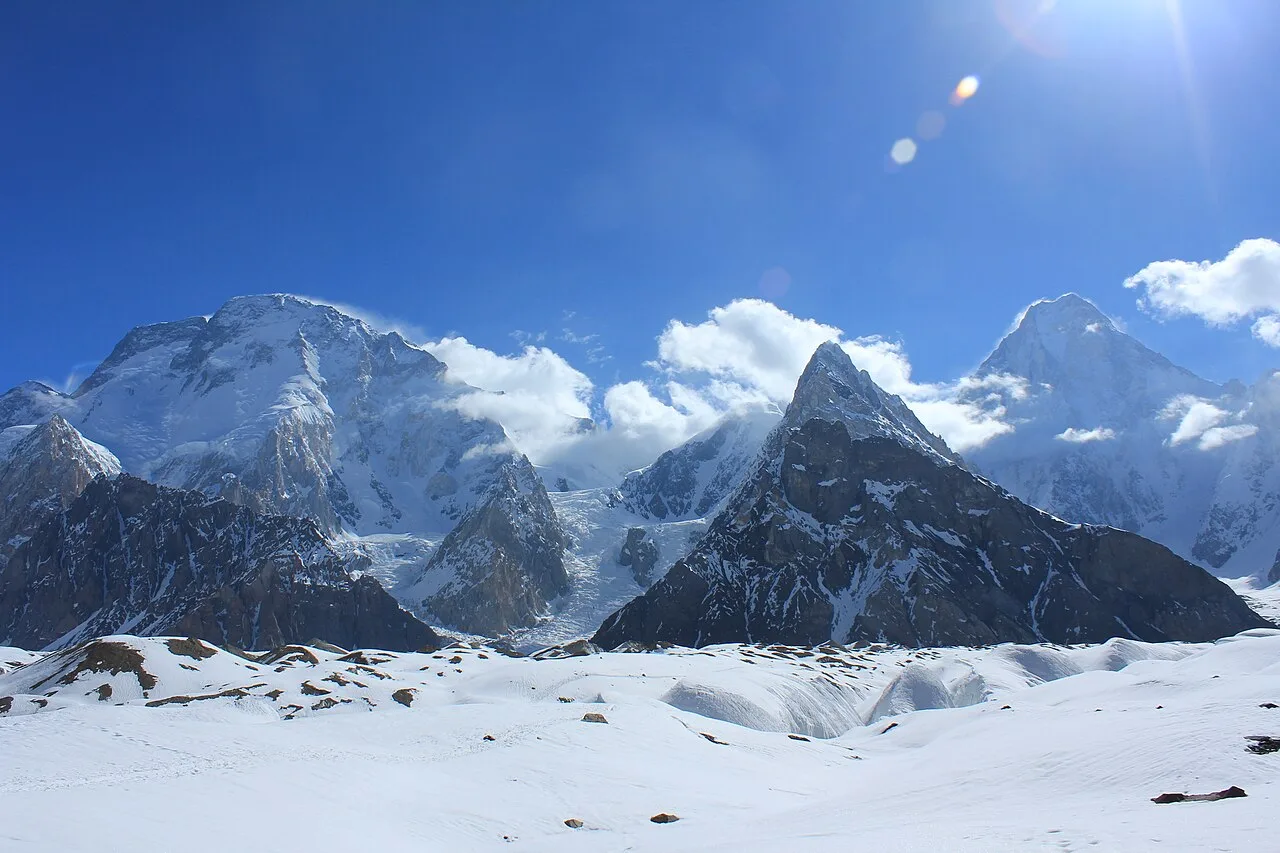
Broad Peak earns its plain English name. Its summit crest runs more than 1.5 kilometres along the sky, a long white wall rather than a single point. The British explorer Martin Conway coined the name in 1892, after the Breithorn (“broad horn”) in the Alps. The Balti people who live beneath it never adopted the literal translation, Falchan Kangri — on the ground it is simply Broad Peak.
It is part of the Gasherbrum massif, at the head of the Baltoro Glacier, roughly eight kilometres from K2 and straddling the Pakistan–China frontier. The mountain has three summits over 8,000 metres — the Main summit (8,051 m), the Rocky Summit (8,028 m) and Broad Peak Central (8,011 m) — plus Broad Peak North (7,490 m) and Kharut Kangri (6,942 m). That detail matters more than it sounds: the gap between the false (forepeak) and true summit is exactly where summit day goes wrong for many climbers.
1957: one of mountaineering’s boldest first ascents
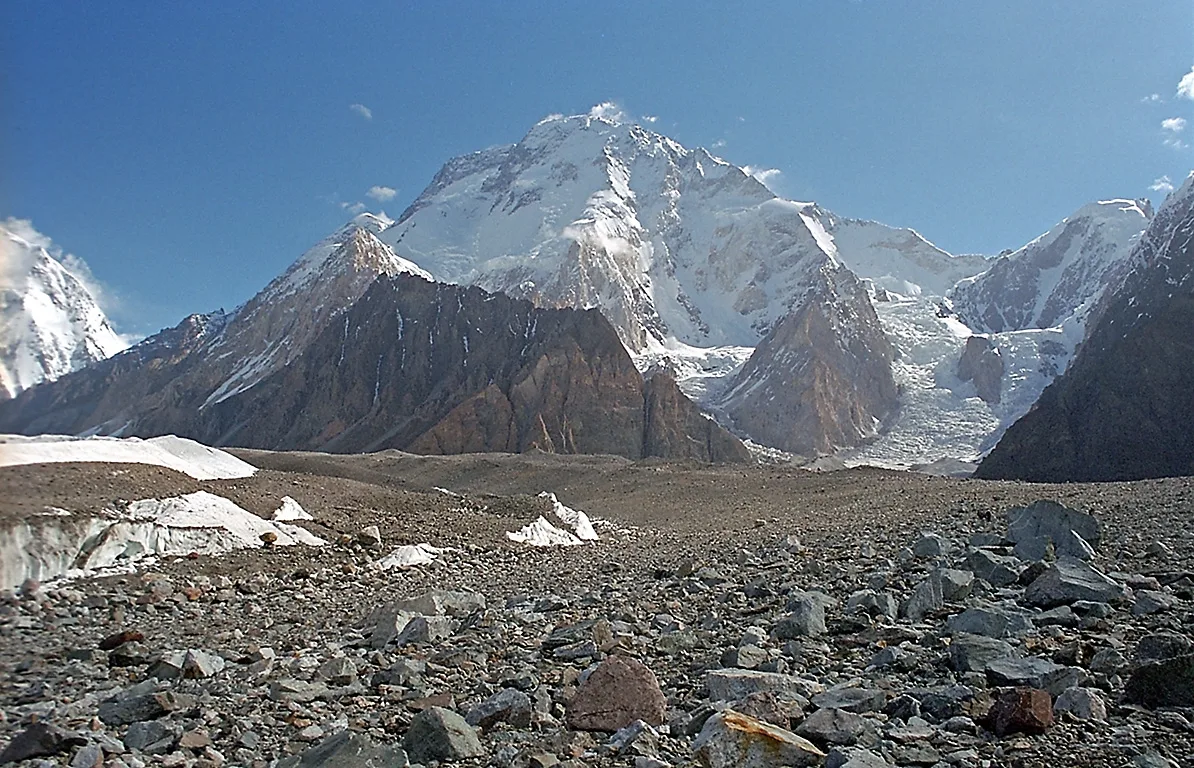
Broad Peak was first climbed on 9 June 1957 by a four-man Austrian team — Marcus Schmuck (the leader), Fritz Wintersteller, Kurt Diemberger and Hermann Buhl. What makes the climb extraordinary even today is the style: they went up the West Spur without supplementary oxygen, without high-altitude porters, and without a support team stocking their camps — what we’d now call alpine style, on an 8,000er, in 1957. A first attempt on 29 May had reached the 8,030 m forepeak before they turned back; eleven days later all four stood on the true summit.
The expedition carries a hard coda. Just over two weeks after summiting Broad Peak, Hermann Buhl — already famous for his solo first ascent of Nanga Parbat — died on nearby Chogolisa on 27 June 1957, when a cornice broke beneath him in poor visibility. The Karakoram has never traded in easy victories, and Broad Peak’s own history since has been written in both records and losses: Krzysztof Wielicki soloed it in a single 21.5-hour push in 1984 — the first one-day ascent of any 8,000er — while the first winter ascent in March 2013 ended with two of the four summiteers, Maciej Berbeka and Tomasz Kowalski, dying on the descent. In 2019 Pakistan’s Shehroze Kashif summited at seventeen, the youngest person to do so.
The normal route, camp by camp
Almost every commercial ascent follows the West Spur (often called the West Ridge or normal route), the same line the 1957 team pioneered. From base camp on the Godwin-Austen/Baltoro side, the route climbs steepening snow and ice to a high col, then traverses to the summit. The figures below are approximate — camp altitudes shift year to year with conditions and where teams fix the route — but they give an honest picture of the shape of the climb.
Base Camp (~4,850 m)
Broad Peak base camp sits on the glacial moraine below the West Spur, a short walk beyond Concordia and within sight of K2 base camp. Teams spend the first stretch here resting, organising loads and taking short acclimatisation walks before the real work begins.
Camp 1 (~5,600 m) and Camp 2 (~6,300 m)
The line above base camp climbs snow slopes and a rock-and-ice spur. The pitch between Camp 1 and Camp 2 is the steepest sustained climbing on the route and is normally fixed with rope. This is where the West Spur tests whether your acclimatisation has actually taken.
Camp 3 (~7,000 m) and High Camp (~7,400 m)
Higher up, the angle eases but the altitude bites. Most teams establish a Camp 3 around 7,000 m and a high camp near 7,400 m for the summit launch. Above this lies the col (roughly 7,800 m) where the route meets the summit ridge.
Summit day — the honest part
From the col, the route does not go straight up. It traverses the long summit ridge, over or around the 8,030 m forepeak, to the true 8,051 m summit perhaps 45 minutes to an hour further along an exposed crest. Every metre of that traverse must be reversed on tired legs. This is where Broad Peak’s reputation as a “gentle” 8,000er falls apart: many climbers stop at the forepeak believing they’ve summited, and the long return in deteriorating afternoon weather is where the mountain has claimed most of its victims.
Safety, said plainly
Broad Peak is statistically one of the more achievable 8,000ers, but it is not a beginner’s mountain and it has killed very experienced climbers. The danger lives in the summit traverse and the descent, not the climb up. We run every expedition with a satellite phone in camp, established helicopter-rescue contacts for the Baltoro region, and a turn-around time that we hold to — even when the summit is in sight. The forepeak is not the summit, and getting down alive is the whole job.
How Broad Peak compares as a “first 8,000er”
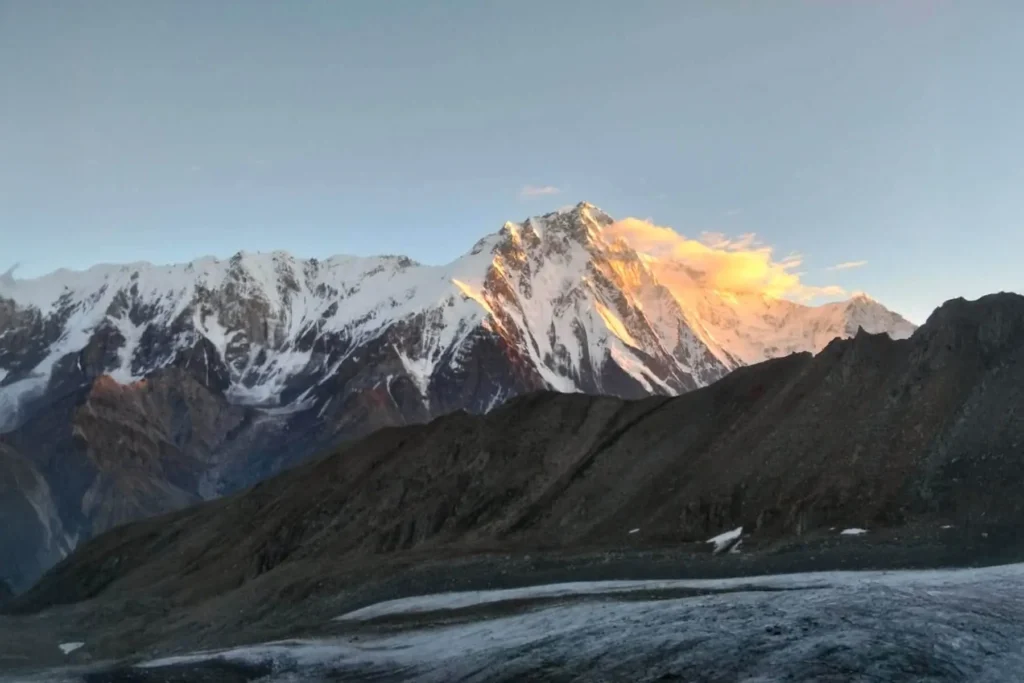
Climbers researching their first 8,000-metre peak usually weigh Broad Peak against Gasherbrum II next door, and against K2 looming across the glacier. Here is an honest side-by-side. Treat altitudes as fixed and everything else — days, difficulty — as approximate and weather-dependent.
| Peak | Height | Normal route | Relative difficulty | Typical trip |
|---|---|---|---|---|
| Broad Peak | 8,051 m | West Spur | Long summit traverse; high objective danger on descent | ~40–50 days |
| Gasherbrum II | 8,035 m | SW ridge | Often rated the most accessible 8,000er; shorter summit day | ~40–45 days |
| K2 | 8,611 m | Abruzzi Spur | Among the hardest and deadliest of all — not a first 8,000er | ~50–60 days |
If this is your first 8,000-metre peak, the sensible ladder is altitude before ambition. Many climbers build up on a 6,000er and then a 7,000er — our Spantik (Golden Peak) expedition is a popular 7,000 m stepping stone — before committing to Broad Peak. For the full picture of who else is on the Baltoro in season, see our overview of the Baltoro climbing season.
The trek in: Askole to base camp
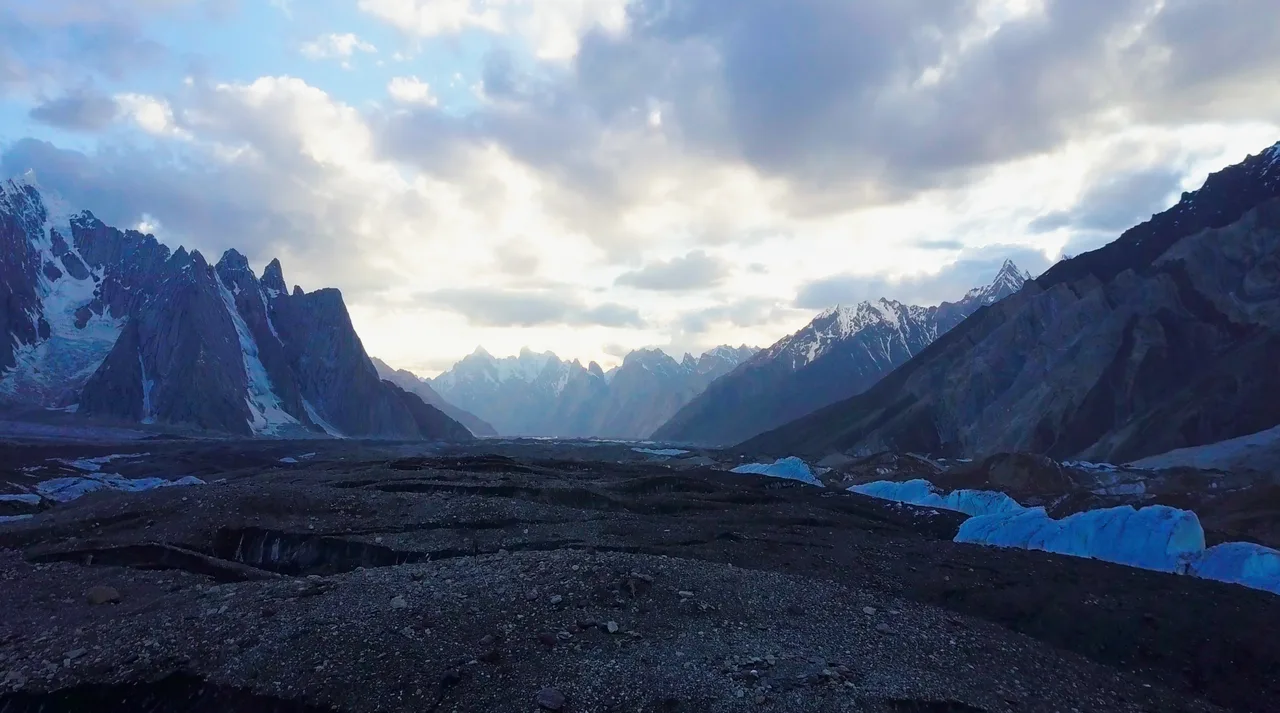
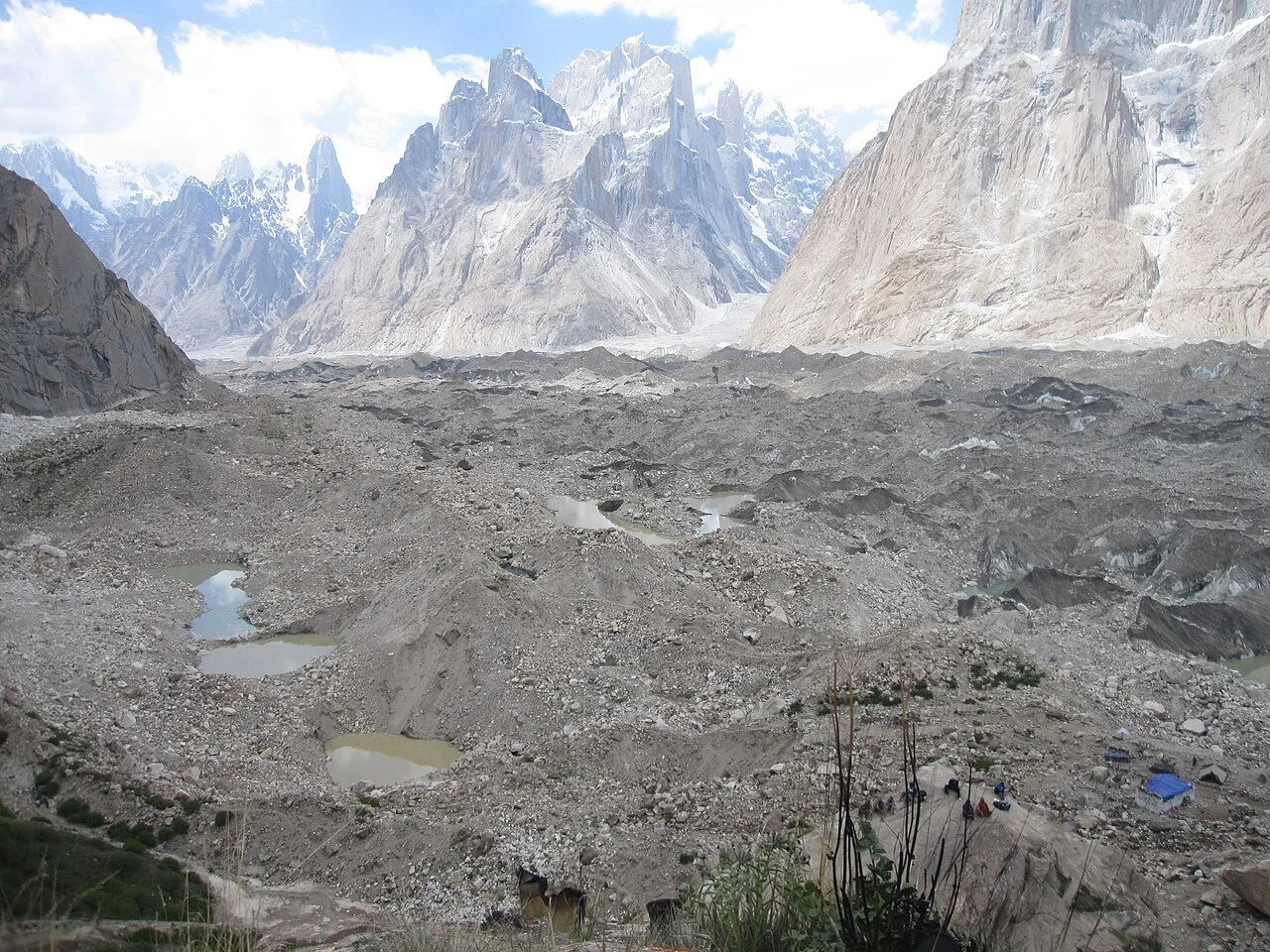
You don’t drive to Broad Peak. The expedition starts with the same legendary walk as the K2 Base Camp trek: a jeep from Skardu to Askole (roughly 7–9 hours on rough road), then six to seven days on foot up the Baltoro Glacier through Jhula, Paiju, Urdukas and Goro, to Concordia — the amphitheatre where the Baltoro and Godwin-Austen glaciers meet beneath K2, Broad Peak and the Gasherbrums. From Concordia it’s a short stage to base camp. This approach is itself part of the acclimatisation, and it’s one of the finest glacier treks on earth. If you’re planning the journey to the trailhead, our guide on how to get to Skardu covers flights and road.
Permits, season and what to expect
Permits & visa — read this early
Climbing Broad Peak requires a mountaineering permit and royalty paid to Gilgit-Baltistan / Pakistan’s Alpine Club, a Trekking & Mountaineering visa (distinct from a tourist visa), and a registered liaison officer with the expedition. These take real lead time and paperwork. We handle the permit process, liaison officer and logistics end to end — but apply early, and don’t arrive on a tourist visa expecting to climb. Exact fees change year to year; WhatsApp us for the current numbers.
The climbing window runs roughly from mid-June to August, with most summits landing in July when the jet stream lifts for a few days. Right now, in June, base camps along the Baltoro are filling for exactly this reason. Expect to spend most of your 40–50 days acclimatising through rotations up to the high camps and waiting at base camp for a weather window — on an 8,000er, patience is part of the skill set.
Who Broad Peak is for
This is a peak for climbers who already have real altitude under their belt — ideally a previous 6,000 m and 7,000 m summit, solid cramponing and fixed-rope skills, and the fitness to carry loads above 7,000 m. It is not a trek with a summit bolted on. If you’re not there yet, the honest move is to build toward it: a Karakoram trek to feel the altitude and the glacier, then a 7,000er, then this. We’ll tell you candidly where you stand — we’d rather put you on the right mountain than sell you the wrong one.
Frequently asked questions
How high is Broad Peak and where is it?
Broad Peak is 8,051 m (26,414 ft), the 12th-highest mountain in the world. It stands in the Karakoram range on the Pakistan–China border, about eight kilometres from K2, at the head of the Baltoro Glacier in Gilgit-Baltistan, Pakistan.
Is Broad Peak really the “easiest” 8,000er?
It is often described as one of the more achievable 8,000ers because the route is fairly direct and the hard sections are fixed with rope. But the long, exposed summit traverse above 7,800 m and the descent have killed many experienced climbers. “Achievable” for a strong, experienced mountaineer — never “easy.”
How long does a Broad Peak expedition take?
Plan on roughly 40–50 days door to door. That includes travel, a 6–7 day trek in via Askole and Concordia, acclimatisation rotations to the high camps, and waiting at base camp for a safe summit window, which usually opens in July.
When is the best season to climb Broad Peak?
Mid-June to August, with the highest chance of a summit in July when the weather settles for a few days. Outside of rare winter expeditions, the mountain is not climbed in the colder months.
What permits do I need for Broad Peak?
A mountaineering permit with royalty, a Trekking & Mountaineering visa (not a tourist visa), and a registered liaison officer. We arrange the permit, liaison officer and full logistics — but the paperwork needs lead time, so start early.
Thinking about Broad Peak in 2026?
Planning your trip? WhatsApp us on +92 312 9921574 or email info@karakoramventure.com — you’ll be talking to a local Balti team who guide these valleys ourselves, not a broker. Tell us your climbing history and we’ll give you an honest read on whether this is your year for an 8,000er — and the current permit fees and fixed dates.
Want to see it without climbing it? Our 18-day Broad Peak Base Camp Trek walks the same Baltoro approach to Concordia and on to base camp at 4,850m, directly beneath the 8,051m wall — no ropes, no summit, no forty-day expedition. Balti guides and porters, sat phone in camp, from $2,150 per person.
Climb it with us. Our 42-day Broad Peak Expedition runs the West Spur from a 4,850m base camp — peak royalty and permits, liaison officer, one high-altitude porter per climber above BC, oxygen, four high camps and fixed rope. Full-board $15,900pp; base-camp service for self-sufficient teams $7,200. We ask for a climbing CV and prior 7,000m experience, and we do not sell summits.
Sources & further reading: Broad Peak and its climbing history — Wikipedia; first winter ascent and 1957 background — American Alpine Journal (L. Griffin, 2013) and the Himalayan Journal; geography of the Baltoro Glacier, Concordia, K2 and the Gasherbrum massif — Wikipedia. Altitudes are from these primary references; camp altitudes and trip lengths are approximate and vary by season and operator.