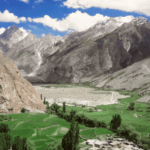
Shipton Spire is a granite tower of just under 6,000 m standing in a side valley off the Trango Glacier, above the Baltoro, in Gilgit-Baltistan, Pakistan. Published heights run from about 5,850 m to 5,885 m and the American Alpine Journal has used 19,700 ft, so take the figure as approximate. From the ice its south-east face throws up roughly 1,300 m of vertical granite, close to twice the wall of Nameless Tower. Base camp is about three days on foot from Askole at roughly 4,400 m, the season runs June to September, and this is a hard technical big wall, not a trek.
We run our treks and expeditions out of Skardu with our own Balti team, and we will be straight with you about this one. Shipton Spire is not a package you book off a page. It is a wall for climbers with real big-wall mileage, and the walk-in is the easy part. What we can do well is everything below the first pitch: the jeeps out of Skardu, the porters out of Askole, the base camp in the meadow below Uli Biaho Tower, the food, the sat phone and the evacuation plan. If you are coming to look rather than to climb, say so and we will put you on the Baltoro instead, where you can see this whole skyline from the trail.
Where Shipton Spire sits in the Trango group
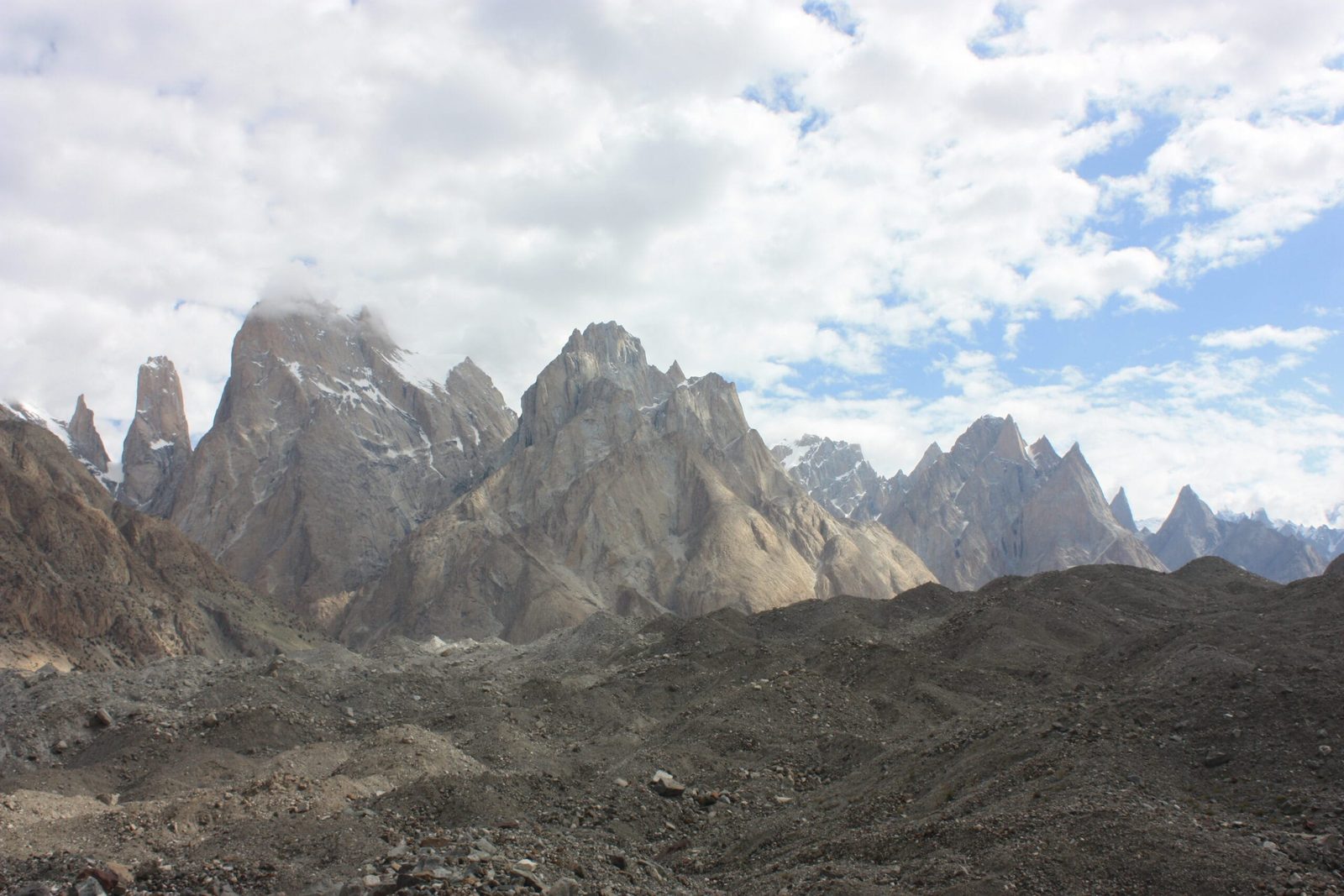
- Height: just under 6,000 m. Commonly given as about 5,885 m; other sources say 5,850 m or 5,852 m and the American Alpine Journal used 19,700 ft. Approximate.
- Other name: Hainablak Central Tower, after the Hainablak (also spelt Hainabrak) glaciers it sits above.
- Where: Baltoro Muztagh, Central Karakoram, in a seldom-visited side valley off the Trango Glacier, just beyond the Trango Towers.
- The wall: about 1,300 m (4,300 ft) of granite on the south-east face, with climbing starting near 4,570 m.
- Access: Skardu to Askole by 4×4, then roughly three days on foot to a base camp around 4,400 m on the Trango Glacier.
- History: first climbed in 1996; the best-known line, Ship of Fools, went to Jared Ogden and Mark Synnott in 1997.
- Season: June to September. A mountaineering permit, not an open-zone trekking permit.
Where Shipton Spire is, and why almost nobody has seen it
Walk up the Baltoro from Askole and the Trango Towers announce themselves for hours before you reach them. Shipton Spire does not. It sits off the main stage, up the Trango Glacier, above the meeting of the north and south Hainablak glaciers, hidden in a side valley that the Baltoro trail never enters. That is the whole reason the peak stayed anonymous until the late 1980s: you simply cannot see it from the path that everyone walks.
It got its name sideways. The American climber Greg Collum spotted the spire in a photograph in a book by the British explorer Eric Shipton and went looking for it, and the working title stuck. Shipton himself surveyed and travelled this country in the 1930s. The peak that carries his name was not formally christened by anyone, it was simply what climbers started calling it. On the Polish maps of the Western Baltoro Mustagh it appears as Hainablak Central Tower, with Hainablak East Tower and an unnamed formation climbers call the Cat’s Ears sitting across the glacier from base camp.
In scale it is in the same family as its neighbours but it is not the biggest. Great Trango Tower is 6,286 m, Nameless Tower 6,239 m, Uli Biaho Tower 6,109 m and Lobsang Spire 5,707 m. What makes Shipton worth the walk is not altitude. It is the uninterrupted sweep of clean granite that comes almost straight out of the glacier.
The approach, step by step
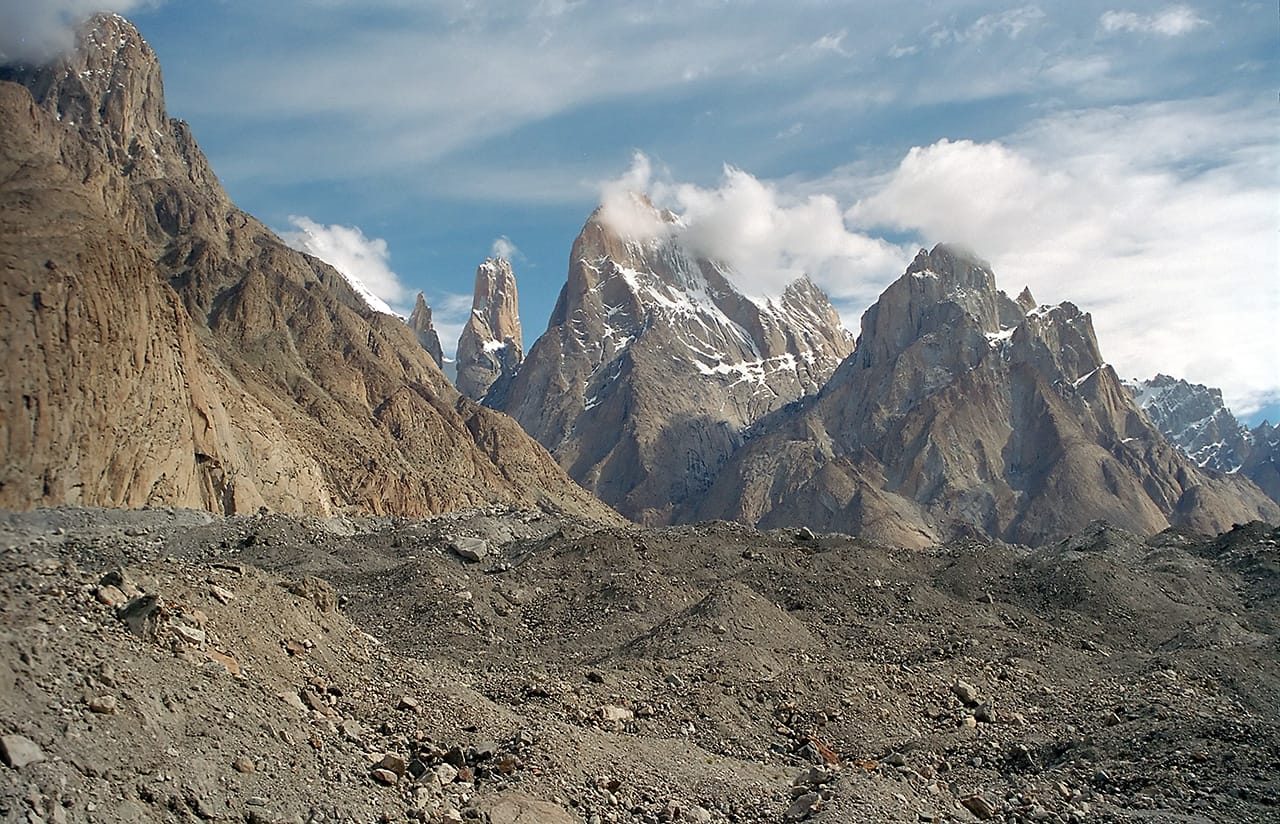
Every expedition on this side of the Baltoro Muztagh starts the same way, on the same jeep road and the same first three stages of the Baltoro trail. These are the stages we use, with the altitudes we work to. Treat them as the commonly quoted approximate figures rather than surveyed points.
- Islamabad to Skardu (about 2,230 m). Fly when the weather allows, drive when it does not. We build buffer days in either case – see our Skardu travel options.
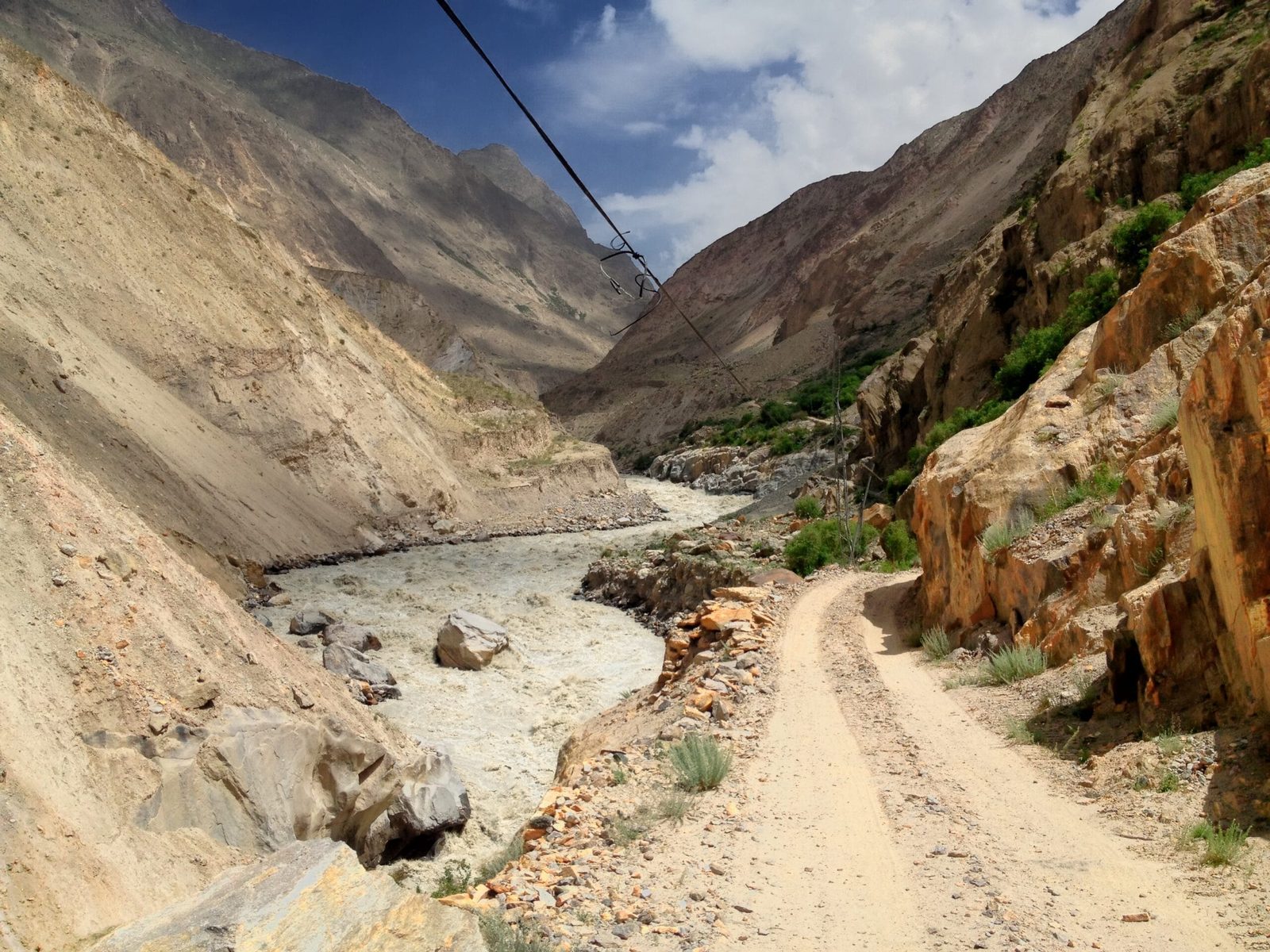
- Skardu to Askole (about 3,000 m), 6 to 9 hours by 4×4. Through Shigar and up the Braldu gorge to the last village on the road. Askole is where porters are hired and where the road ends.
- Askole to Jhola (about 3,250 m), 5 to 6 hours. Across the snout of the Biafo Glacier and along the Braldu River.
- Jhola to Paiju (about 3,460 m), 6 to 7 hours. The last trees, the last running water, and the first full view of the Paiju Peak walls and the granite ahead.
Onto the Trango Glacier and base camp
- Paiju to base camp (about 4,400 m). Off the main Baltoro and up onto the Trango Glacier, to the base camp meadow below Uli Biaho Tower. From there it is roughly two hours of glacier walking to the foot of Shipton Spire.
- Load carries and acclimatisation. Several days ferrying haul bags to the base of the wall while the body catches up. Climbing on this face begins at around 4,570 m and finishes near 5,885 m, which is high ground for hard rock climbing.
- The wall. Capsule style with portaledges is the normal tactic. Published ascents have taken from a handful of days to a fortnight on the face.
- Out the same way. Back down the Trango Glacier to Paiju, Jhola and Askole, then jeeps to Skardu.
The wall, and the climbers who have been up it
Shipton Spire has a short, well-documented climbing history, and it is worth knowing before you come, because it tells you exactly what sort of ground this is.
The first ascent came in 1996, with Greg Child among the climbers involved; whether that attempt touched the true summit has been argued about ever since. In 1997 Jared Ogden and Mark Synnott climbed Ship of Fools on the east face, a 1,300 m line graded VI 5.11 A2 WI6, and that is the route most people mean when they talk about climbing Shipton. In July 1998 Steph Davis, Kennan Harvey and Seth Shaw made the third ascent by a new line on the south-east face, Inshallah (VII 5.12 A1, 4,300 ft), summiting on 25 July after twelve days of climbing and fourteen days on the mountain. They named it after their cook Ghulam’s favourite word.
The hard new lines that followed
Since then the wall has taken a steady trickle of hard new lines: Akelarre (VI 5.10d A4, 1,150 m) by a Basque team in 2000, Women and Chalk (VI 5.13b, 1,150 m) in 2001, The Khanadan Buttress (VI 5.11 C1, 1,300 m) on the south face by McMahon and Wharton in 2002, and Knocking on Heaven’s Door (5.11d A4, 17 pitches) by a Slovak team in 2004 – a route that, like several attempts here, stopped short of the top.
That pattern matters. A good number of serious teams on this wall have not reached the summit, and the reasons repeat. Rockfall, running water in the cracks, and weather windows that close. If you want the same quality of granite with a shorter commitment, the Nangma Valley walls out of Kanday are the sensible alternative.
When to go
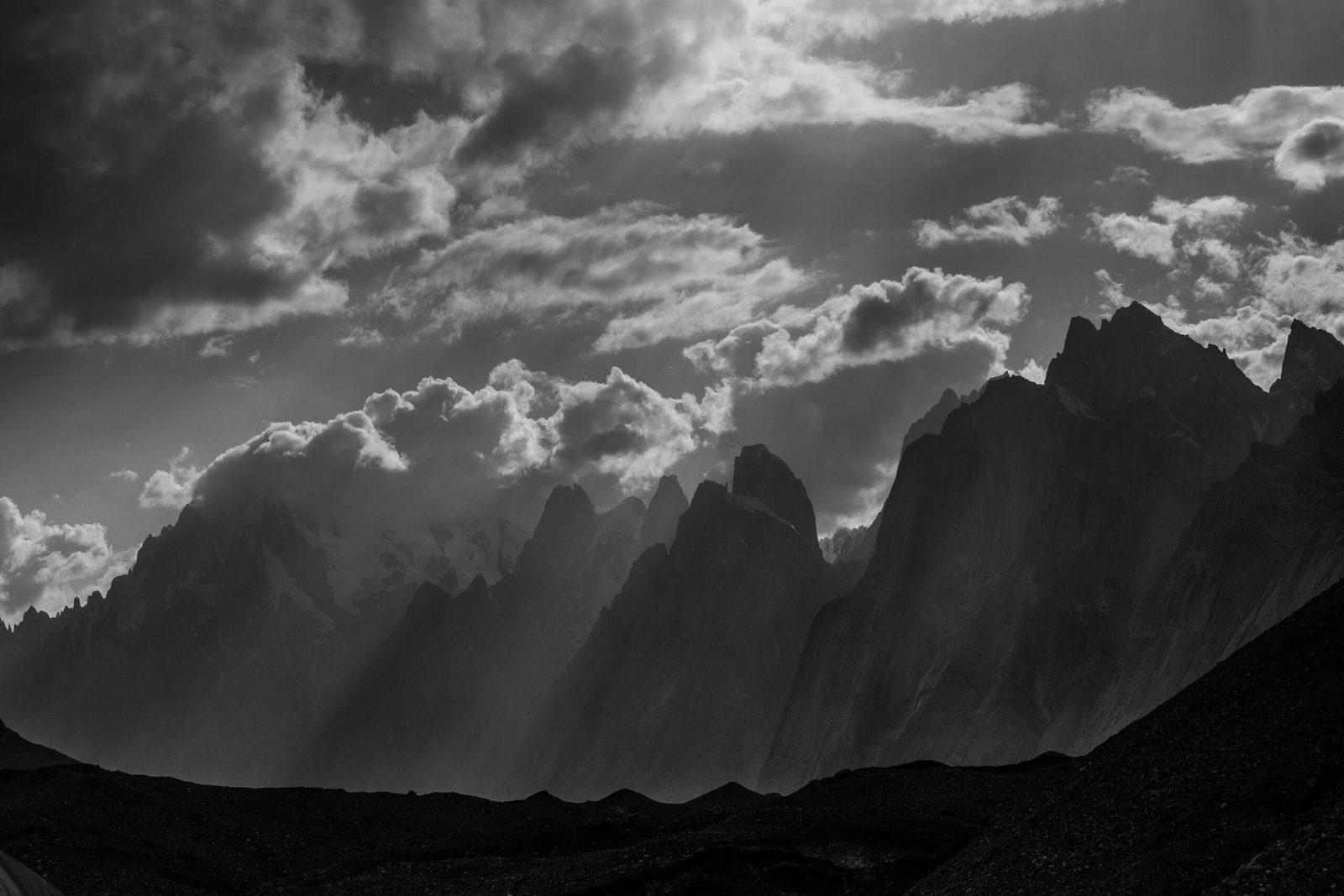
The Baltoro climbing season is short. Ice and snow close the approach either side of it, and in the middle of it the same clear weather that lets you climb is also loosening rock off the walls.
| Months | Conditions on the Trango Glacier | Verdict |
|---|---|---|
| November to March | Deep winter. The jeep road to Askole is unreliable, the glacier approach is heavy with snow, temperatures on the wall are brutal. | Not offered |
| April to May | Approach opening up, snow still on the lower glacier, cold nights, unsettled weather. Expedition teams are moving in rather than climbing. | Approach and acclimatisation only |
| June | Season proper begins. Cracks still hold ice and meltwater, which is both a water source and a problem on wet pitches. | Good, with cold fingers |
| July to August | Warmest, driest and the historical window for almost every ascent here. Also the period of heaviest rockfall and afternoon meltwater. | Best – and the busiest |
| September | Cooler, more stable, less melt, shorter days. Good climbing weather for a team that is already acclimatised. | Very good |
| October | Cold sets in, storms arrive, porters start leaving the Baltoro. | Marginal |
How hard this is, honestly
We would rather lose the booking than sell you this wall as something it is not.
Technically, the easiest line here is harder than most people’s hardest route at home. Every established route involves multi-day aid or hard free climbing at grades in the 5.11 to 5.13 range, big-wall systems, haul bags, portaledges and self-rescue capability. You need prior big-wall experience, not just prior climbing experience.
At altitude, the climbing starts around 4,570 m and tops out near 5,885 m. Hard rock climbing at that height is a different sport. Recovery is slow, fine motor control goes, and a pitch that would be comfortable at sea level becomes a fight. Build a proper acclimatisation plan – ours is set out in our high-altitude acclimatisation guide.
On the approach, the walk-in itself is moderate: three days of valley and glacier trail that fit trekkers in reasonable condition, the same ground as the first stages of the K2 Base Camp trek. Load carries onto the Trango Glacier afterwards are the hard physical work.
Objectively, this is a dangerous piece of rock. A Japanese soloist, Ryuji Taniguchi, died on the wall in 1996, and teams since have been hit by rockfall – one Slovak climber was badly injured by rockfall on pitch twelve in 2004 and had to be lowered off the face. Route choice on this face is a rockfall decision before it is a climbing decision.
The real risk, named plainly
The hazards here are rockfall off a 1,300 m granite face, crevassed glacier travel on the Trango and Hainablak ice, and being days from any road with no mobile signal. People have been killed and badly hurt on this wall. Every Karakoram Venture expedition carries a satellite phone in camp, works to established helicopter-rescue contacts for the Baltoro region, and goes out with a written evacuation plan that names who calls whom, from where, and how the casualty gets down the glacier before a helicopter is even in the conversation. We also require proof of insurance that covers high-altitude rescue and repatriation. Budget operators cut these things because they are the invisible part of the price. We do not.
Permits and visa
Shipton Spire is a climbing objective, so it needs a mountaineering permit from the Government of Pakistan with a registered liaison officer, not the open-zone arrangement that covers ordinary trekking. That is a different process, a different fee and a longer lead time – start it months ahead, not weeks. You will also need the correct visa. Expeditions and treks are handled under Pakistan’s Trekking and Mountaineering visa, which is not the same as a tourist visa. Our Pakistan visa guide for trekkers walks through it. Rules, fees and processing times change, so confirm the current position with us before you book flights.
Getting there, and what it costs
You fly Islamabad to Skardu, or you drive it. The flight is an hour and is the better option when the weather cooperates; the road is long, spectacular and dependable in a way the flight is not, which is why we plan buffer days either side regardless of what you choose. From Skardu it is a day in a 4×4 up through Shigar and the Braldu gorge to Askole, and from Askole it is porters and your own legs.
On price, we keep it personal rather than posting a number that goes stale. An expedition here is quoted on team size, number of days on the wall, porter loads, liaison officer and permit costs, and how much of the base camp operation you want us to run – and all of those move. Tell us your team, your dates and your route, and we will cost it properly. What we will promise is the thing that actually matters on a wall like this: a fair price with no corners cut on guides, food or safety. We would rather talk you into a cheaper objective than sell you a cheap expedition on this one.
Frequently asked questions
How high is Shipton Spire?
Just under 6,000 m. The figure most commonly quoted is about 5,885 m, but other sources give 5,850 m or 5,852 m and the American Alpine Journal has used 19,700 ft. There is no single surveyed number in general circulation, so treat any figure you see, including ours, as approximate.
Where is Shipton Spire?
In the Baltoro Muztagh of the Central Karakoram, Gilgit-Baltistan, Pakistan. It stands above the junction of the north and south Hainablak glaciers, in a side valley off the Trango Glacier, just beyond the Trango Towers. It cannot be seen from the main Baltoro trail, which is why it stayed unknown to climbers until the late 1980s.
Can I trek to Shipton Spire base camp without climbing?
Yes. Base camp sits at about 4,400 m on the Trango Glacier below Uli Biaho Tower, roughly three days’ walk from Askole, and the walk-in suits fit trekkers. It is a quiet alternative to the main Baltoro route with the whole Trango skyline on show. Tell us if that is what you want and we will plan it as a trek, with proper acclimatisation stages rather than an expedition schedule.
Who made the first ascent of Shipton Spire?
The first ascent was made in 1996, with Greg Child among the climbers involved, and there has been debate ever since over whether it reached the true summit. The best-known route, Ship of Fools (VI 5.11 A2 WI6, about 1,300 m) on the east face, was climbed by Jared Ogden and Mark Synnott in 1997. The third ascent, and the first by a new line on the south-east face, was Inshallah in July 1998 by Steph Davis, Kennan Harvey and Seth Shaw.
What permit do I need for Shipton Spire?
A mountaineering permit from the Government of Pakistan with a liaison officer, because this is a climbing objective rather than an open-zone trek, plus a Trekking and Mountaineering visa rather than a tourist visa. Lead times run to months and fees and rules change, so start the process early and confirm the current requirements with us before booking flights.
Talk to the team that lives under these mountains
Tell us your climbing CV, your dates and whether you are coming for the wall or for the walk-in, and we will tell you honestly whether Shipton Spire is the right objective for you – and what else on the Trango Glacier might be a better one.
WhatsApp +92 312 9921574 | Email info@karakoramventure.com
You will be dealing with a local Balti team based in Skardu, not a broker. Our guides and high-altitude porters are from the valleys below these peaks, the sat phone and the evacuation plan are ours, and the price you are quoted is the price we run the trip on. Local hands, real safety, fair price.
Sources and attribution: route names, grades, dates and first-ascent details come from the American Alpine Journal (Steph Davis, ‘Shipton Spire, Free as Can Be in the Pakistan Karakoram’, AAJ 1999, and the Trango Group reports of 1997, 2000, 2002 and 2005) and from Alpinist’s Shipton Spire climbing notes by Vladimir Linek; neighbouring peak altitudes from the Wikipedia entries for Trango Towers, Uli Biaho and Lobsang Spire; approach stages and camp altitudes from established Baltoro itineraries.
Images: Trango Towers and Cathedrals – Black Zero, CC BY 2.0; Trango Group – Kogo, CC BY-SA 2.0; Light over Trangos – Muhammadbinmasood, CC BY-SA 4.0; Braldu River – Zacharie Grossen, CC BY-SA 4.0; all via Wikimedia Commons. None of these photographs shows Shipton Spire itself, which has no freely licensed photograph we could find. They show the Trango group and the approach it sits behind, and are captioned as such. Altitudes are commonly cited approximate figures, and permit rules, fees and flight schedules change, so confirm current details with us before booking.