Six peaks above 7,000 m, run from Skardu by our own Balti team. Permits, oxygen, insured high-altitude porters and a turnaround policy that is actually enforced.
Six peaks above 7,000 m, run from Skardu by our own Balti team. Permits, oxygen, insured high-altitude porters and a turnaround policy that is actually enforced.
Mountaineering in Pakistan: the Peaks, the Permits, the Costs and the Season
HomeMountaineering in Pakistan: the Peaks, the Permits, the Costs and the Season
Mountaineering in Pakistan means five eight-thousanders and more unclimbed 7,000-metre peaks than anywhere else on earth. Moreover, it means a permit system you have to get right months ahead. We are a Skardu company. Our guides, cooks and high-altitude porters come from the Baltoro valleys. Furthermore, we have been putting teams on these mountains for years. In short, this page is the map of everything we have written about climbing here. It runs from a first 6,000er above Shigar to the south face of K2. Finally, it sets out the paperwork and the real prices plainly.
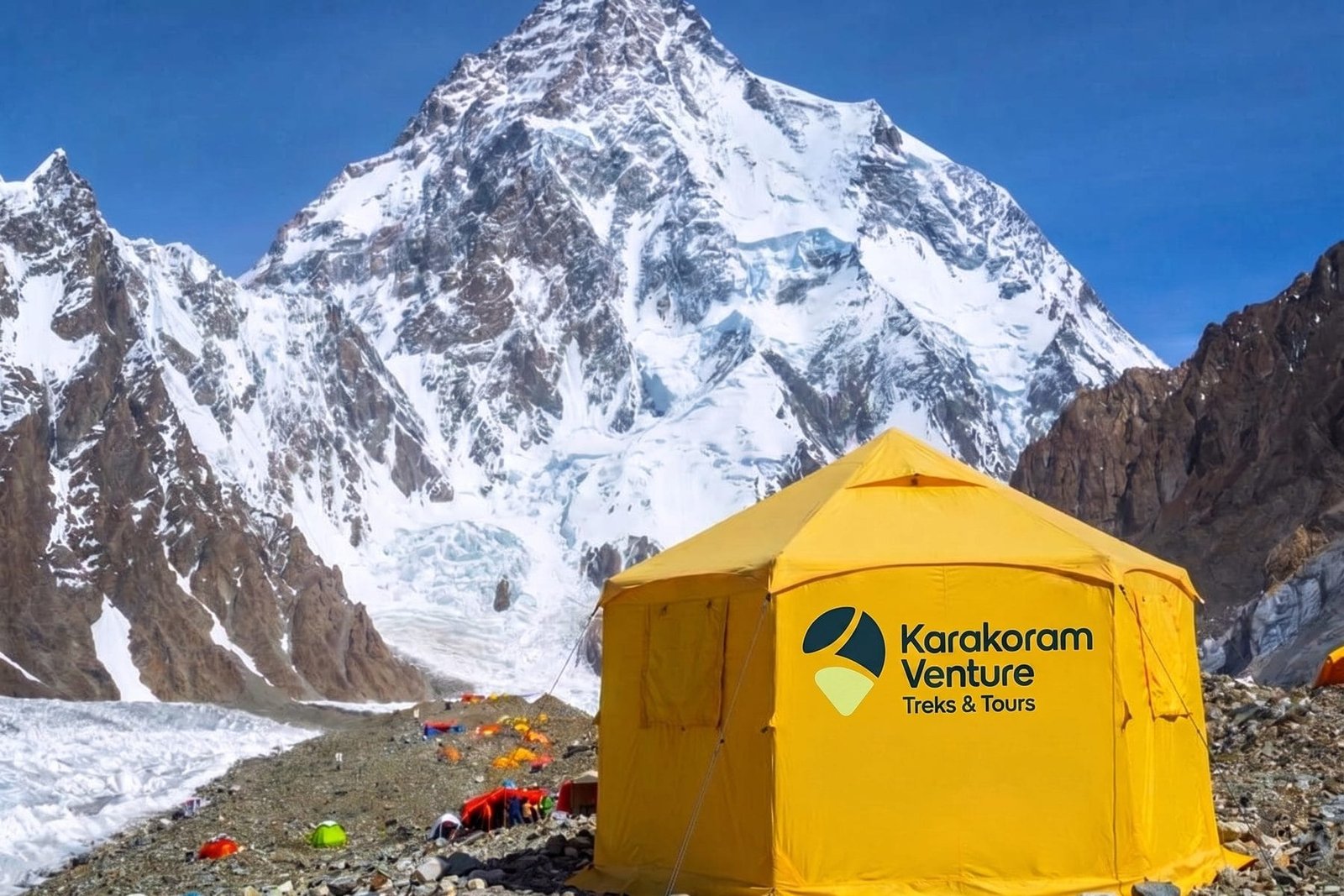
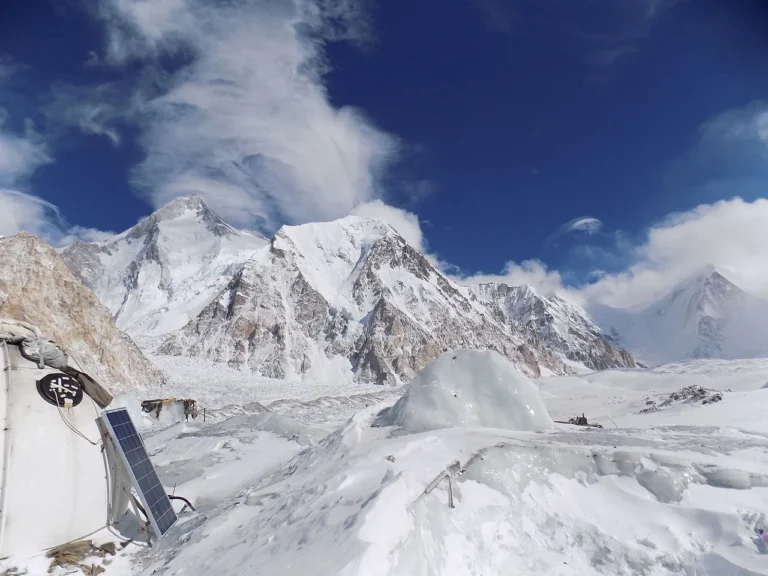
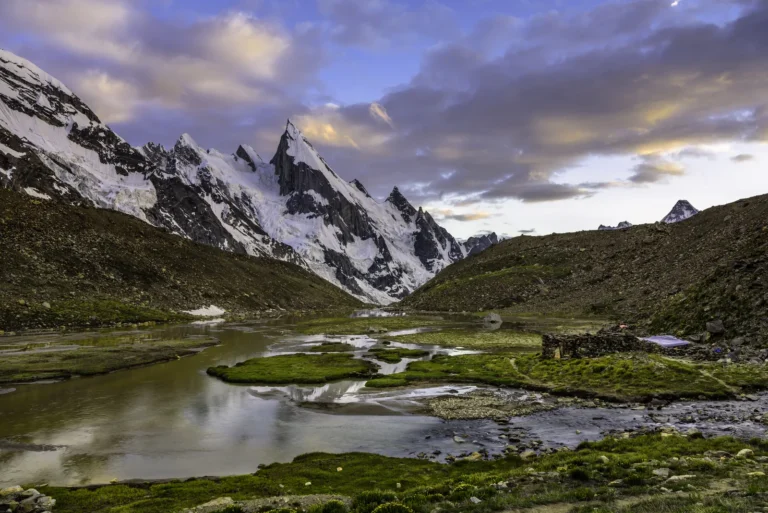
One of our base camps in the Karakoram.
Mountaineering in Pakistan at a glance
The five eight-thousanders
K2 8,611 m · Nanga Parbat 8,126 m · Gasherbrum I 8,080 m · Broad Peak 8,051 m · Gasherbrum II 8,035 m. Four of the five stand around the Baltoro Glacier; Nanga Parbat stands alone
Paperwork
A mountaineering permit with a royalty for the named peak, a Trekking and Mountaineering visa rather than a tourist e-visa, a No Objection Certificate, and a registered government liaison officer who travels with the team
Royalty
Pakistan raised the foreign K2 climbing royalty to $5,000 for the summer season. Teams are currently capped at 20 members, and a permit covers one peak
Season
Mid-June to August on the eight-thousanders. June to September on the 6,000 and 7,000-metre peaks
Price band
From $1,400 for base-camp service on a first 6,000er to $32,000 for a fully supported K2 ascent with two high-altitude porters
Where expeditions start
Skardu for the Baltoro peaks, Nagar and Hunza for Spantik and the Hispar giants, Chilas or Astore for Nanga Parbat, Chitral for the Hindu Kush
What we put on the mountain
Our own Balti team, insured high-altitude porters, oxygen, fixed rope, a satellite phone in camp and established helicopter-rescue contacts for the Baltoro
Mountaineering in Pakistan: the five eight-thousanders
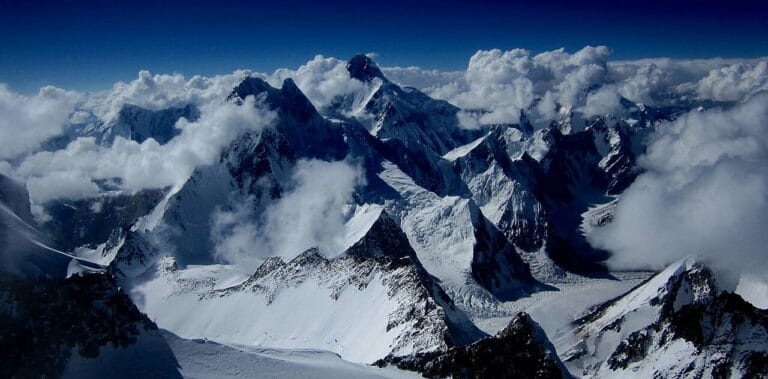
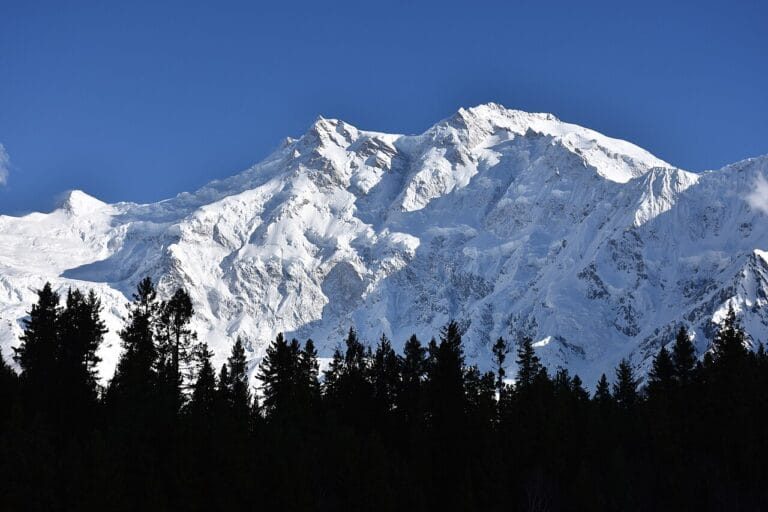
Four of Pakistan’s eight-thousanders cluster at the head of the Baltoro Glacier. Therefore one jeep road out of Skardu serves them all. K2 at 8,611 metres is the hardest of them, and the reason most climbers come. Meanwhile, Broad Peak at 8,051 metres is the one most teams choose first. The Gasherbrums sit behind them, and a single trip can take both. Nanga Parbat, 8,126 metres, is the exception. It stands alone at the western end of the Himalaya. Moreover, it is more exposed to weather than any of them.
The 7,000ers and the first summits
This is the part of the range most visitors never hear about. Indeed, it is where we send most climbers first. Spantik, 7,027 metres above Nagar, is the standard stepping stone to an eight-thousander. Meanwhile, Khosar Gang at 6,401 metres above the Shigar Valley is built as a first 6,000er. There the rope and crampon work is taught on the mountain. Malubiting and Shani Peak are quieter objectives again. Pakistan also holds more unclimbed 7,000-metre summits than any other country. Therefore Gasherbrum VI, Gasherbrum V and Latok I keep drawing serious alpinists.
Permits, visas and the liaison officer
Climbing here is not a visa-on-arrival activity, and this is the step that catches people out. First, you need a mountaineering permit with a royalty for the peak you have named. Second, a Trekking and Mountaineering visa. Third, a No Objection Certificate for the area. Finally, a liaison officer assigned by the government, who walks in with the team. We arrange all four, and we need lead time to do it. Our permits, visa and NOC guide sets out each document and the order they arrive in.
What mountaineering in Pakistan costs
We publish three service levels on every expedition. The honest answer depends on how much of the mountain you want to handle yourself. Base-camp service puts you and your gear at base camp with a kitchen and a camp. However, it leaves the climbing to you. Full board adds the permit and royalty, the liaison officer and oxygen. In addition, it covers one high-altitude porter per climber above base camp, fixed rope and the high camps. Finally, premium doubles the porter support. The full breakdown, including where the money goes on K2, is in our cost guide.
When to climb: the season for mountaineering in Pakistan
Mid-June to August is the window on the eight-thousanders, and it is genuinely short. Meanwhile, the 6,000 and 7,000-metre peaks run June to September. Therefore they are easier to fit around work. Winter ascents exist, and they are a different sport. For example, K2’s first winter ascent came in 2021, and Nanga Parbat’s in 2016. Our Baltoro climbing season guide explains how the weather actually behaves up there.
How we run an expedition
We are not a broker. Our guides, cooks and porters are Balti and Hunza climbers from the valleys the route passes through. Moreover, our logistics are local. Therefore we can price fairly without thinning the things that keep people alive. On every expedition there is a satellite phone in camp, insured high-altitude porters and oxygen where the route needs it. In addition, we keep established helicopter-rescue contacts for the Baltoro region. Finally, we will tell you when an objective is wrong for you. That costs us a booking and saves everyone a bad season.
Mountaineering in Pakistan beyond the Karakoram
Two more ranges meet inside the country. The Hindu Kush above Chitral holds Tirich Mir at 7,708 metres, Saraghrar and Istor-o-Nal. Meanwhile, the Hindu Raj holds Koyo Zom. They see a fraction of the traffic the Karakoram does. Finally, the Karakoram Range guide explains where one range ends and the next begins.
Expeditions we run
Every trip below is operated by our own team out of Skardu, with the permit, royalty and liaison officer included.
Two smaller objectives sit below the eight-thousanders, and they are where most climbers should start. First, the Khosar Gang Expedition above Shigar as a first 6,000er. Second, the Laila Peak Expedition for climbers who already know steep snow.
Five: K2 at 8,611 m, Nanga Parbat at 8,126 m, Gasherbrum I at 8,080 m, Broad Peak at 8,051 m and Gasherbrum II at 8,035 m. Moreover, four of them stand around the Baltoro Glacier above Skardu.
Do you need a permit for mountaineering in Pakistan?
Yes. You need a mountaineering permit with a royalty fee for the named peak, and a Trekking and Mountaineering visa rather than a tourist e-visa. In addition, you need a No Objection Certificate and a government liaison officer who travels with the team. We arrange all of it. However, it needs months of lead time.
What is the royalty fee to climb K2?
Pakistan raised the foreign climbing-permit royalty for K2 to $5,000 for the summer season. Moreover, teams are currently capped at 20 members, and one permit covers one peak. Fees change year to year. Therefore ask us for the current figure.
Which is the easiest 8,000er in Pakistan?
Broad Peak and Gasherbrum II are the two usually chosen first. However, neither is easy. Both still need previous high-altitude experience, oxygen on summit day for most climbers, and a 42-day trip.
What is a good first 6,000 m peak in Pakistan?
Khosar Gang, 6,401 m above the Shigar Valley. It runs 10 days from $2,200, with the rope and crampon skills taught on the mountain. Then Spantik at 7,027 m is the usual next step.
When is the climbing season in Pakistan?
Mid-June to August on the eight-thousanders, and June to September on the 6,000 and 7,000-metre peaks. Winter ascents happen but are a different undertaking: K2 was first climbed in winter in 2021 and Nanga Parbat in 2016.
Is mountaineering in Pakistan safe?
The mountains are serious, and the country is calmer than its reputation. Indeed, the real risks here are altitude, weather, avalanche and the distance to a helicopter. Moreover, we carry a satellite phone in camp, use insured high-altitude porters and hold established helicopter-rescue contacts for the Baltoro.
Do I have to take a liaison officer?
Yes, on an expedition. The government assigns a registered liaison officer who travels with the team, and the cost is part of our expedition prices.
How much does a Pakistan expedition cost?
From $1,400 for base-camp service on a first 6,000er to $32,000 for a fully supported K2 ascent. Our full-board eight-thousander prices run from $15,400 on Gasherbrum II to $21,500 on K2.
Tell us your climbing history, and we will be honest
We will say whether an objective is right for you this year. Moreover, we will tell you the current royalty and what the real landed cost looks like. Local hands, real safety, fair price. 2027 permits are being filed now.
Contains information about the traffic source or campaign that directed user to the website. The cookie is set when the GA.js javascript is loaded and updated when data is sent to the Google Anaytics server
6 months after last activity
__utmv
Contains custom information set by the web developer via the _setCustomVar method in Google Analytics. This cookie is updated every time new data is sent to the Google Analytics server.
2 years after last activity
__utmx
Used to determine whether a user is included in an A / B or Multivariate test.
18 months
_ga
ID used to identify users
2 years
_gali
Used by Google Analytics to determine which links on a page are being clicked
30 seconds
_ga_
ID used to identify users
2 years
_gid
ID used to identify users for 24 hours after last activity
24 hours
_gat
Used to monitor number of Google Analytics server requests when using Google Tag Manager
1 minute
_gac_
Contains information related to marketing campaigns of the user. These are shared with Google AdWords / Google Ads when the Google Ads and Google Analytics accounts are linked together.
90 days
__utma
ID used to identify users and sessions
2 years after last activity
__utmt
Used to monitor number of Google Analytics server requests
10 minutes
__utmb
Used to distinguish new sessions and visits. This cookie is set when the GA.js javascript library is loaded and there is no existing __utmb cookie. The cookie is updated every time data is sent to the Google Analytics server.
30 minutes after last activity
__utmc
Used only with old Urchin versions of Google Analytics and not with GA.js. Was used to distinguish between new sessions and visits at the end of a session.
End of session (browser)
Marketing cookies are used to follow visitors to websites. The intention is to show ads that are relevant and engaging to the individual user.
Facebook Pixel is a web analytics service that tracks and reports website traffic.