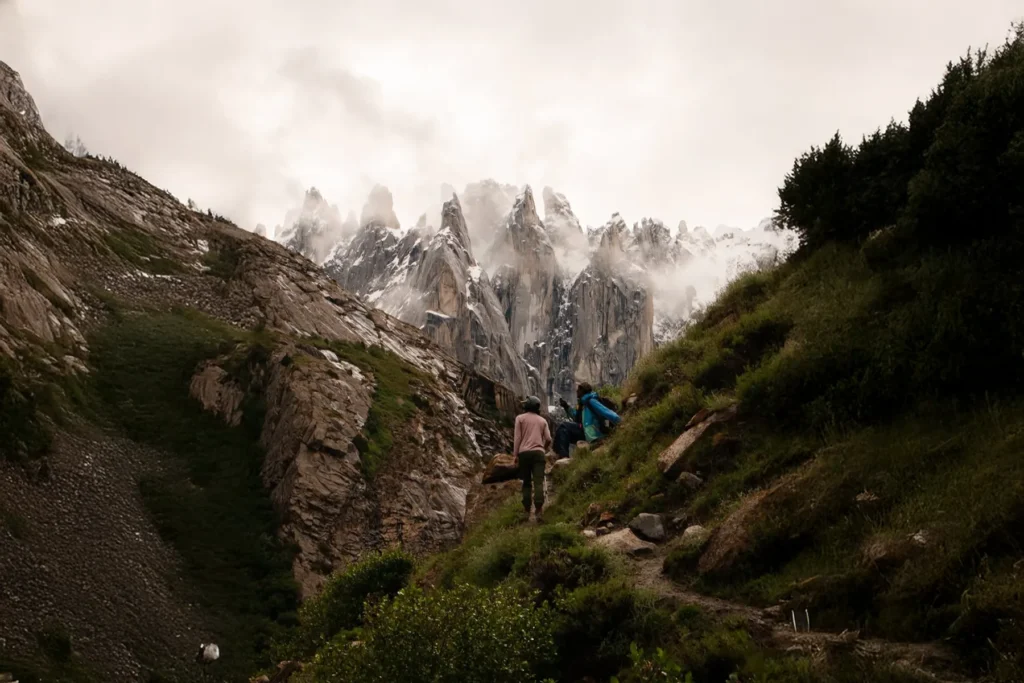
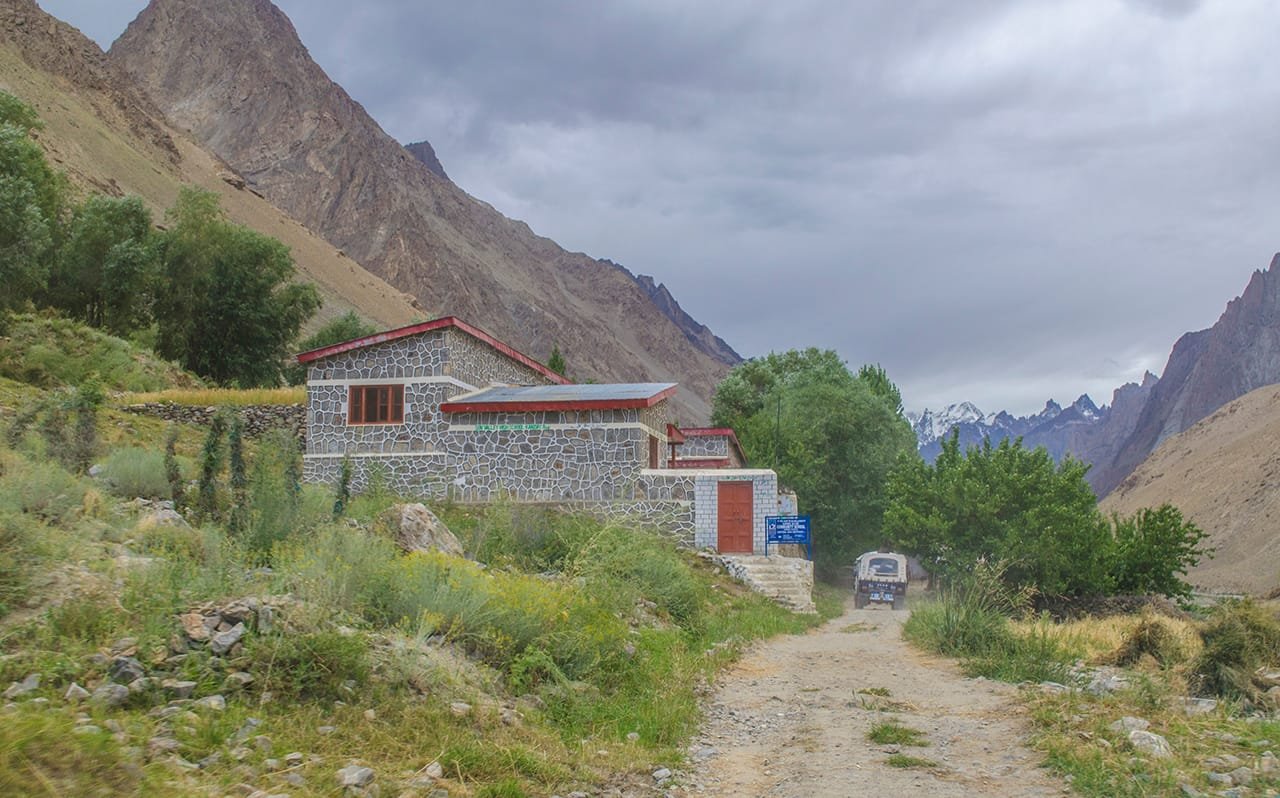
Nangma Valley is a granite-walled side valley above Kanday, in the Hushe region of Gilgit-Baltistan. Climbers have nicknamed it the “Yosemite of Pakistan.” The walk in is short and, by Karakoram standards, gentle. It is roughly two days on foot from Kanday village to alpine meadows and base camps at around 3,900–4,000 m. Most do it as a 4–6 day round trip. The Nangma Valley trek is best walked from June to September. Above those meadows stand some of the finest big walls on earth. They are led by Amin Brakk (~5,850 m), the “Great Tower of Pakistan.” You can come as a fit newcomer to high-altitude trekking. Alternatively you can climb granite that tests the very best in the world. We run both out of Skardu with our own Balti team.
We run Nangma a day’s drive from Skardu, through Khaplu and up the Hushe road. Our porters and cook come from these very villages — and we’ll be straight with you. The trek to the meadows is one of the most rewarding short walks in Baltistan. However it is still remote, high, and cold at night. The granite overhead is a different sport entirely: world-class big-wall climbing, not a guided summit. Here is the honest picture of both.
Key takeaways
- Where: Nangma Valley, a side valley off the Hushe Valley above Kanday village, Ghanche District, Gilgit-Baltistan — with meadows and base camps at roughly 3,900–4,000 m.
- The walls: Amin Brakk (~5,850 m, the “Great Tower of Pakistan”), Shingu Charpa (~5,900 m) and Changi Tower (~5,820 m) — figures approximate, and among the hardest granite big-wall objectives in the Karakoram.
- The trek: about two days on foot from Kanday to base camp; a 4–6 day round trip on the trail, or roughly 10–14 days as a full trip from Islamabad with transport and acclimatisation.
- Difficulty: a moderate, non-technical trek to about 4,000 m (with an option higher to ~4,500 m at Amin Brakk base camp) — a genuine on-ramp to Karakoram trekking. The climbing above is for experts only.
- Season: roughly June to September, with July and August the most settled.
- What we run: guided treks to the Nangma meadows and base camps, and full base-camp logistics for climbing teams. First ascent of Amin Brakk: a Spanish team in 1999.
Where Nangma is, and why they call it the Yosemite of Pakistan
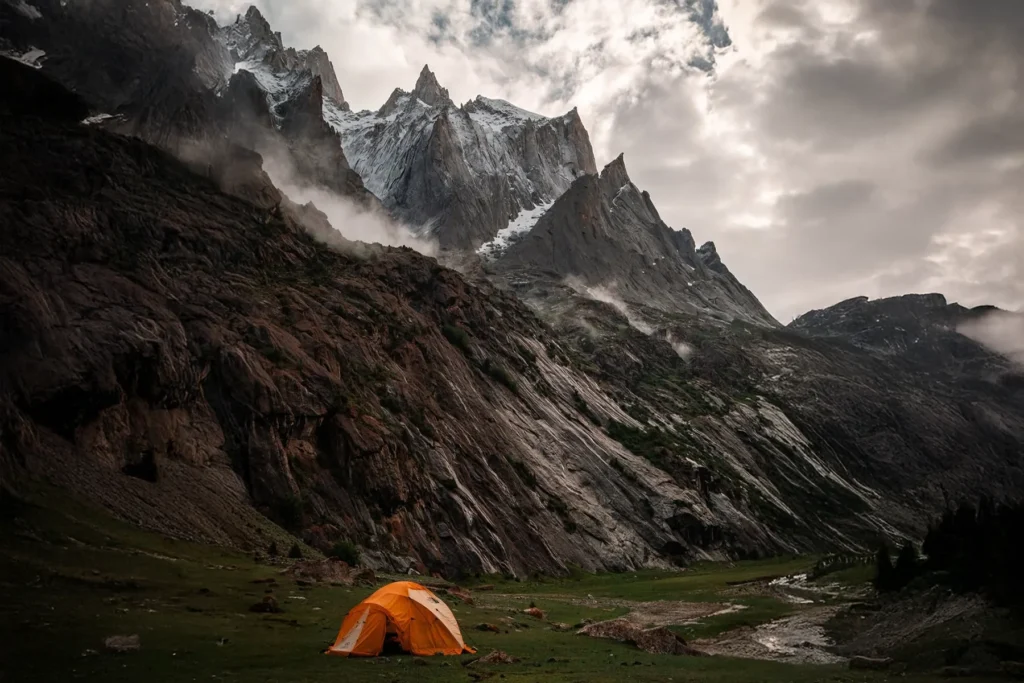
Drive east from Skardu through Khaplu, then turn up the Hushe road toward the high villages. So Kanday sits at the mouth of a narrow cleft in the mountains. That cleft is Nangma. Walk into it and the valley opens out into green summer meadows, braided streams and wildflower slopes. Then the walls begin: clean, vertical sweeps of golden granite rising a kilometre and more straight off the valley floor. It is that combination, soft alpine meadow beneath savage rock, that earned Nangma its nickname. The comparison to California’s Yosemite is about the granite, not the crowds. Out here you may share the valley with a handful of shepherds and the odd climbing team. Indeed, nobody else.
Nangma belongs to the wider Hushe Valley system of trekking and climbing valleys in Baltistan’s Ghanche District. That is the same network that holds Masherbrum and the granite spires of the Charakusa Valley. What sets Nangma apart is how accessible the heart of it is. Notably, you do not need to cross a glacier or a high pass to stand beneath these walls. A fit walker can reach the meadows in a couple of days. That is exactly why the Nangma Valley trek works as a first taste of the Karakoram. It is also a big-wall destination.
The walls of Nangma — granite that draws the world’s best
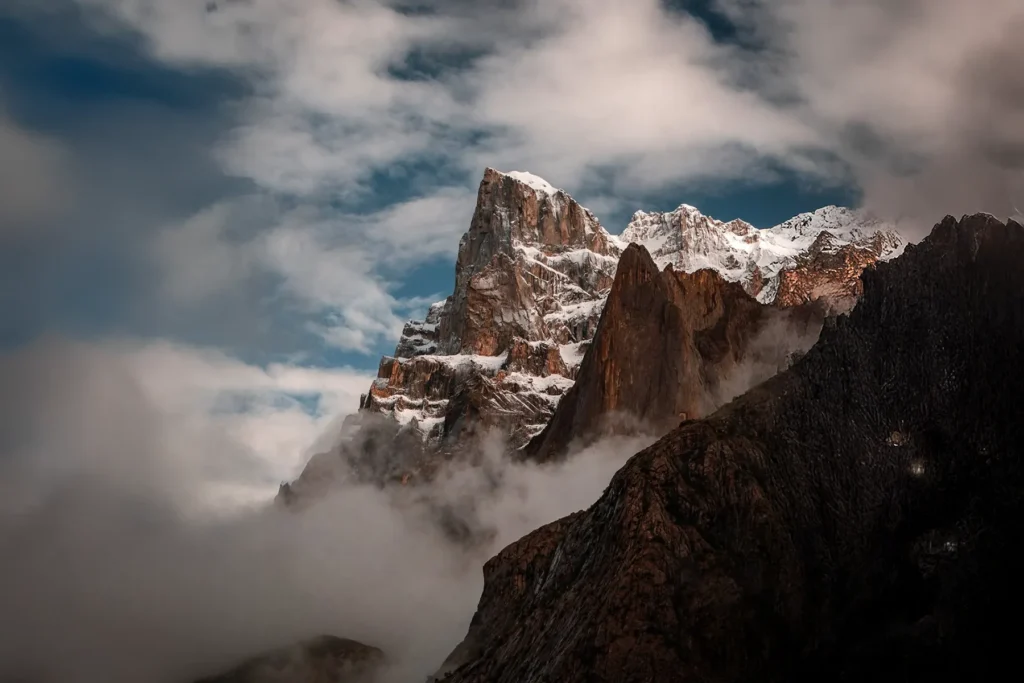
The towers ringing the valley are the reason elite climbers fly halfway around the planet to Kanday. The headline is Amin Brakk, the “Great Tower of Pakistan,” whose sheer face is one of the longest and hardest big-wall climbs in the range. It saw its first ascent in August 1999, when a Spanish team — Silvia Vidal, Pep Masip and Miguel Puigdomènech — pushed a new route up the wall over many days of committing aid and free climbing, after Basque attempts in the years before had turned back close to the top. Around it stand Shingu Charpa, famous for a coveted, repeatedly attempted north ridge, and Changi Tower — clean lines that read like a wish-list for any serious rock climber.
Treat the heights below as approximate reference figures. Sources differ by a hundred metres or so on these towers. We would rather say so than print false precision.
The Nangma Valley trek, step by step
The beauty of Nangma is that the approach is short and the trailhead is a real village, not a glacier snout. The figures below are approximate and shift a little year to year with the state of the road and the snow line.
- Skardu to Kanday (1 day): a 4×4 jeep east through Khaplu and Machulo and up the Hushe road, roughly 5–7 hours on rough mountain road, to Kanday village (~3,000 m) at the valley mouth.
- Kanday to lower Nangma (half to full day): walk up out of the village on a clear trail beside the stream, climbing steadily into the valley as the first towers come into view, to a first meadow camp.
- Into the meadows and base camp (~3,900–4,000 m): continue to the open upper meadows beneath Amin Brakk and its neighbours — the classic camp, and for most trekkers the destination.
- Optional: Amin Brakk base camp (~4,500 m): a steeper day higher for those who want to stand directly under the great wall, weather and acclimatisation permitting.
- The return: back down the same valley to Kanday and the jeep to Skardu, typically making the whole walk a 4–6 day round trip on the trail.
Safety on the Nangma Valley trek, said plainly
Nangma is gentler than the big glacier treks. Still, it is a remote, high valley with no road, no clinic and no phone signal once you leave Kanday. The real risks here are altitude (you sleep near 4,000 m), cold nights, stream crossings, and weather that turns fast. We carry a satellite phone on the trek and hold established helicopter-rescue contacts for the region. Moreover we plan acclimatisation and turn-arounds properly, rather than pushing tired clients higher. For anyone climbing the walls, the exposure is in another league entirely. Loose rock, long committing pitches and serious rescue distance. Out here, the rescue plan has to be real before you start walking.
When to go on the Nangma Valley trek
Nangma runs on the standard Karakoram summer calendar. The valley is snow-locked in winter and the meadows only green up once the season turns. Here is an honest month-by-month read.
| Window | Conditions | Verdict |
|---|---|---|
| April – May | Snow still lying in the upper valley, cold, streams low; very few parties. | Early — for hardy walkers |
| June – August | Green meadows, the most settled spells, warmest days and best rock conditions; this is when climbers come too. | Best — go now |
| September | Crisp, clear and quiet, with the first autumn colour and colder nights. | Excellent for the trek |
| October – March | Winter closes in; deep cold and snow, the high road impractical. | Closed for normal trips |
Right now, in June, the meadows are greening and the season is open. If you are weighing Nangma against the bigger routes, our roundup of the best treks in Pakistan puts it in context.
How hard is the Nangma Valley trek, honestly
The trek and the climbing sit at opposite ends of the difficulty scale, so let us separate them cleanly. The walk to the Nangma meadows is moderate. It is a non-technical trail, two short days up. Therefore the main challenge is altitude rather than terrain. If you have decent hill fitness and can handle sleeping near 4,000 m, you can do this trek. It is one of the friendliest ways to taste the high Karakoram. It is also a sound stepping stone toward harder objectives. Add the optional push to Amin Brakk base camp (~4,500 m) and it gets steeper and a little more demanding, but it stays a walk. Get the altitude right and you will enjoy every day of it. Our acclimatisation guide explains how, and the Karakoram packing list covers the cold nights.
The walls are the opposite. Amin Brakk, Shingu Charpa and Changi Tower are expert big-wall and alpine-rock objectives. They are long, committing, loose in places, and a long way from any help. They are climbed by small, fully self-sufficient teams who already have hard granite walls behind them; like the Trango Towers, this is not a guided-summit product, and anyone selling it as one is not being honest with you. What we provide for climbing teams is the groundwork that keeps a long expedition running. That means porters, a cook, base camp, permits and a working rescue link.
Permits, getting there and cost
Permits & visa — read this early
Nangma sits in an open trekking zone, so the meadows trek needs the normal trekking arrangements. That means a registered guide, local logistics and the usual area paperwork, rather than a climbing royalty. Climbing the walls is different: the big technical peaks draw a mountaineering permit and royalty through the relevant authorities, plus serious lead time, and the exact category depends on the specific tower. Either way, you need the right visa: trekkers and climbers should come on a Trekking & Mountaineering visa, which is distinct from a plain tourist visa. We sort the permits and paperwork end to end — just don’t turn up on the wrong visa expecting to head up the valley. Our Pakistan visa guide walks through it.
You reach Kanday through Skardu. Most visitors fly Islamabad to Skardu when the weather allows, then take the jeep east through Khaplu and up the Hushe road. In contrast the overland route from Islamabad is a longer, scenic alternative that needs buffer days for weather. Our guides to the Skardu region and how to get to Skardu cover both options.
On cost, we keep pricing personal rather than posting a number that goes stale the moment fuel or permit fees change. What we promise is a fair price with no corners cut on guides, food or safety. Tell us whether you want the meadows trek, the Amin Brakk base camp option, or full support for a climbing team, plus your dates and group size, and we’ll give you a straight quote. These are the valleys our team is from; you book the people who actually walk you in.
Frequently asked questions
Where is Nangma Valley and how do you get there?
Nangma Valley is a side valley above Kanday village, in the Hushe region of Ghanche District, Gilgit-Baltistan, Pakistan. You reach it from Skardu by 4×4 jeep east through Khaplu and up the Hushe road to Kanday (~5–7 hours), then walk in on foot. There is no road into the valley itself.
How long is the Nangma Valley trek and how hard is it?
It is a short, moderate trek: about two days on foot from Kanday to base camp at roughly 3,900–4,000 m, and a 4–6 day round trip on the trail. The walking is non-technical, so the main challenge is altitude rather than terrain, which makes it a good first high-altitude trek in the Karakoram.
How high is Amin Brakk and can it be guided?
Amin Brakk stands at roughly 5,850 m and is known as the “Great Tower of Pakistan.” It is an elite big-wall climb, first ascended by a Spanish team in 1999, and is not a guided commercial objective. We provide base-camp logistics and permits for experienced, self-sufficient climbing teams — and the trek to the meadows for everyone who simply wants to stand beneath it.
Why is Nangma called the Yosemite of Pakistan?
Because of its granite. The valley combines soft summer meadows with kilometre-high vertical walls of clean rock — Amin Brakk, Shingu Charpa, Changi Tower — that recall the big walls of California’s Yosemite, but in a remote Karakoram setting you are likely to have almost to yourself.
When is the best time to trek Nangma Valley?
June to September, with July and August the most settled and September often crisp, clear and quiet. The valley is snowbound and impractical from roughly October through March, so trips run only in the Karakoram summer.
Want to walk into Nangma in 2027?
Planning the meadows trek, the Amin Brakk base camp option, or base-camp support for a climbing team? WhatsApp us on +92 312 9921574 or email info@karakoramventure.com — you’ll be talking to a local Balti team who guide these valleys ourselves, not a broker. Tell us your plans, fitness and dates, and we’ll give you an honest read — plus current permit details and fixed departures.
Sources & further reading: Nangma Valley location, the nickname “Yosemite of Pakistan,” and the big walls of Amin Brakk (~5,850 m; first ascent by a Spanish team, 1999), Shingu Charpa and Changi Tower. Sources: SummitPost, Alpinist and standard climbing references. Access via Khaplu and Kanday, trek stages and base-camp altitudes — standard trekking references. Summit heights vary by source and are given as approximate; camp altitudes, drive and trek durations are approximate and vary by season.