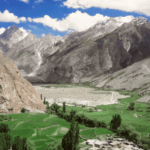
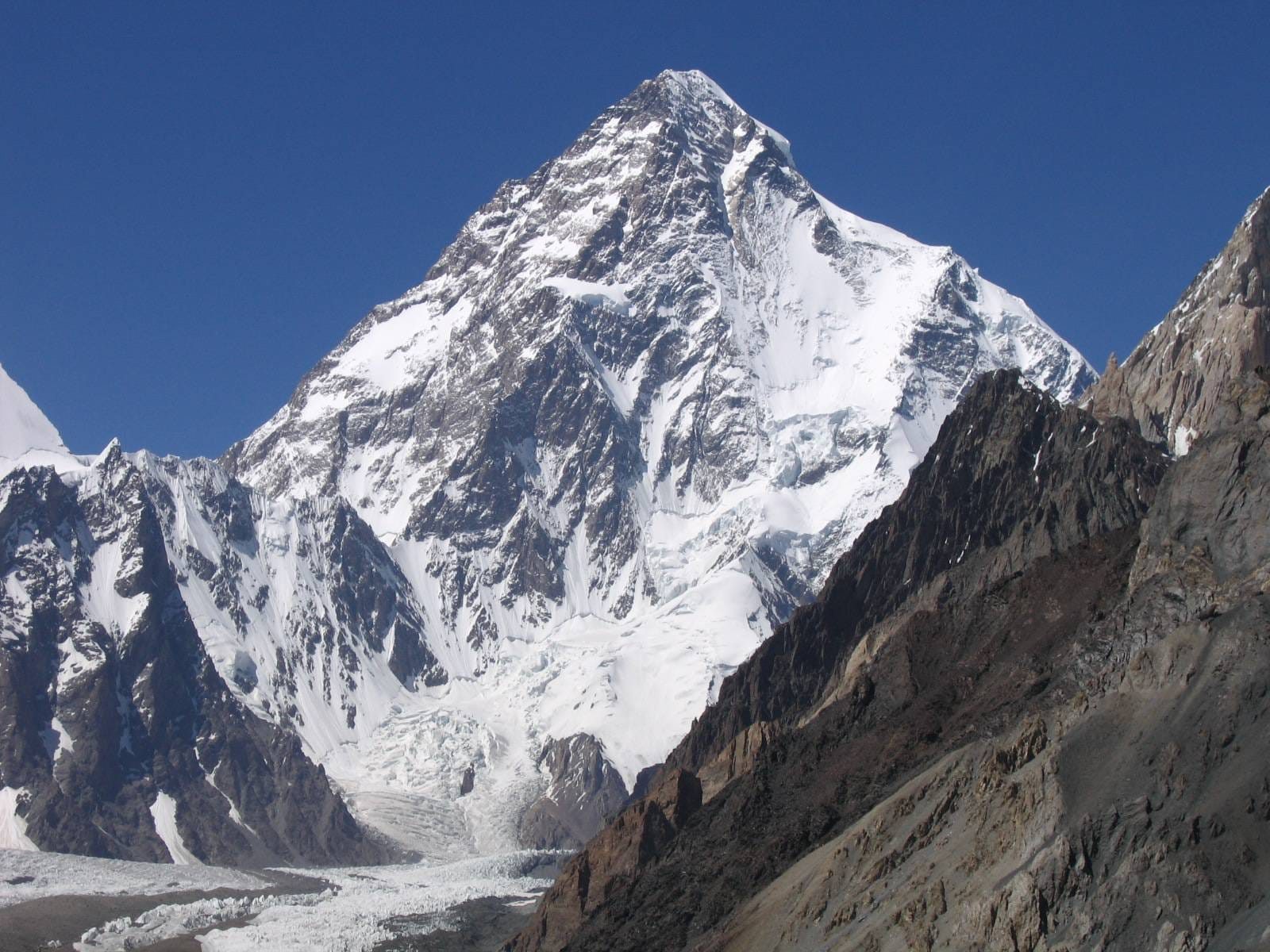
On the 31st of July 1954, two Italians stood on the summit of K2, and the mountain’s ledger opened. One ascent — and already several graves from the American expeditions that came before. Then, on a single July day in 2022, more people summited K2 than in the entire twentieth century combined. Between those two facts lies every number in this article. Between those two facts lies the real K2 death rate.
The K2 death rate is roughly 92 deaths against some 964 summits across all of history. It is the statistic behind the nickname “Savage Mountain”, and it is quoted everywhere — usually wrong, and always without context. We work beneath this mountain every season. Several of the names in its ledger come from villages a jeep-hour from our office. So here is the complete, honest accounting. You will find the real numbers, the disasters behind them, and why the modern rate has collapsed. Above all, you will find the one distinction — climb versus trek — that the statistics never explain.
The K2 death rate, decade by decade
The raw historical ratio — deaths per summit — is just under 10%, but that average hides three different mountains. 1954-1985: K2 saw summits in only a handful of years. Expeditions were national sieges with unreliable oxygen and almost no forecasting. In this era the death-to-summit ratio ran above 25%. The coin-flip reputation comes from here. 1986-2020: the age of independent alpinism. The infamous 1986 season alone killed thirteen climbers in a sequence of storms, Alan Rouse among them. Then 1995 and 2008 added their own dark chapters. Across this era the ratio hovered near 20%.
2021-today: the commercial revolution. In 2022 roughly 200 climbers summited, and two died. In 2023 over a hundred more stood on top against one death. The chronicler Alan Arnette, whose season coverage is the standard reference for these figures, counts the cumulative record near 964 summits and 92 deaths through 2025 — which means the modern seasonal rate has fallen to low single digits. Still among the most serious numbers in mountaineering. No longer a coin flip.
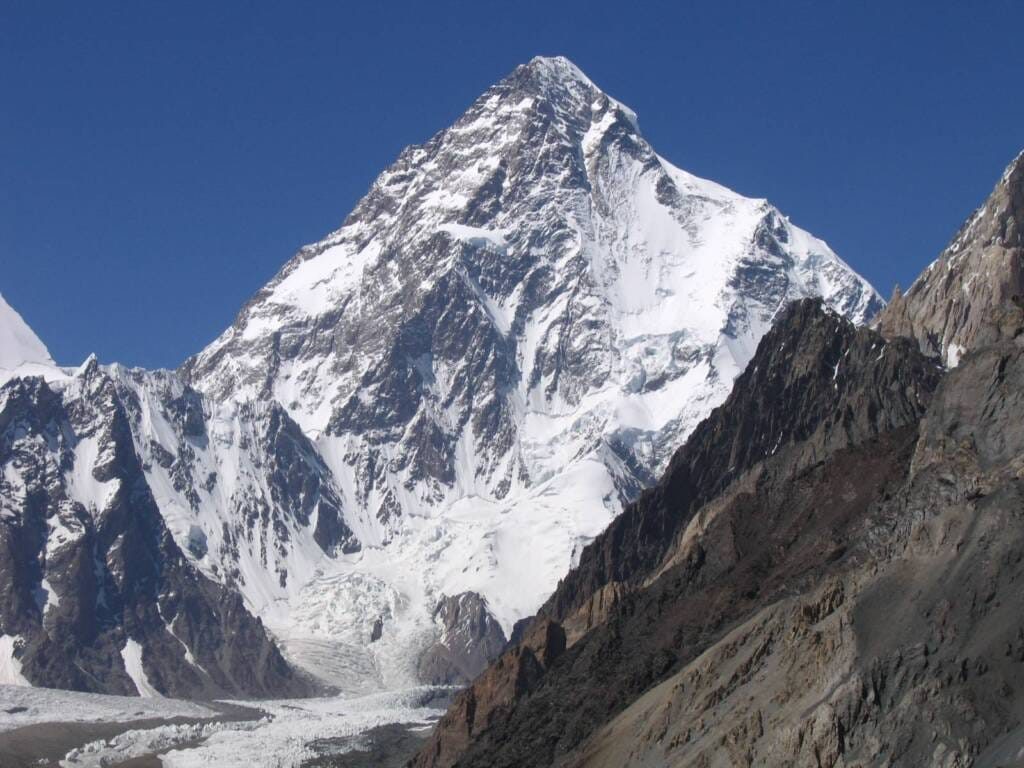
The disasters that built the reputation
Numbers persuade; stories are why the world knows this mountain. 1939: Fritz Wiessner came within 250 metres of the summit without oxygen, decades ahead of his time. Then the expedition collapsed. Dudley Wolfe died high on the mountain. Moreover, so did three Sherpas — Pasang Kikuli, Pasang Kitar and Phinsoo — who went back up for him. Their rescue attempt remains one of the bravest acts in Himalayan history. 1953: Art Gilkey fell ill with thrombophlebitis at 7,800 m. Consequently, his American teammates lowered him through a storm. When six roped men fell at once, Pete Schoening held them all with a single ice axe — mountaineers still call it “The Belay”. Hours later, an avalanche swept Gilkey away. Afterwards, his teammates built a memorial cairn below Base Camp. It now carries the plates of everyone the mountain has taken since.
1986: thirteen dead in one season, storm after storm. 2008: the Bottleneck’s hanging serac calved at the worst possible hour. It cut the fixed ropes above 8,200 m while climbers still descended in darkness. As a result, eleven died in 36 hours — the worst single disaster in the mountain’s history. February 2021: in the same winter that ten Nepali climbers made history with the first winter ascent, Muhammad Ali Sadpara — born in Sadpara village above Skardu, Pakistan’s greatest mountaineer and a man half this town knew personally — disappeared above the Bottleneck with John Snorri and Juan Pablo Mohr.
When his son Sajid, who had turned back with a failed regulator, waited alone at Camp 3, all of Baltistan waited with him. These are the chapters behind the K2 death rate. We tell them plainly, because every figure in this article is a person. Several of them are ours.
Behind the K2 death rate: four reasons, no mystery
First, angle: K2 is relentlessly steep from Base Camp to summit. There are no walking sections, no yak trails, nowhere to be merely tired. House’s Chimney, the Black Pyramid and the summit slopes stack technical climbing at altitudes where Everest offers fixed-line hiking. Second, the Bottleneck: at 8,200 m the standard route funnels beneath a hanging glacier the size of an apartment block. Every climber gambles minutes of exposure — sometimes an hour — on whatever the serac decides that day. 2008 is what it looks like when the serac wins.
Third, weather: Karakoram storms arrive faster, colder and less predictably than the Himalayan pattern. The jet stream sits close. Even now, forecasting carries real uncertainty here, and summit windows are shorter and rarer than on Everest. Fourth, remoteness: there is no village at K2 Base Camp, and no rescue helicopter overhead at 7,000 m as in Nepal. Effective rescue above Camp 2 mostly means other climbers. That is why self-sufficiency still decides survival here. Our K2 expedition guide details how commercial teams manage each factor today.
Why the K2 death rate fell in the modern era
Three changes drove the collapse from 20% eras to single digits. Professional rope-fixing: strong Nepali and Pakistani high-altitude teams now fix the full route early in the season. Notably, the all-Nepali winter 2021 first ascent marked the sport’s shift. And the difference between soloing the Black Pyramid and jumaring it is generational. Pakistan’s own high-altitude porters, many from the Shimshal and Sadpara valleys, finally earn recognition and pay as the elite mountain workers they always were.
Forecasting: summit pushes now cluster inside verified multi-day windows delivered by satellite. A 1986 team read the sky and hoped. Oxygen and support ratios: most commercial clients now climb with bottled oxygen and strong guide support. Two decades ago, by contrast, those ratios were unheard of. Together they convert the death zone from a lottery into a schedule. None of this makes K2 safe. 2025 still recorded deaths, and the Bottleneck votes every year. But it explains why the historic 20% figure misleads more than it informs about today’s mountain.
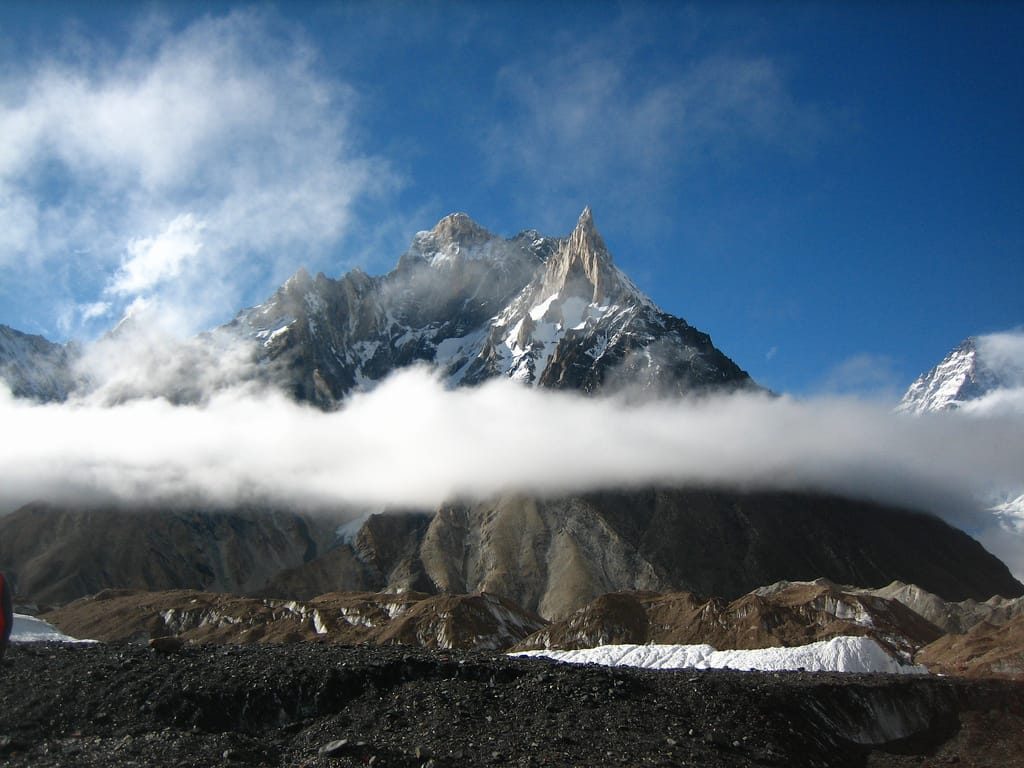
K2 versus Everest, Annapurna and the rest
Context calibrates fear. Annapurna I has historically been deadlier per summit than K2; Nanga Parbat’s early history was worse than either.
Everest’s historic ratio sits far lower, in low single digits. That is not because its upper mountain is gentler terrain-for-terrain. Its standard routes are shorter technical problems buried under vastly more infrastructure, oxygen and rescue capacity. What makes K2 singular is the combination: hardest sustained climbing of the 8000ers with the least margin for error and the thinnest safety net.
That is also precisely why it retains its standing among mountaineers — as our comparison of K2 and Everest from the trekker’s side explains, prestige on this mountain was never devalued by crowds.
The statistic nobody quotes: the trek is not the climb
Now the fact this entire article exists to make plain. Every number above belongs to the climb — the world above Base Camp. The K2 Base Camp trek, the one on your list, is a glacier walk. Instead, it takes ten days up the Braldu valley and the Baltoro to Concordia and Base Camp at 5,150 m. No ropes, no Bottleneck, and none of the death-zone physiology or summit statistics. Its real risks are altitude sickness, cold and rough moraine. That is the same profile as any serious high trek, and it responds to acclimatisation, satellite communications and competent support.
Thousands of trekkers stand beneath the Savage Mountain every season. They walk home with photographs and a changed sense of scale. Meanwhile, their nights pass at Concordia while the statistics play out three vertical kilometres overhead. If that distinction is what you came to understand, our K2 Base Camp trek guide gives the honest cost, route and difficulty — and Is Pakistan safe? answers the question your family will ask next.
K2 fatality rate vs survival rate: reading the numbers responsibly
Below Base Camp stands the Gilkey Memorial: a cairn of tin plates hammered with names in a dozen languages, from Gilkey and Rouse to the Sadpara this valley still mourns. Expedition teams walk there at season’s start, and our trekking groups pause there too. Accuracy honours a mountain more than myth does, and respect is the only correct lens for these figures.
We publish the K2 death rate because clients ask, and because sensationalism serves no one. Above all, the difference between the climb’s risk and the trek’s risk determines which trip belongs on your list. For mountaineers weighing the real thing, our Broad Peak expedition guide explains why most 8000m ambitions should start next door.
Conclusion: respect, not fear
The K2 death rate is real, historic, improving, and — for trekkers — irrelevant in the best possible way. The Savage Mountain earned its ledger in an era of wool and hope. Today’s mountain is climbed with weather windows and rope teams from the valleys below it. Meanwhile, ordinary fit people walk to its base every week of the summer. Come see the mountain that earned the numbers, from the safe side of them, with the people who know both sides best. Local hands, real safety, fair price.
K2 death rate: frequently asked questions
What is the death rate on K2?
Across its whole history K2 has seen roughly 92 deaths against about 964 summits — a death-to-summit ratio near 9-10%. In the modern commercial era the picture improved sharply: 2022 saw around 200 summits with two deaths, and recent seasons run in low single digits.
Why is K2 more dangerous than Everest?
Steeper sustained climbing from the very first camp, objective hazard at the Bottleneck serac, wilder and less predictable weather, and far less rescue infrastructure. Every route on K2 is a technical climb; Everest’s standard routes are sieged with far more fixed support.
How many people have climbed K2?
On the order of a thousand summits since 1954 — a number Everest now passes every two seasons. K2 remains by far the least-climbed of the world’s most famous mountains.
What was the worst disaster on K2?
August 2008, when a serac collapse above the Bottleneck stranded climbers above their fixed ropes on descent: eleven died in 36 hours. The 1986 season, with thirteen deaths across multiple storms, and the 1953 American expedition’s loss of Art Gilkey are the other defining tragedies.
Who was Ali Sadpara?
Muhammad Ali Sadpara, from Sadpara village near Skardu, was Pakistan’s greatest high-altitude mountaineer — eight 8000m summits, including the first winter ascent of Nanga Parbat. He died on K2 in February 2021 attempting a winter ascent with John Snorri and Juan Pablo Mohr. In Baltistan his name is spoken the way other countries speak of national heroes.
Is the K2 Base Camp trek as dangerous as the climb?
No — and this is the most misunderstood fact about K2. Trekking to Base Camp at 5,150 m involves no climbing, no Bottleneck and none of the summit statistics. It is a demanding glacier walk with a strong safety record when properly supported.