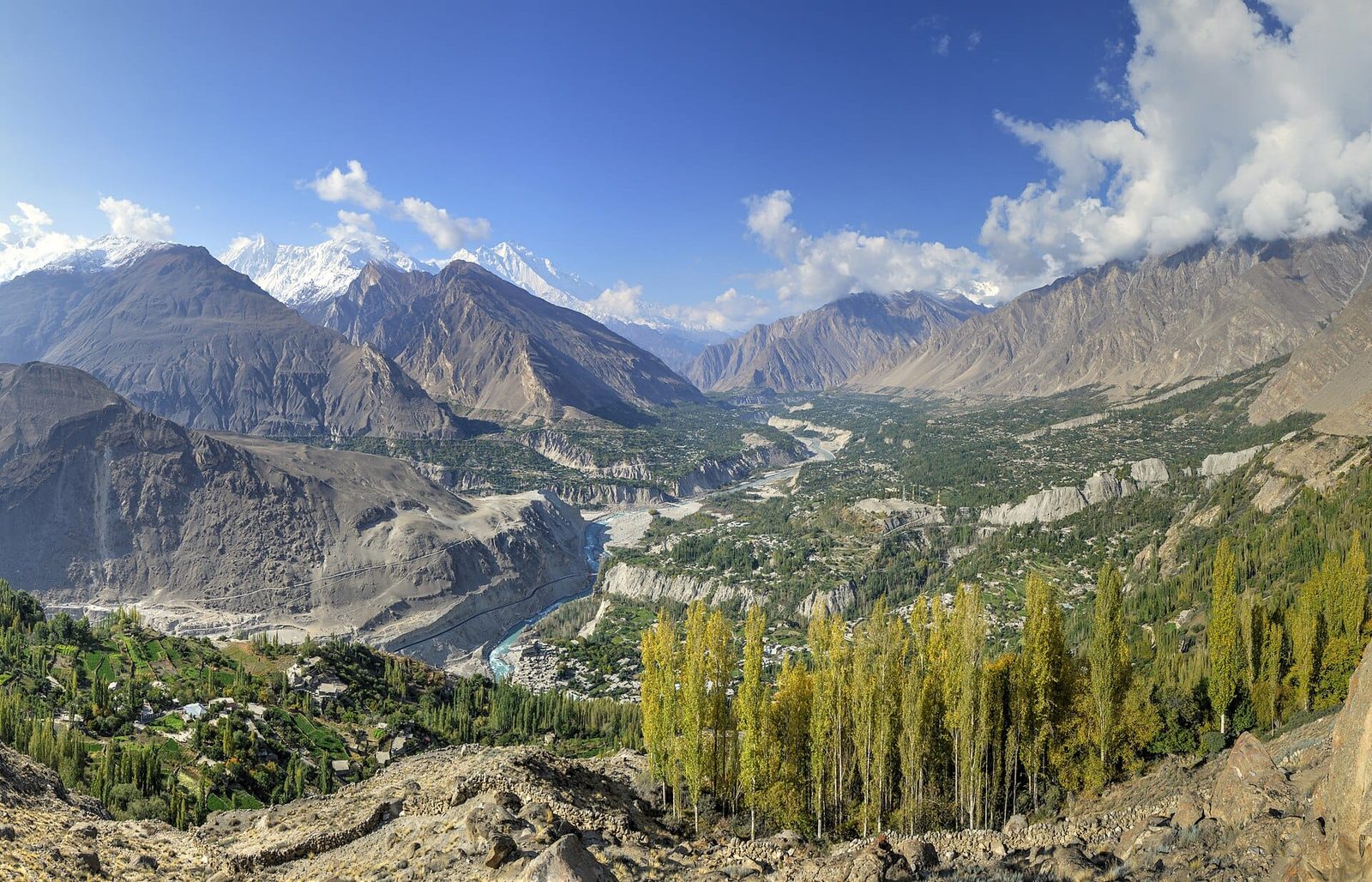
At six in the morning the departure lounge at Islamabad airport tells you more about Pakistan travel safety than any government website. There is a French family arguing about window seats, a British trekking group asleep on their duffels, two Japanese climbers checking a weather app, and a dozen Pakistani grandmothers flying home to Skardu. The 45-minute flight they are all waiting for lands beside the Indus, under an 8,000-metre wall of mountains, in one of the most hospitable corners of Asia.
So — is Pakistan safe? Here is the short answer from a Balti team that has guided here for generations: for the places travellers actually go, yes, with sensible precautions and local support. The long answer deserves the whole article, because your family will ask, your friends will raise eyebrows, and you deserve better than either a scare headline or a sales pitch.
What the travel advisories actually say — all of them
Foreign ministries do not issue one verdict for a whole country, and this is the detail most headlines miss. Read the US State Department advisory closely and a map emerges: the strongest warnings apply to the immediate Afghanistan and Iran border zones, parts of Khyber Pakhtunkhwa’s former tribal districts, and Balochistan. The UK Foreign Office draws nearly the same map, as do Germany’s Auswärtiges Amt — whose “Teilreisewarnung” explicitly means partial warning — and Australia’s Smartraveller. Meanwhile the corridor every trekker uses — Islamabad, the Karakoram Highway, Hunza, Skardu and the Central Karakoram — sits outside those zones in every one of the four.
Germany goes further and specifically recommends reaching the northern mountains by air. In other words: the advisory system, read properly, already contains the itinerary we would design for you anyway. The mistake is reading the country headline and stopping there.
Region by region: an honest map of the country
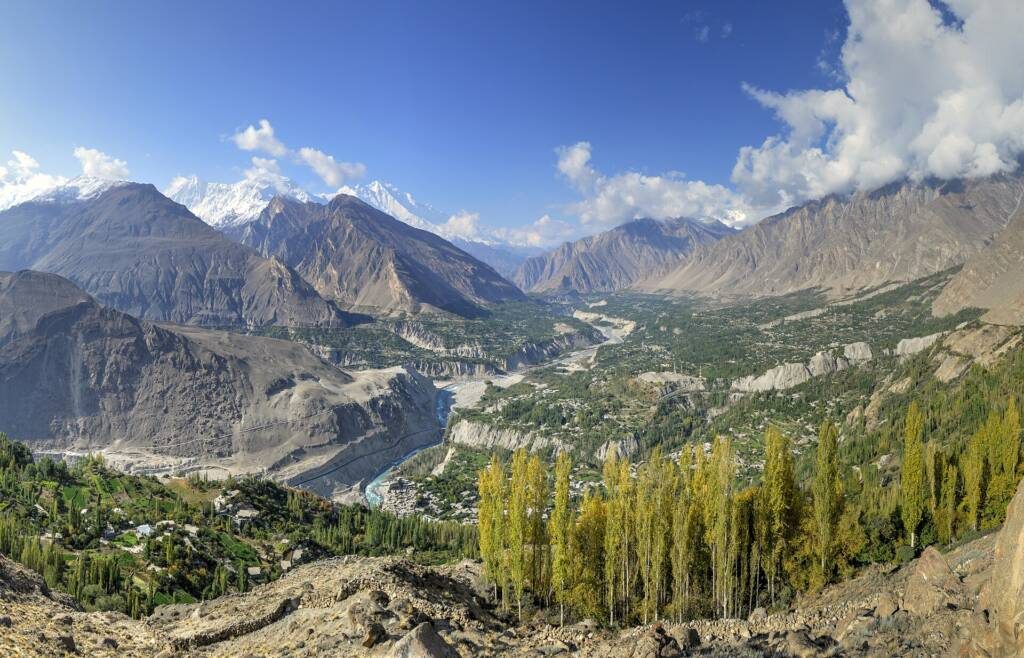
Islamabad is a planned capital of embassies and broad avenues — statistically among the safest big cities in South Asia, and your exposure to it is usually one hotel night and an airport. The Karakoram Highway corridor from Besham through Chilas to Gilgit carries police escorts on a few sections, more as protocol than necessity, and has moved millions of travellers without incident in the past decade. Gilgit-Baltistan — Hunza, Skardu, the trekking valleys — is the heart of the matter and gets its own section below.
Khyber Pakhtunkhwa is split: the Swat and Kaghan tourist valleys function normally and are beloved of domestic tourists, while the merged districts along the Afghan border remain under real warnings — we simply do not go there, and no trekking route requires it. Balochistan is off every tourist map including ours. That is the entire honest geography: the warned-about regions and the visited regions barely overlap.
Gilgit-Baltistan: fifty years of hosting the world
Almost every foreign visitor who contacts us is heading to one region. Gilgit-Baltistan has hosted international expeditions since the 1950s — Hermann Buhl walked through on his way to Nanga Parbat before most modern countries had tourist boards — and the economy of valleys like Hunza and Shigar is built on that half-century of guests. This shapes safety in ways statistics only hint at. A foreign trekker in Skardu bazaar is not a novelty or a target; they are the local economy’s reason to exist, a guest in a culture where hospitality is identity, and — bluntly — surrounded by people whose livelihoods depend on nothing ever happening to them.
Crime against tourists is genuinely rare here. The region also has a practical layer most visitors never notice: checkpoint registration at the GB boundary and along the KKH logs every foreign passport, which feels bureaucratic for ten minutes and then means someone always knows roughly where you are. Our guides clear these posts weekly; for our groups they are a formality measured in handshakes.
Twenty years on the ground: what we have actually dealt with
We are a Skardu company, so our answer to is Pakistan safe comes from incident logs, not intuition. In two decades of running treks and expeditions, here is the complete honest list of what has genuinely hurt trips: altitude sickness that ended treks early, a jeep axle snapped on the Askole road, flight cancellations that ate buffer days, one broken ankle at Urdukas, monsoon landslides that closed the KKH for an afternoon, and a marmot that got into a food barrel with what we can only describe as professional determination.
What has never appeared in that log: a security incident involving a client. That is not luck and we refuse to sell it as such — it is route discipline.
Our itineraries run airport-to-airport inside the tourist corridor, we fly the Islamabad-Skardu leg whenever weather allows precisely so clients skip the long road, and our drivers and guides live on these routes and hear about any problem long before it reaches an embassy bulletin.
Where we do not take clients — because honesty is the policy
A safety article that only reassures is an advertisement. So, plainly: we do not operate near the Afghanistan or Iran borders. We do not enter the merged districts of Khyber Pakhtunkhwa. When the Babusar Pass road carries an active advisory we fly clients over it or route around it, even when the pass is technically open, because a spectacular shortcut is not worth a degraded safety margin.
And when a client asks for an itinerary we consider unwise, we decline it and explain why, at the cost of the booking if necessary. One more piece of honesty, because you may read about it elsewhere: in 2013, militants attacked a climbing base camp on the Diamir side of Nanga Parbat — the worst incident in the history of Pakistani mountain tourism. It changed everything about how the region is secured: dedicated protection for that area, the registration system tightened, and a decade of incident-free seasons since. We tell you this rather than hoping you never search for it, because trust built on omission is not trust.
The risks that are real — and how we manage them
Strip away the geopolitics and Pakistan’s genuine travel risks are the same as Nepal’s or Peru’s, and they deserve more attention than the imagined ones. Altitude is the big one: our itineraries build acclimatisation days in, our guides are trained on symptoms, and we would rather turn a group around than push a headache into an emergency — the physiology is covered in our acclimatisation guide.
Mountain roads come second: we fly over the worst of them, use our own maintained 4x4s and vetted drivers on the rest, and never drive them in the dark. Remoteness is third: beyond the roadheads there is no phone signal, so every remote-valley group carries a satellite phone, and we maintain genuine helicopter evacuation contacts — with the honest caveat that evacuation costs fall to your insurance, which is why we require cover and explain exactly what it must include in our insurance guide.
Stomachs come fourth: bottled or filtered water, expedition-standard kitchens on trek, and a little restraint at roadside stalls solve almost all of it.
Women, solo travellers, and who this country suits
We host solo women on group departures every single season, and their debriefs are remarkably consistent: Gilgit-Baltistan is conservative but courteous, the hassle level is far below what most expected from South Asia, and the dominant experience is being invited to tea by someone’s grandmother. Practical notes still apply — dress modestly, expect curiosity, and know that a woman travelling with a known local guide moves through the region with complete ease.
Fully independent solo travel is workable for experienced travellers with time to spare; most solo guests join small groups here not out of fear but because permits, checkpoints and jeeps are simply easier shared. Families do well on the softer circuits — lakes, forts, Hunza orchards — and our Hunza-or-Skardu comparison is the right starting point for a first visit.
Keeping Pakistan safe in practice: how we brief our groups
First, paperwork: secure the e-visa before flying, carry passport photocopies separately, and Americans should register with STEP. Second, structure: book with a licensed operator — registered itineraries are what turn checkpoints into formalities and problems into phone calls.
Third, communications: assume no signal beyond the roadheads and let the sat phone be the plan, not your SIM card. Fourth, timing: build buffer days around the Skardu flight and check our season guide, because weather — not security — is what actually reshuffles itineraries here.
Finally, attitude: the traveller who accepts tea, learns three words of Balti and asks before photographing will be safer than any checklist can make them, because the whole valley will have adopted them by dinner.
So, is Pakistan safe? The honest conclusion
For the mountain corridor travellers come for — yes, on the evidence of fifty years of trekking tourism, two decades of our own incident logs, and advisory maps that, read honestly, agree with us. Not risk-free: no high-mountain country is, and we have laid the real risks out plainly. But the gap between Pakistan’s reputation and the on-the-ground reality of Hunza or Skardu is the single largest we know of anywhere in travel — and closing that gap is why arrivals keep growing, and why the travellers in that dawn departure lounge keep coming back. Respect the advisories about places you were never going anyway.
Travel with people who know the ground. The Karakoram will meet you with tea, not trouble. When you are ready: browse all treks and tours, walk the bazaar on the Skardu City Tour, or start gently with the Hunza Cultural Tour. Local hands, real safety, fair price.
Is Pakistan safe? Frequently asked questions
Is Pakistan safe for tourists right now?
For the regions tourists actually visit — Islamabad, the Karakoram Highway corridor and Gilgit-Baltistan — yes, with normal precautions and a reputable local operator. Advisories warn against specific border areas that no tour itinerary goes near.
Is Pakistan safe for American tourists?
Thousands of Americans trek the Karakoram every season without incident. The US advisory distinguishes sharply between regions; Gilgit-Baltistan sits outside the areas of strongest concern. Register with STEP, carry your e-visa, and travel with a licensed operator.
Is Gilgit-Baltistan different from the rest of Pakistan?
Practically, yes. It is a mountain tourism economy with its own entry checkpoints, a distinct administrative status and a fifty-year record of hosting foreign expeditions. Local communities depend on visitors and treat their safety as personal responsibility.
Is the food and water safe?
Treat water as you would anywhere in South Asia: bottled, filtered or boiled. Food in established hotels and on organised treks is safe — our cooks manage kitchens to expedition standards. Most stomach trouble we see comes from tap water and roadside salads, both easy to avoid.
What about the mountain roads?
They are the genuine risk most visitors underrate. We mitigate the big ones by flying the Islamabad-Skardu leg when weather allows, using our own vetted drivers on the rest, and never driving mountain roads at night.
What does a local operator actually do for safety?
Registered itineraries, checkpoint handling, licensed guides who hear about problems before they reach the news, satellite phones beyond mobile coverage, evacuation contacts and insurance guidance. The gap between travelling with and without that support is the honest answer to most safety questions.