
 EN
 العربية
 Deutsch
 Español
 Français
 Italiano
 Polski
 Русский
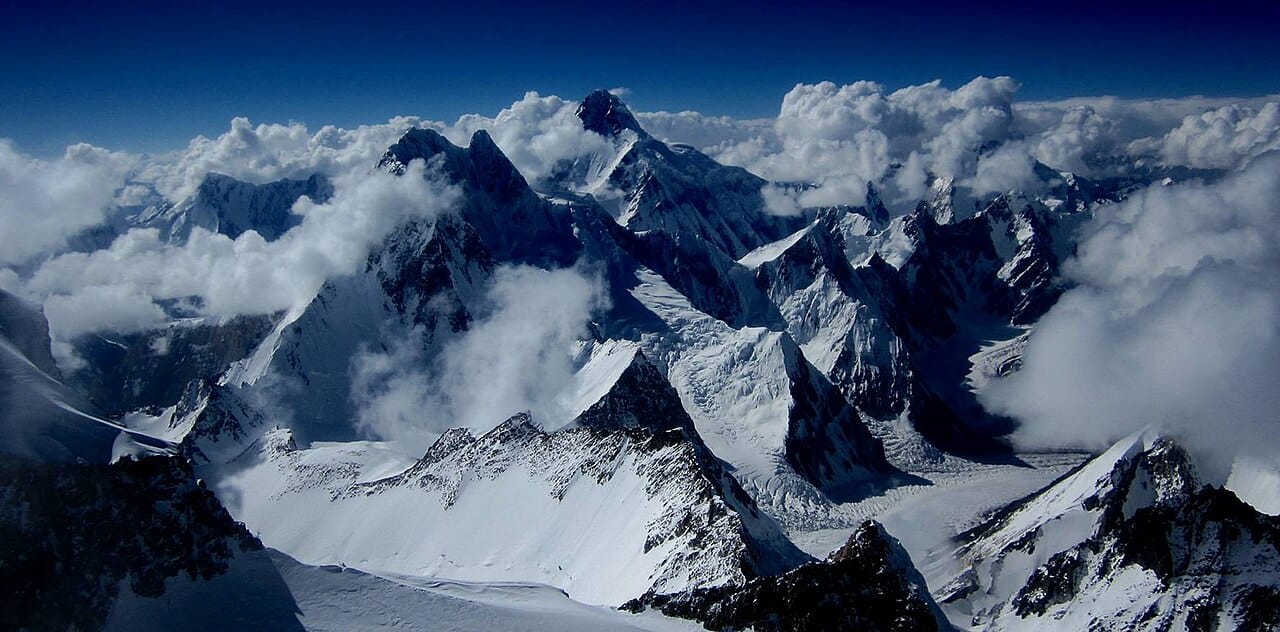
No eight-thousander is easy. "Easiest" here means the lowest technical difficulty, the least objective danger and the simplest logistics among 14 mountains that can all kill you. Climbers usually put Cho Oyu, Manaslu, Gasherbrum II and Broad Peak on the shortlist. We run the last two from Skardu every summer, so we are not neutral, and we will say where our own peaks fall short of the others.
What does "easiest" actually mean?
We rank on five things, in this order. Nothing in the list is a success rate, because we won't quote numbers we cannot source.
- Technical difficulty of the normal route. Steep ice and rock, or mostly snow slopes with fixed rope?
- Objective danger. Avalanche, rockfall and serac exposure you cannot manage by climbing well.
- Length and exposure of summit day. A long exposed ridge is harder than a short push.
- Approach and logistics. Days of walking, remoteness, evacuation.
- Altitude. Every peak here is above 8,000 m, so all are in the death zone. The differences between 8,035 m and 8,188 m are small next to the other four.
A peak can be easy on one of these and not on another. Treat the list as a way to ask better questions, not a league table.
Which peaks make the shortlist?
| Peak | Height | World rank | Country / range | Why it is on the list |
|---|---|---|---|---|
| Cho Oyu | 8,188 m | 6th | Nepal/Tibet border, Himalaya | Moderate slopes on the standard route; often called the easiest |
| Manaslu | 8,163 m | 8th | Nepal, Himalaya | Long ridges and glaciers give feasible approaches from every side |
| Broad Peak | 8,051 m | 12th | Pakistan/China, Karakoram | The most achievable of Pakistan's five, but the summit day is long |
| Gasherbrum II | 8,035 m | 13th | Pakistan/China, Karakoram | The most attainable of the Baltoro four, with a shorter summit day than Broad Peak |
The other ten eight-thousanders do not make this list for different reasons. Everest, Kangchenjunga and Annapurna are not "easy" on any of our five criteria, and K2 is the opposite of easy. Shishapangma is the lowest at 8,027 m and lies wholly in Tibet.
Why does Cho Oyu usually come first?
Because of the shape of the route. The northwest ridge has generally moderate slopes, and it sits near the Nangpa La, a glaciated pass at 5,716 m that the Sherpas and Tibetans use as a trade route. It is popular with professionally guided parties.
Our honest caveats: we do not run Cho Oyu, so everything we know about it is reading. Access, permits and logistics for peaks in Tibet and Nepal are set by other governments, and we cannot speak to them.
What is Manaslu's case?
Manaslu is the eighth-highest mountain in the world at 8,163 m, in west-central Nepal. It was first climbed on 9 May 1956 by Toshio Imanishi and Gyalzen Norbu of a Japanese expedition. Its long ridges and valley glaciers offer feasible approaches from every direction. The Manaslu trekking circuit, which skirts the massif, reaches Larkya La at 5,106 m.
We make no claim on Manaslu's summit-day difficulty because we have no first-hand data.
Why do Gasherbrum II and Broad Peak make the shortlist?
Both are in the Pakistan Karakoram, at the head of the Baltoro Glacier, a few days' walk past Concordia.
Gasherbrum II (8,035 m) is the 13th-highest mountain on earth and, by common agreement, the most attainable of the four eight-thousanders at the head of the Baltoro. The normal route on the south-west side is not technically extreme by 8,000 m standards, the objective danger is lower than on K2, and the summit day is shorter than Broad Peak's. It was first climbed on 7 July 1956 by an Austrian expedition.
Broad Peak (8,051 m) is the 12th-highest mountain, and the most achievable of Pakistan's five. It is climbed by the West Spur, with fixed rope on the steep sections, from a base camp at about 4,850 m. The catch is the summit day: a long, exposed traverse above 7,800 m that turns many climbers back at the false summit. Our own FAQ is blunt: "most achievable" is a phrase that has killed people. We say the same here.
On 30 July 2026 Broad Peak saw its deadliest single accident: Wikipedia records that an avalanche on the slope between Camp 2 and Camp 3, at about 6,600 m, swept a group of 10 climbers down the mountain, and all 10 died. We mention it because anyone choosing this mountain should know.
How do the two Pakistan peaks compare?
| Gasherbrum II | Broad Peak | |
|---|---|---|
| Height | 8,035 m | 8,051 m |
| Route | Normal route, south-west side | West Spur, fixed rope on steep sections |
| Summit day | Shorter | Long, exposed traverse above 7,800 m |
| Experience we require | Prior experience above 6,500 m | Prior experience above 7,000 m |
| Duration with us | 42 days | 42 days |
| Season | June to August, summit window usually mid-July | Mid-June to August, summit window usually July |
Both expeditions follow the same approach: roughly a week on foot each way from Askole via Jhola, Paiju, Urdukas and Goro II to Concordia, then three rotations to higher camps, a weather window, the summit push and the walk out. The itineraries are 26 stages in a 42-day package; the remaining days are the rest and waiting that the climbs need.
What do you need before you try one?
Neither is an entry-level mountain. For Gasherbrum II we require prior experience above 6,500 m and a climbing CV before we accept a booking. For Broad Peak, prior experience above 7,000 m. Both need you to be competent on fixed rope with jumar and descender, solid in crampons on steep snow, and able to decide well at altitude in bad weather. The minimum age is 21 and we require a full medical including a recent cardiac assessment. If you have not been that high, a 7,000 m peak such as Spantik is the sensible rung below.
For the training side, see the Gasherbrum I and II guide and the Broad Peak route guide. For the full line-up of Pakistan's five, see Pakistan's five eight-thousanders.
What do they cost in 2027?
Our full-board guided prices for 2027 are $15,400 for Gasherbrum II and $15,900 for Broad Peak, per person. A base-camp-service tier for self-sufficient teams is $6,900 and $7,200, and premium tiers with two high-altitude porters per climber are $22,500 and $23,500. Published prices assume a minimum team of four. For a breakdown of what these prices cover, read what it costs to climb K2 and Pakistan's 8,000ers.
Booking terms on these expedition pages differ from our trek terms. A 10% deposit confirms a place, 50% is due 120 days before departure, and the balance at 60 days. Permit and liaison-officer fees are non-refundable once filed. Insurance must cover mountaineering above 6,000 m and helicopter evacuation.
Ready to talk? Our 2027 Pakistan 8,000 m expeditions are the Gasherbrum II Expedition at $15,400 full-board and the Broad Peak Expedition at $15,900 full-board. Departures run in June and July 2027. We will ask for your climbing CV and talk to you before we accept a booking.
Frequently asked questions
What is the easiest 8,000 m peak in the world?
Cho Oyu is the one most often named. Wikipedia describes it as considered the easiest 8,000 m peak because of the moderate slopes of its northwest ridge. "Easiest" still means serious, and none of the fourteen is safe.
Is Gasherbrum II easier than Broad Peak?
On our reading, yes on summit day: Gasherbrum II's is shorter, and the experience we require is lower (above 6,500 m against above 7,000 m). Both are 42-day expeditions with us.
What is the easiest 8,000 m peak in Pakistan?
Gasherbrum II and Broad Peak are the usual choices for a first Pakistan eight-thousander, and both still need prior high-altitude experience.
Can I climb without bottled oxygen?
It is a legitimate choice on Gasherbrum II, and an oxygen allocation is included at full-board and premium. Tell us at booking because it changes the plan. On Broad Peak most climbers use oxygen from the high camp upward.
What are the summit chances?
We don't publish a success rate, because we have no audited figure to give you. Your guide's turnaround call is final, and there is no refund for an unsuccessful summit.
Written by Zulfiqar Ali, founder of Karakoram Venture.