
 EN
 العربية
 Deutsch
 Español
 Français
 Italiano
 Polski
 Русский
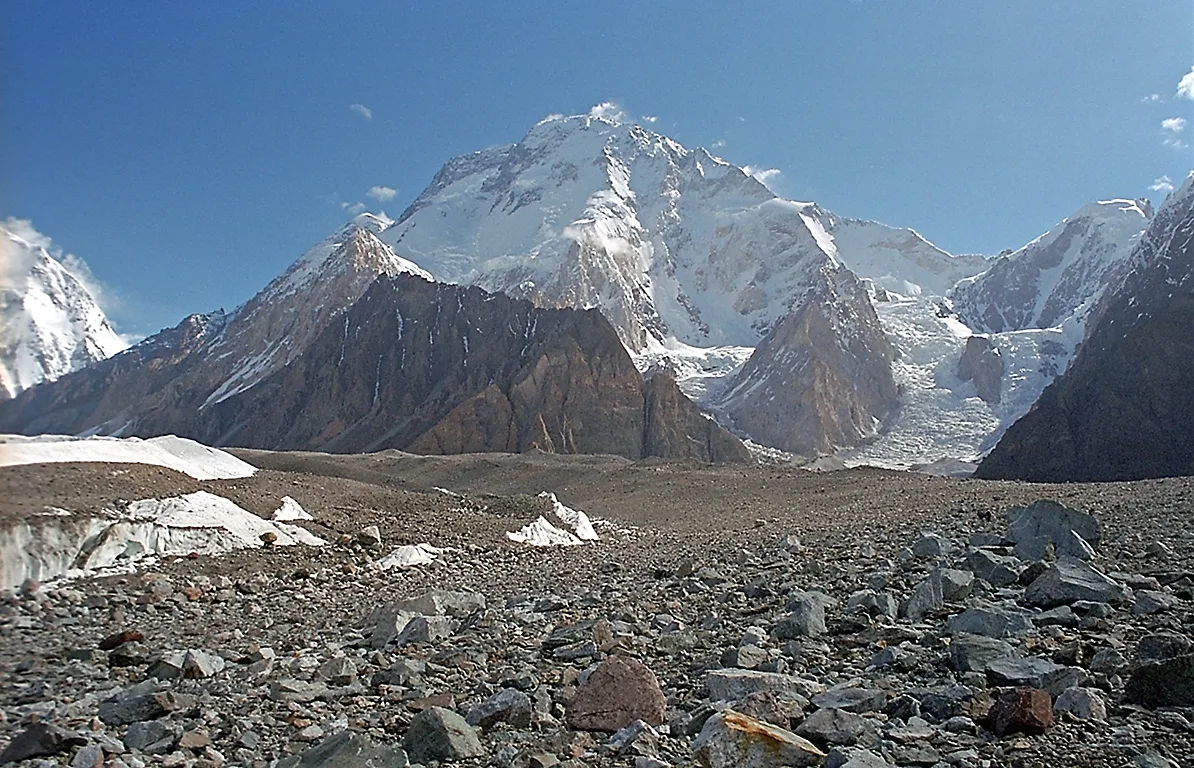
If your first eight-thousander is going to be in Pakistan, the choice usually comes down to Broad Peak (8,051 m) or Gasherbrum II (8,035 m). On our own pages, Gasherbrum II asks for less experience (prior climbing above 6,500 m, against 7,000 m for Broad Peak), has the shorter summit day, and costs $500 less on the full-board tier. Broad Peak is higher by 16 m and has the longer, more exposed summit day. Neither is easy, and both are the same 42 days on our itineraries. This guide puts the two side by side using only our published 2027 pages and dated Wikipedia articles, then gives a plain decision list.
We run both from Skardu, so we are not neutral. Where our pages say something favours one mountain, we say whose page said it. For a wider ranking of the world's lower eight-thousanders, read our easiest 8,000 m peaks ranked post; this one is the head-to-head.
How do the two mountains compare at a glance?
| Broad Peak | Gasherbrum II | |
|---|---|---|
| Height | 8,051 m | 8,035 m |
| World rank | 12th highest | 13th highest |
| Range and border | Karakoram, Gilgit-Baltistan (Pakistan) and Xinjiang (China) | Karakoram, Gilgit-Baltistan (Pakistan) and Xinjiang (China) |
| First ascent | 8–9 June 1957, Austrian expedition (Wintersteller, Schmuck, Diemberger, Buhl), West Spur, without supplemental oxygen, high-altitude porters or base camp support | 7 July 1956, Austrian expedition (Moravec, Larch, Willenpart), Southwest Ridge |
| Position | Part of the Gasherbrum massif, about 8 km from K2 | Third-highest member of the Gasherbrum group, behind Gasherbrum I and Broad Peak |
Wikipedia gives the two Gasherbrum II heights as 8,035 m and 8,034 m in different sections of its article, which is a reminder that survey figures vary by a metre.
How do our two expeditions compare?
Everything below is taken from our own pages for the 2027 season. Figures are in US dollars per person.
| Broad Peak Expedition | Gasherbrum II Expedition | |
|---|---|---|
| Duration | 42 days, 41 nights | 42 days, 41 nights |
| Approach | 6–7 days on foot each way | 6–7 days on foot each way |
| Base camp | Beneath the West Spur, about 4,850 m | Beneath Gasherbrum I and II, about 5,000 m |
| Summit-day wording | Alpine start, up to the col and along the exposed summit ridge past the false summit | Alpine start, up the summit slopes and the final ridge; our page says the summit day is shorter than Broad Peak's |
| Experience required | Prior experience above 7,000 m | Prior experience above 6,500 m |
| Minimum age | 21 | 21 |
| Base Camp Service tier | $7,200 | $6,900 |
| Full-Board Guided tier | $15,900 | $15,400 |
| Premium (2 HAP) tier | $23,500 | $22,500 |
| Published-price team minimum | 4 climbers (4 to 8 listed) | 4 climbers (4 to 8 listed) |
| Summit window (our page) | Mid-June to August; usually July | June to August; usually mid-July |
| 2027 departures listed | 10 Jun – 21 Jul; 20 Jun – 31 Jul | 12 Jun – 23 Jul; 22 Jun – 2 Aug |
| Deposit and payments | 10% deposit; 50% due at 120 days; balance at 60 days | 10% deposit; 50% due at 120 days; balance at 60 days |
| Royalty (per our FAQ) | $2,500 per person in summer | $2,500 per person in summer |
| Combination | Priced privately; one peak per permit | With Gasherbrum I: $26,900 full-board for the pair, about 55 days |
What the three tiers mean, quoted from the pages: Base Camp Service is for self-sufficient alpine teams and covers permits, royalty, liaison officer, transport, porters and full base camp, "nothing above BC". Full-Board Guided adds one high-altitude porter per climber above base camp, oxygen, high camps, fixed rope, an expedition guide, a base-camp medic and forecasting. Premium has two high-altitude porters per climber, a larger oxygen allocation, a private base-camp tent, a priority evacuation arrangement and a guaranteed departure.
Not included on either page: international flights, Pakistan visa fees, personal climbing equipment and down suit, mountaineering and evacuation insurance (mandatory, arranged by you), summit bonuses and staff tips, personal oxygen beyond the stated allocation, and the helicopter costs themselves. Both pages also say a summit is not sold or implied.
What is Broad Peak like?
Our page calls Broad Peak the twelfth-highest mountain on earth and "the most achievable of Pakistan's five eight-thousanders", then adds that achievable is not the same as safe. It describes the climb as the West Spur with fixed rope on the steep sections from a base camp at about 4,850 m, with four high camps. The catch, the page says, is the summit day: a long, exposed traverse above 7,800 m that has turned back strong mountaineers at the false summit. Wikipedia agrees about the summit's shape, giving its length as over 1.5 km, and records that the main summit has two subsidiary eight-thousanders, Rocky Summit (8,028 m) and Broad Peak Central (8,011 m).
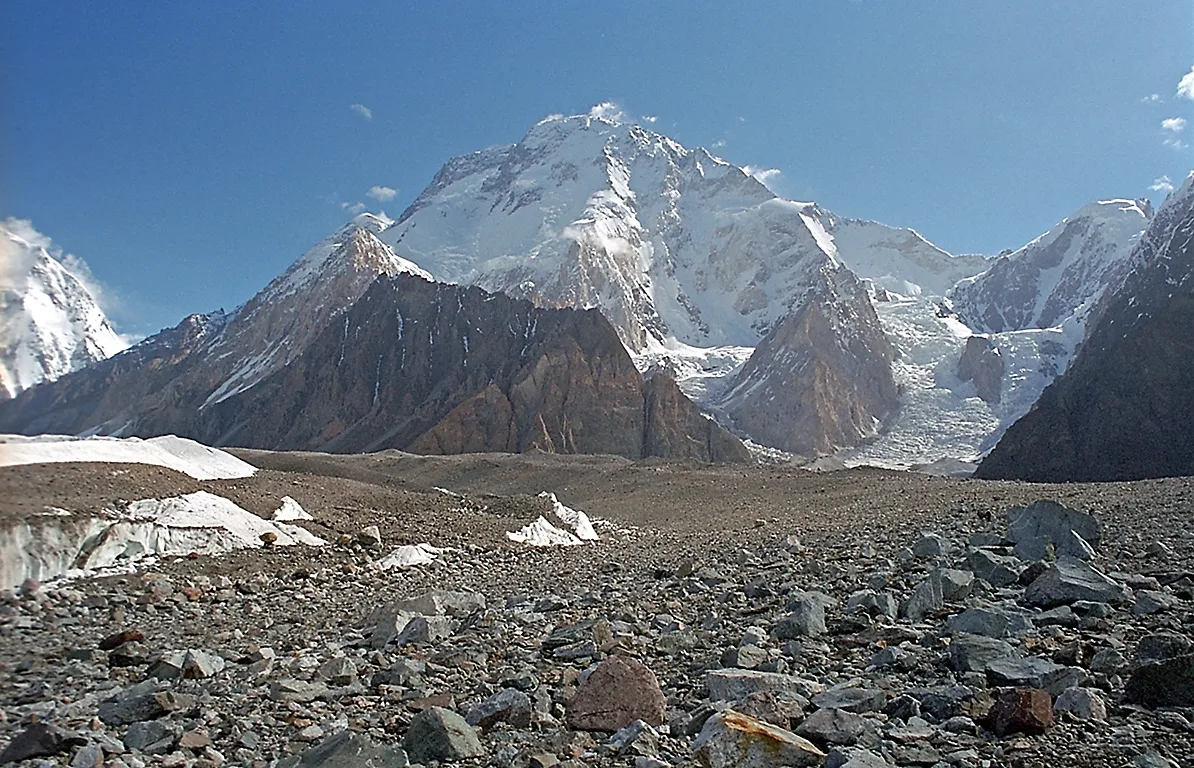
Our Broad Peak guide covers route and history in full.
What is Gasherbrum II like?
Our page calls Gasherbrum II the thirteenth-highest mountain on earth and, by common agreement, the most attainable of the four eight-thousanders at the head of the Baltoro. It describes the normal route on the south-west side as not technically extreme by eight-thousander standards, objective danger as lower than on K2, and the summit day as shorter than Broad Peak's, and still warns it is "not casual", with a short weather window. Wikipedia describes the first ascent route as the Southwest Ridge and says the Gasherbrum group was explored in 1909 by the Duke of the Abruzzi and Vittorio Sella.
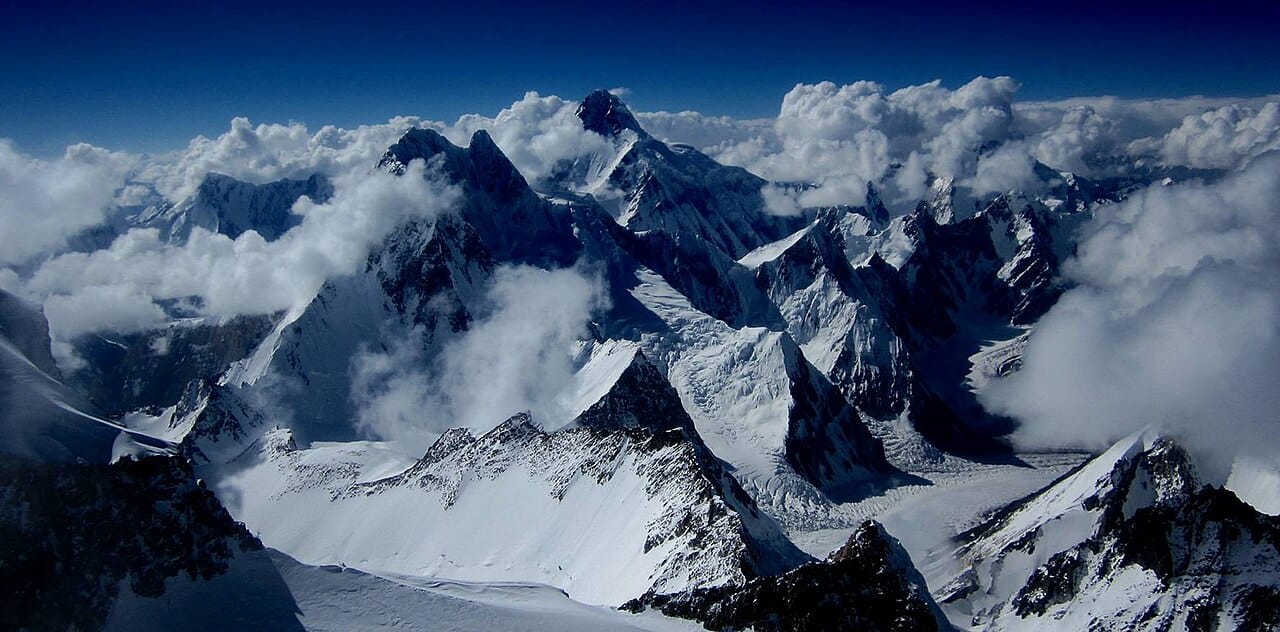
Gasherbrum II is also the shared-base-camp mountain: our page says it shares a base camp with Gasherbrum I, and prices the pair at $26,900 full-board over about 55 days, with two permits and two royalties, so the saving is smaller than people assume. Our Gasherbrum I and II guide covers both.
Which one is more dangerous?
We have no success-rate or fatality statistics of our own and we do not quote any that Wikipedia does not state. What we can give you is what our pages and Wikipedia say, plainly attributed.
- Our pages. Broad Peak: the summit day is long and exposed above 7,800 m and "has turned back very strong climbers". Gasherbrum II: objective danger lower than K2, shorter summit day, "and people have died on it".
- Broad Peak, 2026. Wikipedia records that on 30 July 2026 an avalanche struck a group of 10 climbers on the slope between Camp 2 and Camp 3, at about 6,600 m; it confirms all 10 died, among them experienced Nepalese and Pakistani guides, and says conditions in the preceding days were reportedly unstable. It calls this the biggest single fatal incident on the mountain. Wikipedia's account names other teams and outfitters. We mention it because a comparison that left it out would not be fair to you, and we do not draw a rate from a single event.
- Gasherbrum II. Wikipedia's account of the first ascent says the party found Camp I and its supplies buried by an avalanche when they returned, and it records a death during a descent in 2011.
Both mountains have avalanche exposure on the way up. Neither page lets you assume "the easier one" means "safe".
Which has the better route for a first eight-thousander?
On our pages, Gasherbrum II. The summit day is shorter, the experience bar is 500 m lower (6,500 m against 7,000 m), and the objective danger is described as lower than K2.
That is a statement about our pages, not a promise. The two itineraries share their first eleven days to Concordia and then split: Broad Peak goes up the Godwin-Austen to a base camp at about 4,850 m and rotates to Camps 1, 2 and 3 at about 5,800, 6,300 and 7,000 m, while Gasherbrum II goes south-east up the Abruzzi onto the Gasherbrum glacier to a base camp at about 5,000 m and rotates to about 5,900, 6,400 and 7,000 m.
Which costs less, and how do the terms differ?
Gasherbrum II costs $500 less at full-board ($15,400 against $15,900), $600 less at Base Camp Service ($6,900 against $7,200) and $1,000 less at Premium ($22,500 against $23,500).
The terms are the same on both pages: published prices need a team of at least four; a party of one to three is quoted privately because the liaison officer, base camp, cook staff and fixed-rope budget are per-expedition costs shared across the team. Cancellation terms are identical too. Peak royalty, permit and liaison-officer fees are non-refundable once filed; more than 120 days out everything except filed permit costs is refunded; 60 to 119 days, 50% of the remaining balance; under 60 days, non-refundable.
Insurance is not optional. Both pages require cover for mountaineering above 6,000 m and for helicopter evacuation, and say standard travel insurance will not do. For where these numbers sit against the rest of the Pakistan expedition line, read our cost of climbing K2 and Pakistan's 8,000ers guide.
Broad Peak vs K2: is Broad Peak a stepping stone?
People search for "Broad Peak vs K2" because the two are neighbours: Wikipedia puts Broad Peak about 8 km from K2, and our page says the two share the Baltoro approach. K2 is 8,611 m, the second-highest mountain on Earth, and Wikipedia says its first ascent was in 1954 by an Italian expedition. On our pages, our K2 Expedition is 55 days, against 42 for Broad Peak, with full-board at $21,500 against $15,900.
Whether Broad Peak is the right preparation for K2 is a coaching question we answer by conversation, not by article. Our K2 Expedition page has the details.
So, which one should you pick?
A decision list, using only what the pages say:
- Pick Gasherbrum II if your highest point is above 6,500 m but not above 7,000 m, if you want the shorter summit day, or if you want the lower full-board price. It also fits a later Gasherbrum I plan, because the two share a base camp.
- Pick Broad Peak if you already have experience above 7,000 m, if you prefer the longer West Spur route with its fixed-rope sections, or if K2 is your longer goal and you want to be on the same approach.
- Neither yet if you have not climbed above 6,500 m. Our pages point to Spantik (7,027 m) as the rung below Gasherbrum II; ask us.
- Not sure? Talk to us before you pay. Both pages say we will ask for your climbing CV and a cardiac assessment before accepting a booking.
Ready to choose your first eight-thousander?
See the Broad Peak Expedition ($15,900 full-board) and the Gasherbrum II Expedition ($15,400 full-board), or read the hub at Mountaineering in Pakistan. Each page carries its own booking terms: the deposit is 10%, 50% is due at 120 days and the balance at 60 days. Message us on WhatsApp with your highest altitude so far and your preferred July window, and we will tell you honestly which one fits.
Frequently asked questions
Is Broad Peak or Gasherbrum II easier?
On our pages, Gasherbrum II: shorter summit day, lower experience bar (6,500 m against 7,000 m), objective danger described as lower than K2. Both are still serious eight-thousanders.
How much do Broad Peak and Gasherbrum II cost with you?
Broad Peak: $7,200 Base Camp Service, $15,900 Full-Board Guided, $23,500 Premium. Gasherbrum II: $6,900, $15,400 and $22,500. Published prices run with a team of four or more.
How long is each expedition?
Both are 42 days, 41 nights, including a 6–7 day walk each way from Askole to Concordia.
Who found each mountain first?
Wikipedia says an Austrian expedition made the first ascent of each: Gasherbrum II on 7 July 1956 and Broad Peak on 8–9 June 1957.
Do I need to climb with bottled oxygen?
Both pages include an oxygen allocation at full-board and premium and say you should tell us at booking if you want to climb without it.
Can I climb both in one season?
Gasherbrum II can be combined with Gasherbrum I (the pair is $26,900 full-board over about 55 days). Combining Broad Peak with another peak is priced on request; one peak per permit.
Written by Zulfiqar Ali, founder of Karakoram Venture. Mountain facts are read from Wikipedia on 13 November 2026; expedition details are our published 2027 pages and are quoted per page.