
 EN
 العربية
 Deutsch
 Español
 Français
 Italiano
 Polski
 Русский
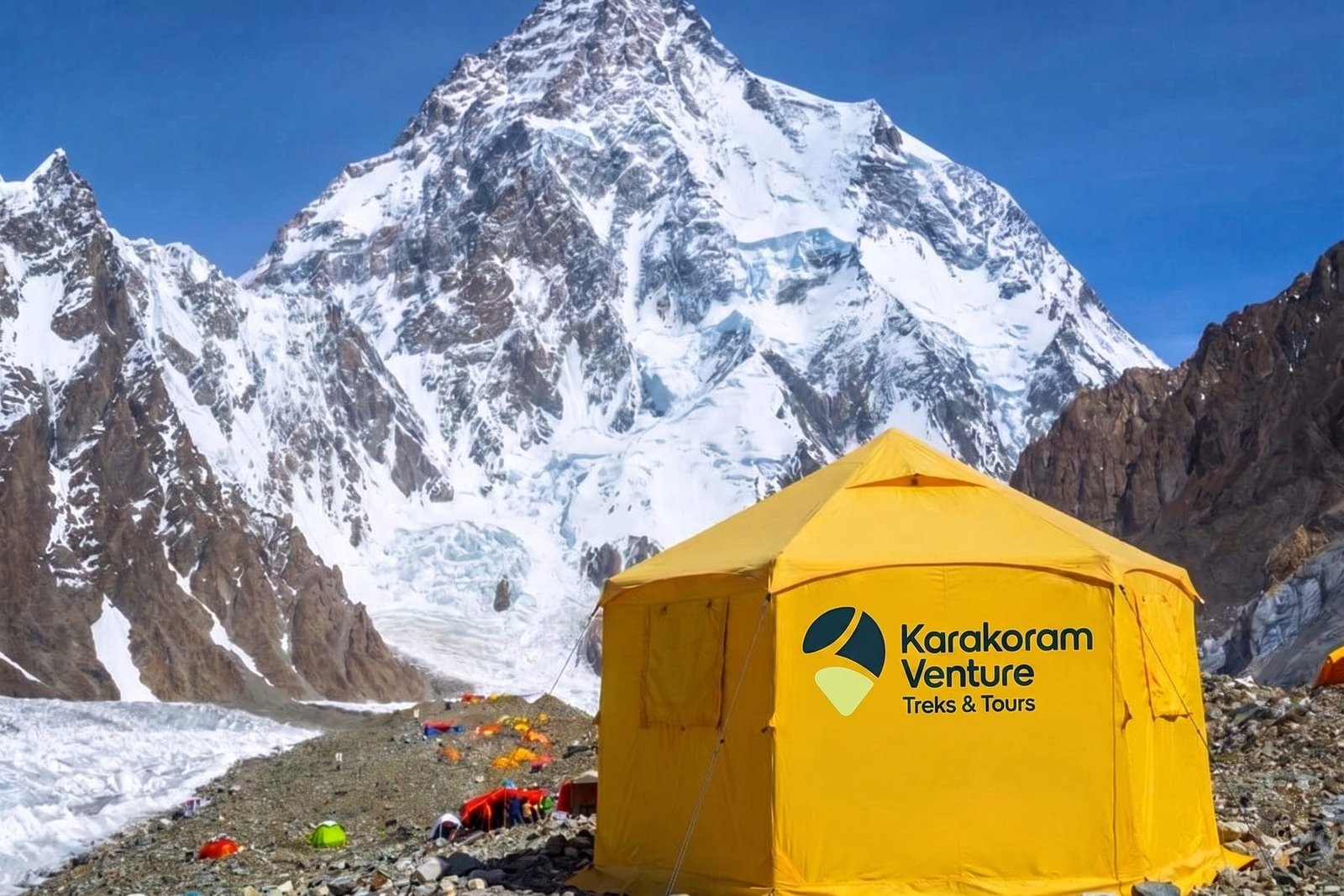
A K2 expedition takes six to eight weeks door to door. Ours runs 55 days from Islamabad and back. Only a handful of those days are spent climbing. The rest is walking in, acclimatising, resting and, above all, waiting for the weather.
This page walks through the timeline phase by phase, anchored to our real 2027 itinerary. It does not cover route, history or cost; our K2 expedition guide does that.
What does the 55-day schedule look like?
Our 2027 departures run from Islamabad to Islamabad. The first runs 10 June to 3 August and the second 20 June to 13 August. The plan breaks into six phases.
| Phase | What happens | Itinerary stages |
|---|---|---|
| 1. Islamabad and Skardu | Briefing, liaison officer, flight, load-out | Days 1–4 |
| 2. Walk-in to base camp | Askole to K2 Base Camp via Concordia | Days 5–12 |
| 3. Base camp and rotations | Puja, three acclimatisation rotations | Days 13–17 |
| 4. The weather window | Waiting, then the summit push | Days 18–20 |
| 5. Descent and contingency | Clear the mountain, spare day | Days 21–22 |
| 6. Walk-out and home | Baltoro back to Skardu, fly out | Days 23–26 |
The itinerary lists 26 named stages, while the package runs 55 days — because most stages on the mountain are not single days. The rotations, the rest blocks, the weather-window wait and the contingency stage each absorb days as the mountain allows; only the approach and return march run roughly a stage a day.
The same timeline, week by week
- Weeks 1 and 2: Islamabad, Skardu, then the Baltoro walk-in. By itinerary day 12 you are at K2 Base Camp.
- The middle weeks: the puja, the three rotations and rest days, then the wait at base camp. How long the wait lasts is the one thing nobody can schedule.
- The summit push: two itinerary days, if and when the forecast allows.
- The last week: descent, a spare day, then the walk out to Askole, the 4×4 to Skardu and the flight to Islamabad.
Phase 1: Islamabad and Skardu (about 4 days)
You assemble in Islamabad for a kit check, an insurance and documentation review, and dinner with the expedition leader. Day 2 is the mandatory expedition briefing, where you meet the liaison officer who travels with the team. Day 3 is the flight to Skardu, which is weather-dependent, so the schedule carries slack for it. Day 4 is load-out: gear, oxygen and rope inventory, food packing and porter loads weighed.
Phase 2: The walk-in (about 8 days)
A full day by 4×4 takes you from Skardu to Askole, then the approach begins. The route goes Jhola, Paiju (with a full rest day), Urdukas, Goro II and Concordia, and on day 12 up the Godwin-Austen Glacier to K2 Base Camp at 5,150 m. We list the approach as six to seven walking days each way.
The rest day at Paiju is not optional padding. It is the first block of acclimatisation. Our acclimatisation guide explains why.
Phase 3: Base camp and the rotations (5 stages)
The expedition proper starts on day 13 with the puja, the dome and kitchen going up, and oxygen and rope staged. After that comes the real acclimatisation work:
- Rotation 1: a carry to Camp 1 at about 6,050 m, a night, then back to base camp.
- Rotation 2: up through House's Chimney to sleep at Camp 2 at about 6,700 m, then down to rest.
- A full rest day at base camp, with weather models reviewed daily.
- Rotation 3: over the Black Pyramid to Camp 3 at about 7,350 m for a last night, then down to thick air.
Each rotation climbs high and returns low. This is the same principle as on a trek, applied to a mountain.
Phase 4: The weather window (the long part)
This is the phase that decides the length of the trip. Our itinerary's day 18 reads: "Waiting. This is most of an 8000m expedition and it is the part nobody photographs." You move when the forecast says so.
Once a window opens, the push takes two days. You go up through the camps to Camp 4 on the Shoulder at about 7,900 m, where most climbers go on oxygen and have a short, sleepless night. Then comes summit day: an alpine start into the Bottleneck, the traverse under the hanging serac and the summit snowfields. The turnaround time is not negotiable.
Why does the window, not fitness, set the end date? Because K2 gives fewer windows than the Gasherbrums, and they close faster. That is why the schedule is longer than for our other peaks, not shorter.
Our itinerary also notes that the summit window is usually in late July. For how the Baltoro season works across K2, Broad Peak and the Gasherbrums, see our Baltoro climbing season guide.
Phase 5: Descent and the spare day
Day 21 is the descent through the camps, stripping the route and carrying everything off. Day 22 is held in reserve at base camp for a second summit attempt or bad weather. If it is not needed, the team starts walking out early.
Phase 6: The walk out
Base camp to Paiju, then Paiju to Askole, then the long 4×4 to Skardu, and finally the flight to Islamabad for a debrief and onward connections. Allow slack in your flights home. The Skardu flight is weather-dependent, and the schedule carries a buffer for it.
What can shorten or lengthen the trip?
- A good early window can end the climb sooner and leave contingency days unused.
- A bad season can use every day and still end without a summit. Whole seasons pass with no summits.
- Flights to and from Skardu depend on the weather.
- Combining peaks adds time and cost. The rule is one peak per permit, so a second summit means a second permit.
We make no promise of a summit. There is no refund for an unsuccessful summit, and the turnaround decision is made on conditions and on your state, not on how much you paid. We do not quote success rates.
How much time off do you need?
Plan on eight weeks, to be safe: 55 days on the schedule, plus travel to and from Islamabad on your own tickets and some margin. The expedition runs on a minimum team of four. Prior experience above 8,000 m is strongly preferred, and 7,000 m is the absolute floor. Accident insurance is required for every member, and we carry the high-altitude porters' own cover; your policy must be valid for mountaineering at these altitudes, including evacuation.
Ready to plan? See the 55-day K2 Expedition page for the departures and the full day-by-day itinerary, and our guide to what climbing K2 costs.
Frequently asked questions
How long does it take to climb K2?
Six to eight weeks door to door. Ours is 55 days from Islamabad and back, with roughly a week each way on the Baltoro approach and the rest at and above base camp.
How many days are spent actually climbing?
Very few. The climbing is three acclimatisation rotations, a two-day summit push and the descent. Most of the 55 days are the walk-in, rest and waiting for a weather window.
When is the best time to climb K2?
Mid-June to August, with the summit window usually in late July.
Can I do it faster?
Not safely. The schedule is longer than for our other peaks because K2 gives fewer weather windows and they close faster.
What happens if the weather never opens?
You come home. There is no refund for an unsuccessful summit and the turnaround call is based on conditions.
Written by Zulfiqar Ali, founder of Karakoram Venture.