
 EN
 العربية
 Deutsch
 Español
 Français
 Italiano
 Polski
 Русский
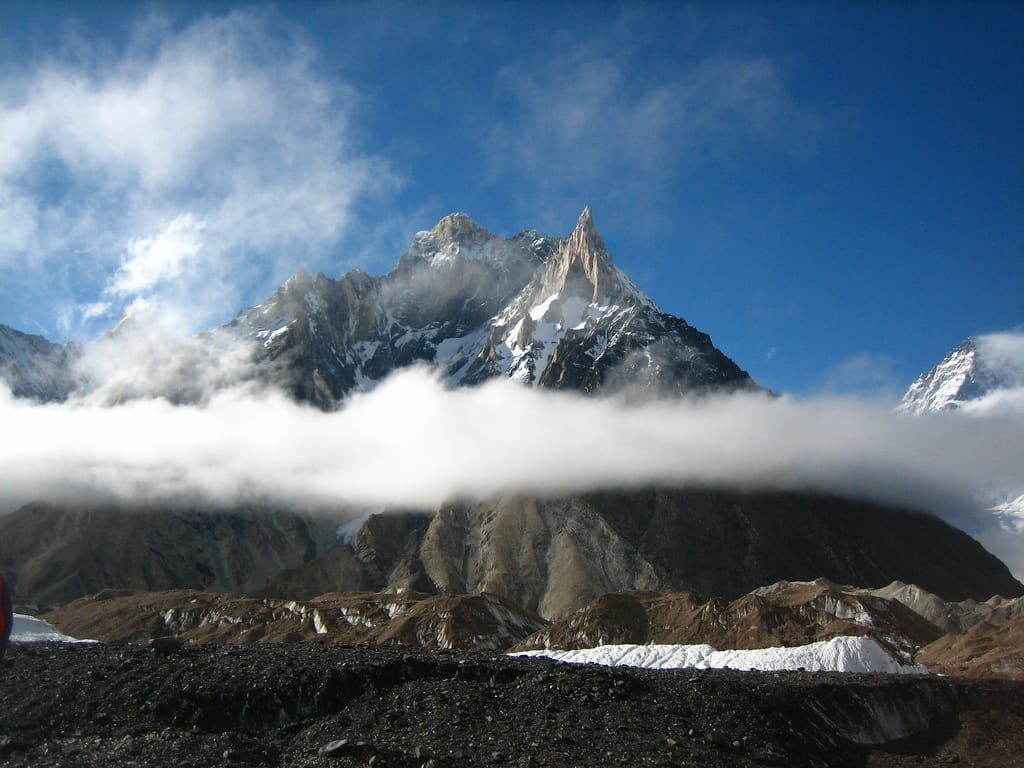
A first 6,000 m peak is not a technical climb. It is a fitness test with a summit at the end. The mountain does not ask for rock skills or steep ice, but it does ask you to climb for ten hours at altitude and then do it again the next day. This is the 16-week plan our guides would give a client who asked how to get ready.
It is advice from a mountain team, not medical advice. If you have a heart, lung or other health condition, or you are unsure about starting hard exercise, see your doctor before you begin and before you book a high-altitude trip.
What does a first 6,000 m peak actually demand?
The demands come straight from our 2027 packages, so train for the one you are booking.
- Khosar Gang (6,401 m). Base camp is at about 4,300 m. Summit day starts in the dark, with the alarm at 1am, and climbs roughly 1,100 m on snow from a high camp at about 5,300 m. The route is snow and straightforward glacier.
- Pastore Peak (6,209 m). Our package calls it a genuine first climbing expedition: two weeks above 3,400 m, a 5,150 m base camp trek, a ten-hour summit day and a fixed-rope pass crossing.
- Gondogoro Peak (5,785 m). Two weeks above 3,400 m, the K2 Base Camp day, a fixed-rope pass at 5,585 m and then the summit day.
The skills side is taught on the mountain. Crampon, ice-axe and rope work are rehearsed at base camp, and you do not need a climbing CV. What we ask for is "strong trekking fitness and the will to learn".
So the job is to build four things: a big aerobic base, strong legs under load, the ability to recover and go again, and the mental habit of long, slow days.
How is this different from trek training?
Our K2 Base Camp trek training guide prepares you for a 20-day walk with a light pack. A climb is different. Days are shorter but much steeper, the pace is slower, you carry more, the cold and the early start matter, and summit day is one very long effort. So this plan adds loaded stair and hill work and consecutive long days, and it starts earlier.
The 16-week plan
Read this as a progression, not a prescription. Adjust it to your life.
| Weeks | Block | Typical week |
|---|---|---|
| 1–4 | Base | Three steady aerobic sessions (hike, run, cycle or swim), one of them 2–3 hours. Two short strength sessions: squats, lunges, step-ups, core. |
| 5–8 | Build | The long day becomes a hill day of 3–4 hours. Add a stair or incline session. Start carrying a light pack. Keep strength work twice a week. |
| 9–12 | Load | Long hill day of 4–6 hours with 8–10 kg. Weighted step-ups and stair repeats once a week. One easier recovery day after every hard one. |
| 13–15 | Peak | Back-to-back long days at the weekend, 5–7 hours each, with the pack. One interval or tempo session. This is the hardest block. |
| 16 | Taper | Short, easy movement only. Sleep, eat, sort kit. |
What do the sessions actually look like?
The long hill day. This is the centrepiece. Find the longest climb near you and go slowly. Eat and drink on a schedule, not when you feel like it. The target is to finish able to walk another hour.
Loaded stairs or step-ups. Summit day on a snow slope is thousands of small steps uphill. Stairs with a pack train exactly that. Build duration before weight.
Back-to-back days. The ability to repeat is the point. On Khosar Gang you climb to high camp, sleep a short night and summit the next morning. On Pastore the summit day follows long approach days. Consecutive-day fatigue is the best rehearsal for both.
Strength. Legs, hips, back and core, twice a week. Nothing fancy: squats, lunges, step-ups, planks. Strong legs also protect the knees on the descent, which is where many people suffer.
Easy aerobic volume. Most of your training should feel comfortable. Slow volume builds the engine; hard sessions are the exception.
How do you know the plan is working?
You do not need a lab test. Three simple checks are enough. Can you climb your long hill day at a steady pace without stopping to recover? Can you wake the next morning and walk again without dreading it? And can you eat and drink well while moving? If yes to all three by week 12, you are on track for the peak block. If not, repeat the load block rather than rushing into the back-to-back days. Fitness that arrives late is still useful; fitness that arrives with an injury is not.
Do you need to train at altitude?
You do not need to. Fitness and acclimatisation are separate things, and the fittest person on a rushed schedule does worse than an average person on a sensible one. Your itinerary carries the acclimatisation: a skills day, a carry to the high camp and then a rest day before moving up. Our acclimatisation guide explains the principles, including climbing high and sleeping low.
What about gear and mental preparation?
Wear your boots in before you travel. Train in the layers and pack you will carry. And practise the mental side: rising at one in the morning, moving slowly in the cold, eating when you do not want to, and turning round when the guide says so. The turnaround call belongs to the guide on every trip we run.
Which peak should this plan lead to?
- Shortest and closest: Khosar Gang, 10 days from Islamabad, from $2,200.
- The K2 Base Camp trek with a summit: Pastore Peak, 25 days, $4,200.
- The gentlest summit above a famous circuit: Gondogoro Peak, 25 days, $2,750.
For the side-by-side comparison, read The Easiest 6,000 m Peaks in Pakistan and the Pastore Peak climbing guide. On all three, travel insurance with helicopter-evacuation cover valid to the summit height is mandatory, and a 10% deposit confirms your place — each package page states its own balance deadline.
Pick the peak you are training for. See the Khosar Gang Expedition for the shortest route to a 6,000 m summit, or the Pastore Peak Expedition for the full Baltoro.
Frequently asked questions
How long should I train for a 6,000 m peak?
Sixteen weeks is a comfortable runway for most people who already exercise regularly. If you are starting from very little, begin earlier and see a doctor first.
Do I need to run, or can I hike?
Either works. What matters is aerobic volume and, in the last two months, loaded hills and stairs. Hill walking with a pack is the closest rehearsal.
Do I need technical climbing skills?
No. Crampon and ice-axe work is taught at base camp on the packages above.
Is it safe for beginners?
Our first-peak packages are designed for strong, fit beginners, with a guide-owned turnaround call, a satellite phone in camp and helicopter-rescue contacts. Mandatory insurance covers evacuation.
What if I miss a week of training?
Do not double up. Pick the plan up where you are, and protect the long days and the back-to-back weekends in the peak block.
Written by Zulfiqar Ali, founder of Karakoram Venture.