
 EN
 العربية
 Deutsch
 Español
 Français
 Italiano
 Polski
 Русский
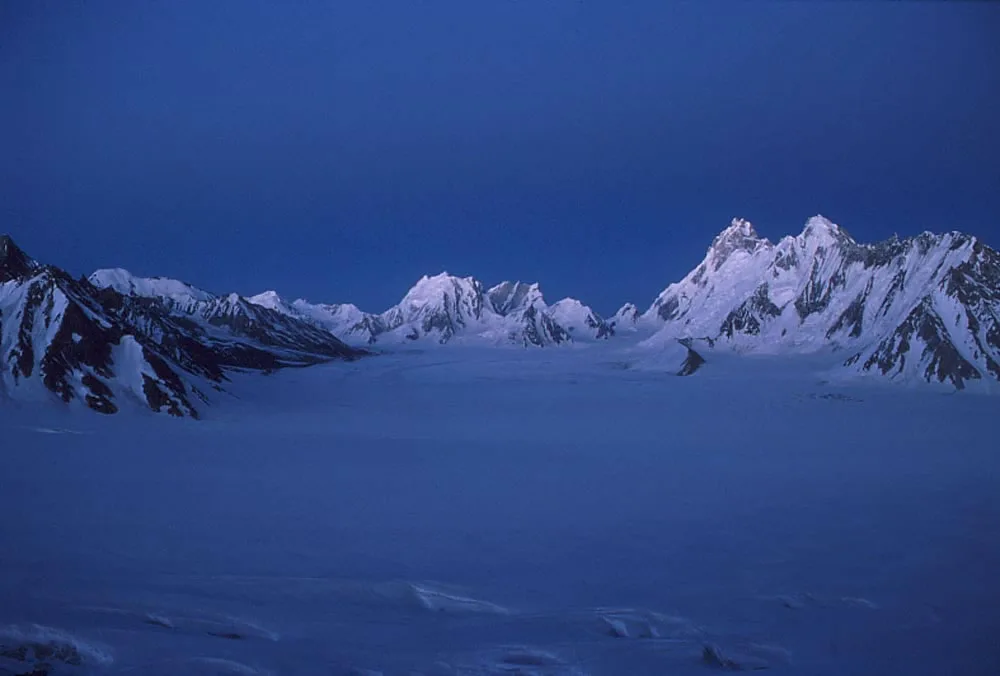
Everest Base Camp is a wonderful trek. It is also a busy one. If what you want from the mountains is quiet, empty trail and nobody else at camp, the Pakistani Karakoram has better answers. Here are seven treks we run from Skardu and Hunza, each one a long way from a teahouse.
Our own comparison describes the Everest trail as popular and busy, with teahouse lodges the whole way, and K2-side treks as few trekkers and true remoteness. We are not going to put numbers on how many people walk each trail. We have no counts to quote, and neither do the trekking agencies that do.
What makes a trek remote, not just quiet?
Three things. There are no lodges, so every night is a tent. There is no phone signal on the long stretches, so you are on your own team's satellite phone. And the route takes you far from a road, so a bad day cannot be solved by walking down. On the Shimshal trek, for example, our own FAQ says that if something goes wrong there is no phone signal, no clinic and no quick way down.
That is the price of solitude. It is also why insurance with helicopter evacuation is mandatory on every high-altitude trek we run, and why a proper acclimatisation plan matters. Read our acclimatisation guide before you choose.
The seven treks
1. Snow Lake and Hispar La: the long way across the glacier
This is a 22-day crossing of the Biafo and Hispar glaciers, two of the longest outside the polar regions, from Askole to Hunza via Snow Lake. The high point is the Hispar La at 5,151 m. It is graded strenuous, needs no climbing skills, and costs $2,800 per person in the largest group.
Pick it if you want the biggest commitment and the biggest reward.
2. Shimshal Pass and the Pamir: the most isolated valley
Fourteen days into what we call Pakistan's most isolated inhabited valley, up to the Shimshal Pass at 4,735 m and the summer grazing plateau locals call the Pamir. Only about three to four days are actual walking. The jeep road to Shimshal was built by the community in 2003; before that it was a three-day walk from the highway. From $1,850 per person.
Pick it for culture and wide-open pasture rather than glacier.
3. Ogre (Baintha Brakk) Base Camp: granite at the end of a glacier
Thirteen days up the Biafo Glacier to the foot of the Ogre, 7,285 m. The trek tops out at about 4,200 m, three walking days up the glacier from Askole, and you look up at more than three kilometres of granite from camp. It is graded demanding, and it is the shorter alternative to the full Snow Lake traverse. From $1,790 per person.
Pick it if you want the Biafo without a three-week commitment.
4. K6 and K7 Base Camp: the Charakusa Valley
Sixteen days into the Charakusa Valley, beneath K6 (7,282 m) and K7 (6,934 m). We describe it as the Karakoram's finest base camp trek away from the Baltoro crowds. The maximum altitude is about 4,500 m and the route is demanding. From $2,200 per person.
Pick it for steep granite walls close enough to touch.
5. Thalay La: a 4,700 m crossing to Shigar
Fourteen days from Hushe through the Charakusa and over the Thalay La at about 4,700 m into the Shigar Valley. It is a demanding high crossing for fit trekkers, and no prior trekking experience is required. From $2,000 per person.
Pick it if you want a real pass without the Baltoro.
6. Barah Brok: Blue Lake and a K2 viewpoint
Twelve days from Islamabad to Islamabad through Khaplu to Barah, then up to Blue Lake and Moses Peak. You sleep at about 4,300 m at Blue Lake. The optional summit of Moses Peak is about 5,300 m, and K2 stands on the skyline from the viewpoint just below it. The trails are steep but non-technical, with no glacier. It is graded moderate and costs $1,450 per person.
Pick it as the most accessible route on this list.
7. Laila Peak Base Camp: the Hushe Valley
Thirteen days with Laila Peak above Hushe, a maximum altitude of about 4,535 m, and a viewpoint toward the Gondogoro La. Graded moderate to demanding, from $1,690 per person.
Pick it for a mid-length trek with big mountain scale.
How do they compare at a glance?
| Trek | Days | High point | Grade | From (per person) |
|---|---|---|---|---|
| Snow Lake & Hispar La | 22 | 5,151 m | Strenuous | $2,800 |
| Shimshal Pass & Pamir | 14 | 4,735 m | Demanding | $1,850 |
| Ogre Base Camp | 13 | ~4,200 m | Demanding | $1,790 |
| K6 & K7 Base Camp | 16 | ~4,500 m | Demanding | $2,200 |
| Thalay La | 14 | ~4,700 m | Demanding | $2,000 |
| Barah Brok | 12 | ~5,300 m (optional summit) | Moderate | $1,450 |
| Laila Peak Base Camp | 13 | ~4,535 m | Moderate–demanding | $1,690 |
Which one should you choose?
- First big trek, limited time: Barah Brok.
- Culture and open pasture: Shimshal.
- Granite walls: K6 and K7, or the Ogre.
- A pass crossing: Thalay La.
- The biggest journey: Snow Lake and Hispar La.
If you want the classic Karakoram trek instead, our Best Treks in Pakistan guide ranks the full list, and the K2 vs Everest Base Camp comparison covers the headline choice.
What do you need before you book?
All seven require the Pakistan Trekking & Mountaineering visa, not a tourist visa. We send a Letter of Invitation after booking and arrange the permits. Insurance must include helicopter evacuation to the trek's maximum altitude. A 10% deposit (minimum $50) confirms your place, with the balance due two weeks before arrival or in Islamabad.
All seven run in summer. For 2027 the departures start in June; Snow Lake, for example, has a group departure beginning 1 June. The monsoon ends by mid-August in this region, so July and August are the prime window for most of them.
Not sure which fits your fitness? Start with the Snow Lake and Hispar La trek if you want the biggest journey, or the Shimshal Pass and Pamir trek for the most isolated one.
Frequently asked questions
Are these treks suitable for beginners?
Barah Brok and Laila Peak are the most approachable, and Barah Brok is graded moderate. The others are demanding or strenuous, and all of them need proper fitness and acclimatisation.
Do I need climbing skills?
No. None of the seven needs technical skills on the standard route. Thalay La and the Hispar La are high crossings, not climbs.
Is it safe to trek this far from a road?
These treks are remote, which is the point. Our team carries a satellite phone and we keep helicopter-rescue contacts for the region, but evacuation costs fall to you and your insurer, so insurance is mandatory.
What is the best month?
For most of these, July and August are prime, with June and September workable depending on the snow.
Why not just do Everest Base Camp?
You can, and it is a fine trek. Choose these when you want camping, quiet and a trek that feels like an expedition.
Written by Zulfiqar Ali, founder of Karakoram Venture.