
 EN
 العربية
 Deutsch
 Español
 Français
 Italiano
 Polski
 Русский
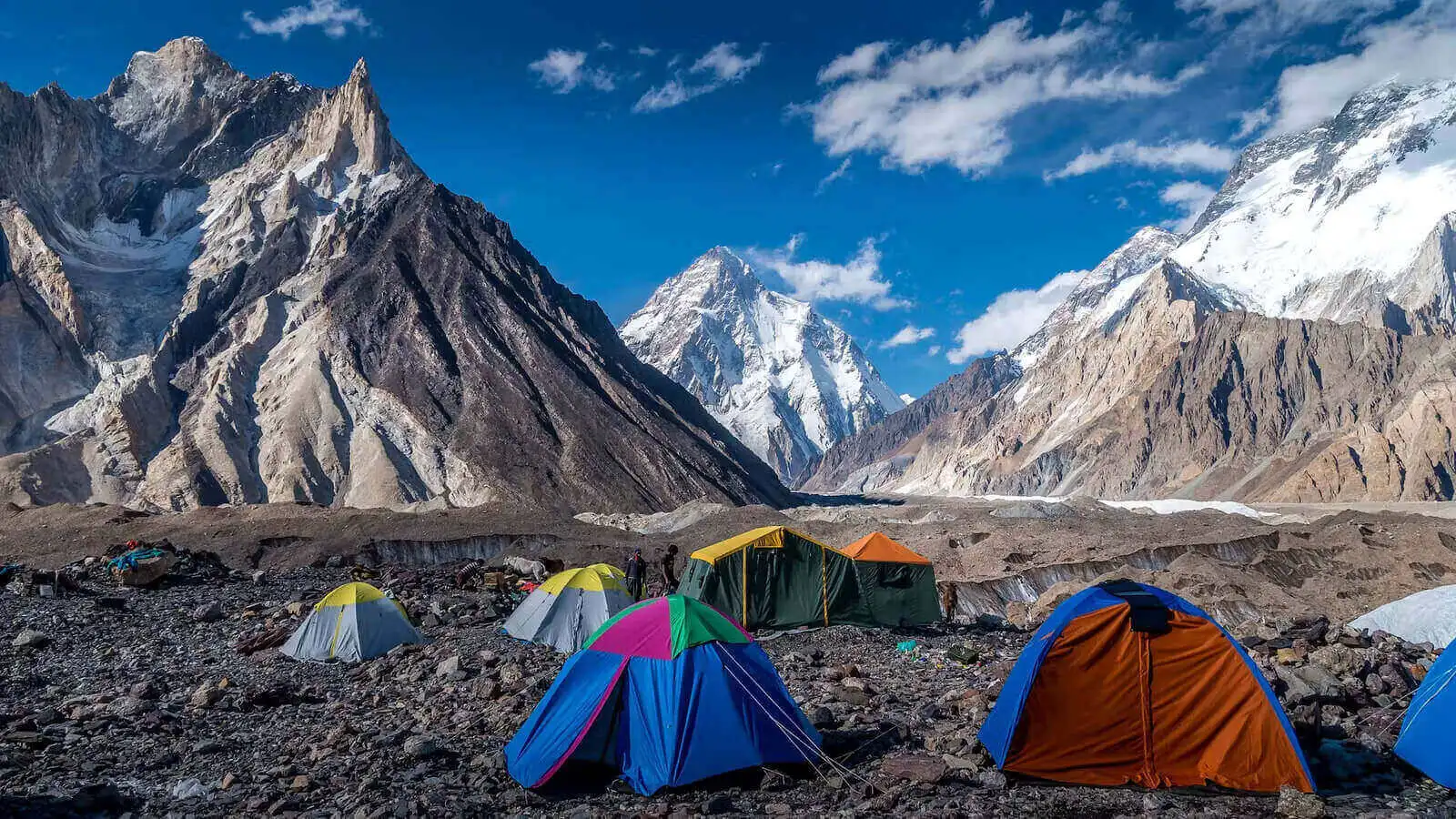
Short answer: for the standard K2 Base Camp route, no. Foreign trekkers on the Baltoro need a Trekking and Mountaineering visa, a trekking permit and a No Objection Certificate (NOC), and our published permits guide says a Pakistani tour operator files the permit on the trekker's behalf because individuals cannot file it themselves. On top of that, our Broad Peak Base Camp page says foreign trekkers in the Baltoro zone need "a trekking permit, a licensed guide and accident insurance for the whole party".
The rest of this post is the longer, more honest answer. What exactly does the rule say? Is a guide a legal requirement or a practical one? And if you set the rules aside, what would a guide actually be doing for you on a glacier with no road, no village and no phone signal? We are an operator with an obvious interest here, so we have kept to what our own pages say, and we mark what we could not confirm.
What does Pakistan require to trek to K2 Base Camp?
Three documents, plus insurance. Our permits guide describes them as the Trekking and Mountaineering visa, a trekking permit, and a No Objection Certificate. They apply because the route enters what our guide calls a restricted zone: "the whole Baltoro corridor to K2, Broad Peak and the Gasherbrums", and also the Gondogoro La and the Snow Lake route. If your trip stays in an open zone, such as the Hunza Valley, Skardu, Fairy Meadows or Deosai, the ordinary tourist e-visa is enough.
Each document does a different job.
The visa. The Trekking and Mountaineering category sits on the same online portal as the tourist e-visa, visa.nadra.gov.pk. You choose it instead of the tourist category when your itinerary enters a restricted zone, and you attach a Letter of Invitation that names your route and dates. Our K2 tour pages say the same thing: this visa is "different from a standard tourist visa". Notice what this already implies. The visa application itself asks for an invitation tied to a named route. That is a first hint that the system assumes an organised trip, not a walk-up one.
The permit. Our guide says the tourism authorities issue it "for a named route, a named group and fixed dates", and that police and army posts along the route check it. It also says an operator applies on the trekker's behalf "because individuals cannot file it themselves". The K2 Classic page puts it simply: Baltoro trekking permits are fully included in the package.
The NOC. The permits guide calls it "the security clearance behind the permit for restricted areas", obtained by the operator and needing your passport details well in advance. Of the three documents it takes the longest. The K2 tour FAQ adds that the trek needs "trekking permits and an NOC for the Central Karakoram National Park". That park is a real, large protected area: Wikipedia describes it as the highest national park in the world and the largest protected area in Pakistan, covering about 10,557 km² and including the Baltoro, Panmah, Biafo and Hispar glaciers.
Is a guide actually required, or just recommended?
This is the question the search term really asks, and it is the one where we have to be most careful.
What we can say from our own pages:
- The Broad Peak Base Camp terms say foreign trekkers in the Baltoro need "a trekking permit, a licensed guide and accident insurance for the whole party, and an NOC may be required".
- The permits post says a licensed Pakistani operator files the permit, and its FAQ concludes that this "is one reason independent trekking on the Baltoro is not practical".
- The same wording on the Broad Peak page adds a hedge: "rules change, so we confirm what is current with you before you book".
What we cannot say is which regulation creates the licensed-guide requirement, whether it is written as a rule for the zone or a condition attached to each permit, or what penalty applies. We do not have the text of the rule, and we will not paraphrase one we have not read.
Here is the practical consequence, and it does not depend on the legal detail. A foreign visitor cannot, on our pages' account, obtain the permit without an operator, and the permit is what the checkpoints inspect. A trek with no permit is therefore not a bold independent alternative. It is a trek that does not get past the first post.
What about trekking without a guide elsewhere in Pakistan?
The picture changes in open zones. Our Rakaposhi Base Camp and Nanga Parbat and Rakaposhi pages both say these sit in open trekking zones, so the trip generally needs no special NOC, only a valid tourist visa. Our Fairy Meadows page says the same about Fairy Meadows, with a small community and forest fee included. Wikipedia notes that the road to Fairy Meadows from Raikot Bridge is open only to local drivers who carry visitors, and that the final stretch is a three-to-four-hour walk.
So the honest map is this. Open-zone walks are a different regulatory category, and we do not claim a guide is legally required there. Our point in this post is narrower: the Baltoro to K2 is not one of those walks.
What would going without a guide actually involve?
Set the paperwork aside for a moment and look at the route itself. This is the K2 Base Camp Trek Classic as published, with the altitude we list for each night.
| Day | Where | Altitude (our itinerary) |
|---|---|---|
| 2 | Fly to Skardu | 2,500 m |
| 4 | Jeep to Askole, the trailhead | 3,000 m |
| 5 | Jhola | 3,050 m |
| 6-7 | Paiju, with a rest day | 3,420 m |
| 8 | Khoburtse, on the glacier | 3,795 m |
| 9 | Urdukas | 3,930 m |
| 10 | Goro II | 4,295 m |
| 11 | Concordia | 4,691 m |
| 12 | K2 Base Camp | 5,150 m |
| 13-14 | Rest days at Concordia | 4,691 m |
| 15-19 | The same route back to Askole | 4,295 m down to 3,000 m |
Askole is the last village: Wikipedia calls it the last settlement in the Shigar Valley, and our Askole guide covers the trailhead. From there to Concordia the route is a glacier, and it is not a still one. Wikipedia reports that scientific observations between 2001 and 2011 recorded visible changes on the Baltoro, with research indicating the glacier "is not retreating but experiencing surges, shifting and flowing into neighbouring glaciers". Its name in Balti is usually translated "bone breaker".
The Classic is graded demanding, non-technical. The page says no ropework or mountaineering skills are needed, and what it asks for is endurance: long days on glacier moraine, altitude up to 5,150 m, cold camps and remote ground with no roads. "Non-technical" is a statement about climbing skill. It is not a statement about navigation, logistics or rescue.
What does a guide actually provide on a glaciated route?
Here we stay strictly inside what our K2 tour pages commit to. We are not describing a generic ideal guide. We are listing what the package says is there.
1. A whole camp, not just a person. The Classic includes "licensed Balti guide, porters, cook, and all permits", plus return domestic flights, all transport, accommodation and all trek meals. On a route where the first night after the trailhead is already above the last village, food and shelter are not a detail. There is nowhere to buy either.
2. Daily health monitoring. The Light page says the guide "monitors every trekker's acclimatisation daily using the Lake Louise Scoring System". The Lake Louise score is a widely used symptom questionnaire for acute mountain sickness. The value of having someone else apply it is simple: you are not marking your own homework at 4,500 m. The Classic builds in rest days at Paiju and Concordia, and the Broad Peak page describes the Paiju rest day as an altitude briefing with a rest day built in. Our acclimatisation guide goes deeper on the physiology.
3. A satellite phone and a rescue chain. The K2 pages state that every Karakoram Venture expedition carries a satellite phone for camp communication, and that helicopter rescue can be arranged through regional contacts. The Classic FAQ is blunt about who pays: the cost of a heli evacuation "is borne by the client and settled through their insurance, not bundled into the trek price". Without a phone, the Baltoro offers no way to call anyone, and the nearest road is days away.
4. Permits that match the route. A permit is issued for a named route, group and dates, and checkpoints inspect it. Someone on the trek has to hold the paperwork and know what the checkpoints expect.
5. Local knowledge of the ground. Our team is described as 100% local Balti guides and porters from the valleys beneath K2, "our own staff". We would be wary of any claim that goes beyond that, such as how many seasons a particular guide has worked. We have not been given figures for that and we do not invent them. In plain terms: on a glacier that shifts from year to year, the person who has crossed it before is walking a line, and you are following it.
6. Turn-around judgement. The Broad Peak page says "we turn parties around when conditions say so". Deciding to stop is the hardest decision in the mountains when you are tired, close to a goal and a long way from home.
One more distinction matters. Expeditions to the 8,000 m peaks carry a government liaison officer who travels with the team, and the permits guide describes that for expeditions. The base camp treks on this page are not expeditions, and we have not found a liaison officer requirement attached to them in our published terms.
What does it cost, and is "solo" the same as going alone?
Here is the point that surprises people. Our "Solo (1 Person)" price is not an unguided option. It is a fully private trek with a dedicated guide. The Classic describes it as "fully private K2 Classic trek with a dedicated personal guide". So if what appeals to you about going without a guide is solitude and your own pace, a private departure answers a large part of that.
| Group size | K2 Base Camp Trek Classic (21 days) | K2 Base Camp Trek Light (15 days) |
|---|---|---|
| Solo (1 person) | $5,060 | $3,960 |
| 2-3 persons | $3,680 per person | $2,880 per person |
| 4-6 persons | $2,875 per person | $2,250 per person |
| 7-10 persons | $2,300 per person | $1,800 per person |
The price includes the services listed above and the Baltoro trekking permits. It does not include international flights, Pakistan visa fees, personal travel insurance, personal gear and tips. The deposit is 10% of the trip price, with a minimum of $50, and the balance is due two weeks before arrival or can be paid on arrival in Islamabad.
The Light version is the same Baltoro route in 15 days instead of 21. The page says none of the route is cut, "only the spare rest days are", and that prior trekking experience above 3,500 m is essential. It is faster, so it suits experienced trekkers. Our comparison of the Gondogoro La loop and the classic return covers the other K2 option.
What about insurance?
It is part of the rules, not an optional extra. Our permits post says every restricted-zone trek requires valid insurance for high-altitude trekking and helicopter evacuation, and warns that ordinary policies stop covering you somewhere between 4,500 and 5,500 metres, with Concordia alone above that line. Our travel-insurance guide explains the helicopter clause that matters on the Baltoro.
For our K2 Base Camp treks the requirement is helicopter-evacuation cover valid to at least 6,000 m.
How long do the permits take?
Longer than most people expect. Our permits guide recommends booking ten to twelve weeks before departure, with the Letter of Invitation arriving within two business days of your deposit, the visa typically clearing in seven to ten working days, and the NOC being the slowest piece. It also asks for a passport scan with six months' validity beyond your return date at booking.
For 2027, the K2 Classic departs from 1 June, and the season runs June to September. July and August give the most settled weather, while early June and September are quieter but colder.
So what is the honest conclusion?
If you read "without a guide" as "without an operator", our published terms say the Baltoro permit goes through an operator, and the permit is what you need to pass the checkpoints. We have not found a route to K2 Base Camp that avoids this, and we cannot honestly point you to one.
If you read it as "without being herded", you have more options than you think. A private departure, a custom date, a slower pace, or the Light route for a fast, experienced party are all available. The Classic's own page says every itinerary can run privately and be tailored to dates, pace and group size.
And if you want to test your own judgement before committing to a month on the Baltoro, the right move is an open-zone walk first, such as Rakaposhi Base Camp or Fairy Meadows, where you can learn how your body behaves at 3,000 to 4,000 m.
To start planning, read our permits, visa and NOC guide, then our K2 Base Camp Trek guide and the K2 Base Camp Trek Classic or Light pages. Pack with our packing list and buy cover using the insurance guide.
Frequently asked questions
Can I trek to K2 Base Camp on my own?
Not on the standard route, according to our published pages. The Baltoro is a restricted zone needing a Trekking and Mountaineering visa, a permit and an NOC, and the permit is filed by an operator on the trekker's behalf.
Is a licensed guide mandatory for the Baltoro?
Our Broad Peak Base Camp terms say foreign trekkers in the Baltoro need a trekking permit, a licensed guide and accident insurance for the whole party. We have not seen the underlying regulation, so we recommend confirming with the tourism authorities.
Can I get the trekking permit myself?
No, according to our permits guide: it is issued for a named route, group and dates, and an operator applies for it.
Do I need a different visa for K2 Base Camp?
Yes. Apply in the Trekking and Mountaineering category rather than the tourist category. Fees depend on nationality and are paid on the government portal, not to us.
Is a solo booking the same as going without a guide?
No. Our solo tier is a private trek with a dedicated personal guide, priced at $5,060 for the Classic and $3,960 for the Light.
Do I need climbing skills for K2 Base Camp?
No. The route is demanding but non-technical, with no ropework required on the Classic. It needs endurance, altitude tolerance and prior multi-day trekking.
Written by Zulfiqar Ali, founder of Karakoram Venture. Rules and prices as published on our pages in November 2026; check the current position with us before you book.