
 EN
 العربية
 Deutsch
 Español
 Français
 Italiano
 Polski
 Русский
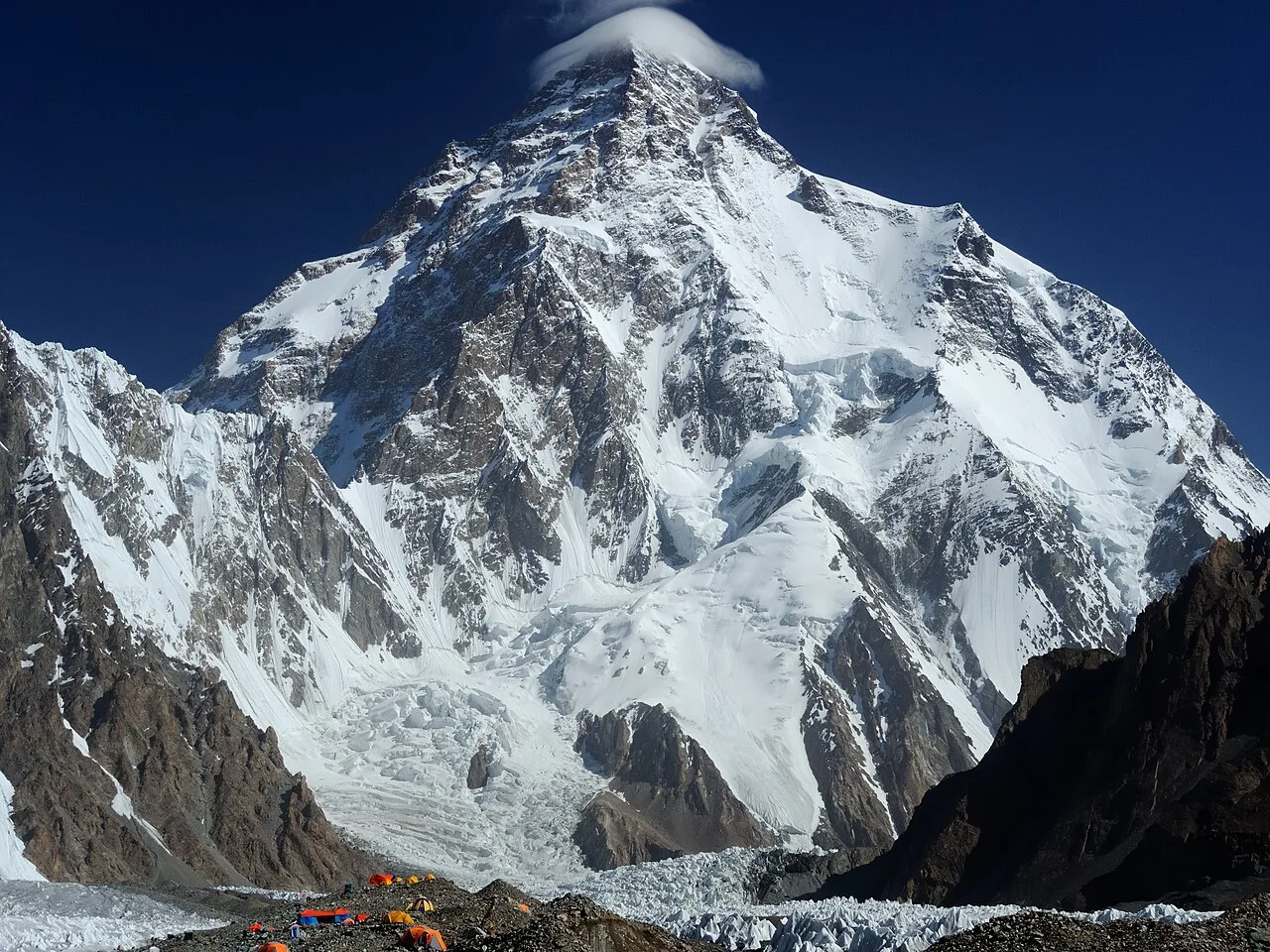
On 31 July 1954, at about six in the evening, Achille Compagnoni and Lino Lacedelli reached the summit of K2 (8,611 m). It was the first time anyone had stood on the second-highest mountain in the world.
Nobody doubted that they got there. What people argued about for more than fifty years was what happened the night before, and who paid for it. The story is also, for us, a local one. It was carried by Balti and Hunza porters, and one of them lost his fingers and toes for it.
Who was on the 1954 expedition?
The expedition was led by Ardito Desio, a geologist from Milan, and sponsored by the Italian Alpine Club. It was a large, military-style undertaking, with eleven Italian climbers, none of whom had been to the Himalaya or Karakoram before.
The mountain had a long history before that. The Duke of the Abruzzi scouted the south-east spur in 1909 and reached about 6,250 m before retreating. That spur still carries his name, the Abruzzi Spur.
The team was also much bigger than eleven. Around 500 Balti porters carried more than 12 tonnes of gear up the Baltoro Glacier, and ten Hunza high-altitude porters worked the upper mountain. That is the line of the story that usually gets left out.
What happened on summit eve?
By late July the team had camps up to about 7,600 m. Compagnoni and Lacedelli were chosen to try for the top. The plan was for a second pair to carry the oxygen cylinders up to their high camp.
That second pair was Walter Bonatti, then 24, and the Hunza porter Amir Mahdi. They carried the oxygen up toward the agreed camp, but when they got to the place where it should have been, it was not there. The summit pair had pitched their tent higher than planned.
Bonatti and Mahdi were at about 8,100 m, in the dark, without a tent or sleeping bags. They called out, and heard a reply from above, but could not find the camp. They left the oxygen cylinders and spent the night in the open. Both survived. Mahdi lost most of his fingers and toes to frostbite.
In the morning Compagnoni and Lacedelli recovered the cylinders and climbed on. Without Bonatti and Mahdi, the summit would have been very unlikely. With them, the summit pair had the oxygen they needed.
Why was there a controversy?
The official account written by the expedition said little of this, and what it said left Bonatti's role in doubt. For decades Bonatti said that the camp had been moved on purpose, so that he and Mahdi could not reach it or the summit. The Italian Alpine Club's first account of the expedition did not agree with him.
That official account was eventually discredited. A second official account, published in 2007, largely confirmed what Bonatti had been saying for over fifty years.
We are not going to try to settle the arguments about motive here. What is documented is the sequence: the camp was higher than agreed, two men were left in the open above 8,000 m, and one of them was a Hunza porter whose name was missing from the story for a long time.
Why does this story matter to people in Baltistan?
Because it is a local story. The route those Italians climbed passes through the Braldu Valley and the last village of Askole. The porters were Balti and Hunza. The Hunza high-altitude porters worked the upper mountain, and Mahdi was among them.
Almost every K2 expedition still works that way. Teams of Balti porters and high-altitude staff carry, fix and cook; the climbers' names are the ones that appear in the books. As the K2 expedition guide on our site puts it, the names on the certificate were European, but the climb was built on Balti and Hunza hands.
What did the 1954 team climb?
They climbed the route that would become the standard one, the Abruzzi Spur. Above Camp 4 the route traverses to the Bottleneck, the narrow couloir under a wall of seracs that is the most dangerous part of the mountain. In 1954 the summit pair found a line through it that was blocked by snow, close to a route used by an earlier American party. We explain the Bottleneck in detail in The K2 Bottleneck.
The first ascent was also the last one for twenty-three years. After 1954, nobody stood on top again until 1977. The mountain stayed rarely climbed for a very long time.
What came before 1954, and what came after?
The Italians were not the first to get high. In 1939 Fritz Wiessner came within 250 metres of the summit without oxygen. Then the expedition collapsed: Dudley Wolfe died high on the mountain, and so did three Sherpas, Pasang Kikuli, Pasang Kitar and Phinsoo, who went back up for him. In 1953 the Americans lowered the sick Art Gilkey through a storm, and Pete Schoening held six roped men with a single ice axe in what mountaineers still call The Belay. An avalanche then swept Gilkey away, and his teammates built the memorial cairn that now carries the plates of everyone the mountain has taken since.
So by the time Desio's team arrived in 1954, K2 had already taken lives and refused two serious American attempts. That context is why the 1954 climb was celebrated as a national triumph in Italy, and why the argument over how it was won hurt so much.
Today the mountain is climbed differently. Summit pushes cluster inside verified multi-day weather windows delivered by satellite, and most commercial clients climb with bottled oxygen and strong guide support. None of this makes K2 safe: the Bottleneck still votes every year.
How does the 1954 story compare with K2 today?
The terrain above Camp 4 is the same as it was in 1954. What has changed is the logistics. The fixed lines, the forecasts and the number of people on the mountain are all different.
By August 2023 about 800 people had summited and 96 had died. For the full statistics, see How many people have climbed K2 and for the history and cost of a modern attempt, our K2 expedition guide. The wider Pakistani context is in Pakistan's five 8,000 m peaks.
Can you walk the 1954 approach yourself?
You cannot climb K2 without an expedition, but the approach is open to trekkers. In 2027 our K2 Base Camp Trek Classic follows the same Baltoro Glacier path used by the great mountaineers of the past century: Askole, Jhola, Paiju, Urdukas, Goro II, Concordia, and K2 Base Camp at 5,150 m. It runs 21 days and costs from $2,300 per person on group departures.
A 10% deposit (minimum $50) holds your place. The balance is due two weeks before arrival, or in Islamabad. Insurance with helicopter evacuation is mandatory.
See the K2 Base Camp Trek Classic for dates and the day-by-day itinerary.
Frequently asked questions
Who made the first ascent of K2?
Achille Compagnoni and Lino Lacedelli, on the Italian expedition led by Ardito Desio, on 31 July 1954.
Who was Amir Mahdi?
A Hunza high-altitude porter on the 1954 expedition. He carried oxygen with Walter Bonatti to about 8,100 m, spent the night in the open, and lost most of his fingers and toes to frostbite.
What was the K2 1954 controversy?
A dispute over where the summit pair's high camp was placed and what that meant for Bonatti and Mahdi, who were left without shelter above 8,000 m. The expedition's first official account was later discredited, and a second, published in 2007, largely confirmed Bonatti's version.
Which route did they climb?
The Abruzzi Spur, which is still the standard route on the Pakistani side.
Can I visit the place where it started?
You can walk to K2 Base Camp on the Baltoro Glacier with a guided trek. You do not need climbing skills for that.
Written by Zulfiqar Ali, founder of Karakoram Venture.