
 EN
 العربية
 Deutsch
 Español
 Français
 Italiano
 Polski
 Русский
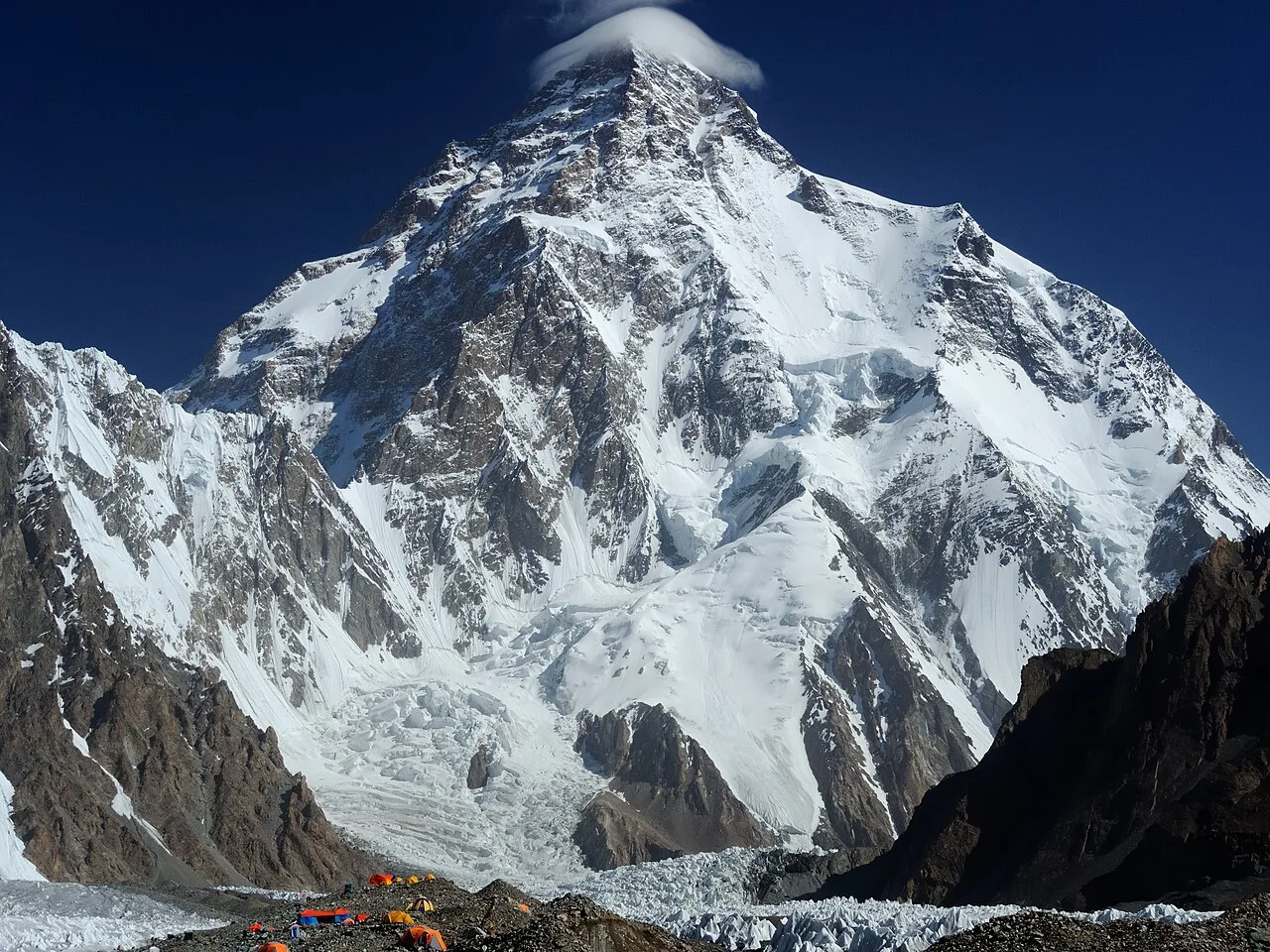
The Bottleneck is a narrow, steep couloir high on K2's standard route, between the top camp on the Shoulder and the summit. Climbers pass directly under a wall of seracs, an ice cliff that can collapse without warning. It is the last major obstacle on the Abruzzi Spur and the single most dangerous place on the mountain. Here is what climbers face there, explained by the Skardu team that runs K2 Base Camp every summer.
Key Takeaways
- Where: above Camp 4 on the Shoulder (about 7,800–7,900 m), inside the death zone above 8,000 m.
- What: a steep couloir overhung by seracs from the ice field east of the summit.
- Why it kills: falling ice, crowding on fixed ropes, and the time climbers spend exposed underneath it.
- 2008: 11 climbers died on 1–2 August after serac falls in the Bottleneck cut the fixed lines.
- No way around: the Abruzzi Spur and the Česen route both funnel into it.
What is the Bottleneck on K2?
The Bottleneck is a narrow couloir, a steep gully of snow and ice, near the top of K2's Abruzzi Spur. Above it hangs a wall of seracs, towers of glacier ice that form a cliff east of the summit. Climbers must climb up the couloir and then traverse left underneath that ice.
It sits above Camp 4, which teams pitch on the broad snow slope called the Shoulder at around 7,800 to 7,900 m. By the time climbers reach it, they are above 8,000 m. There is about a third of the oxygen there is at sea level. Most summit days start in the dark, so climbers reach the Bottleneck tired, cold and slow.
Why is the Bottleneck so dangerous?
Three dangers stack up in one place. Ice can fall from the serac wall at any time. The couloir is steep and narrow, so climbers queue on a single fixed line. And it is so high that every minute of waiting costs strength and body heat.
Seracs do not collapse on a schedule. A collapse can come in cold weather or warm, by night or by day. Nobody can climb through faster than the altitude allows. The only real defence is to spend as little time under the ice as possible. That means good acclimatisation, an early start, ropes fixed before the main group arrives, and a strict turnaround time.
What happened in the Bottleneck in 2008?
On 1 and 2 August 2008, 11 climbers from several expeditions died on K2. Many teams went for the summit on the same day. Ropes ran short above the Bottleneck, and the delays put climbers on the summit very late. On the descent, serac falls in the Bottleneck swept away the fixed lines.
Climbers who had summited were left above the couloir, in darkness, without ropes, in the death zone. Among those who died was Meherban Karim from Pakistan. The disaster led many teams to plan rope fixing more carefully and to set and keep turnaround times. The full record is in our K2 death rate guide.
The obstacles on the way to the Bottleneck
The Abruzzi Spur, used by about 75% of K2 climbers, has several named features. Camp heights vary from team to team. This table follows the route from the bottom up.
| Feature | What it is | Why it matters |
|---|---|---|
| Advanced Base Camp | Foot of the spur, about 5,400 m | Where the climbing proper begins |
| House's Chimney | A steep rock cleft on the lower spur | Technical rock climbing on fixed ropes |
| The Black Pyramid | A long band of dark rock and ice | Sustained, difficult mixed climbing; hard to retreat from in a storm |
| The Shoulder | A broad snow slope, home to Camp 4 at about 7,800–7,900 m | Exposed to wind; the launch point for the summit |
| The Bottleneck | A narrow couloir under the serac wall, above 8,000 m | Falling ice, queues, extreme altitude |
| The traverse | A leftward traverse under the seracs | Still exposed to the same ice |
| Summit | 8,611 m | Then the whole way back down |
The Česen route (also called the Basque route) on the south-southeast spur avoids the Black Pyramid and is considered safer below. It joins the Abruzzi Spur on the Shoulder, below the Bottleneck, so climbers on both routes face the same final couloir. Our K2 expedition guide covers the route camp by camp.
Why is K2 harder than Everest?
K2 is about 240 m lower than Everest but much harder to climb. Every route on K2 is steep and exposed, so there is no easy side. It lies further north, where storms lasting several days are common. And because of the steepness, retreating in bad weather is slow and dangerous.
Before 2021, about one climber died on K2 for every four who reached the top. By August 2023 about 800 people had summited and 96 had died. Everest has far more summits and a far lower ratio. Our K2 vs Everest base camp comparison covers the trekking side of the same question.
What climbing grade is K2?
K2 has no single official grade. It is graded by route, and every route is serious. The Abruzzi Spur combines technical rock in House's Chimney, mixed rock and ice on the Black Pyramid, and steep snow and ice in the Bottleneck, all at extreme altitude.
A more useful question is what experience you need. For our K2 expedition we ask for prior 8,000-metre experience and solid skill on steep mixed ground. A typical path runs through a 7,000 m peak such as Spantik and an 8,000 m peak such as Broad Peak.
How do teams reduce the risk in the Bottleneck?
Teams cannot remove the risk. They can reduce the time spent under the seracs. That comes down to planning and discipline, not equipment alone.
- Fix the ropes first. A rope team fixes the Bottleneck and the traverse before the main group arrives, so nobody waits halfway up.
- Start early and keep a turnaround time. A climber who has not reached a set point by a set hour turns back.
- Coordinate teams. Teams at base camp try to agree who climbs on which day, to avoid queues in the couloir.
- Watch the forecast. A window of low wind and settled weather matters more than a date on the calendar.
- Acclimatise well. Strong, acclimatised climbers move through faster.
Climbing K2 in 2027?
Our K2 Expedition (8,611 m) runs 55 days from Islamabad, with a Balti team, four high camps, fixed rope and daily forecasting. Not ready for the summit? The K2 Base Camp Trek Classic takes you to the foot of the Abruzzi Spur in 21 days.
Frequently asked questions
What is the Bottleneck on K2?
The Bottleneck is a narrow, steep couloir near the top of K2's standard route, above Camp 4 on the Shoulder. Climbers pass under a wall of seracs that can collapse without warning. It is the last major obstacle before the summit.
How high is the Bottleneck on K2?
It sits above Camp 4, which teams pitch at about 7,800 to 7,900 m, and climbers cross it above 8,000 m, inside the death zone. The summit is at 8,611 m.
Can you avoid the Bottleneck on K2?
Not on the routes most climbers use. The Abruzzi Spur and the Česen route both lead into the Bottleneck. The rarely climbed routes on other faces avoid it but are harder and more remote.
How many people died in the Bottleneck in 2008?
Eleven climbers died on K2 on 1 and 2 August 2008. Serac falls in the Bottleneck cut the fixed ropes and left climbers stranded above it in darkness.
Why is K2 so dangerous?
Every route is steep and exposed, the weather brings storms lasting several days, retreat is slow, and the Bottleneck puts climbers under a serac wall above 8,000 m. Before 2021, about one climber died for every four who summited.
Is K2 harder than Everest?
Yes. K2 is about 240 m lower but steeper, more technical and more exposed to bad weather, and it has a much higher death-to-summit ratio.
Written by Zulfiqar Ali, founder of Karakoram Venture, who has led the K2 Base Camp and Gondogoro La treks at least 26 times. Route facts checked against the public record in November 2026.