
 EN
 العربية
 Deutsch
 Español
 Français
 Italiano
 Polski
 Русский
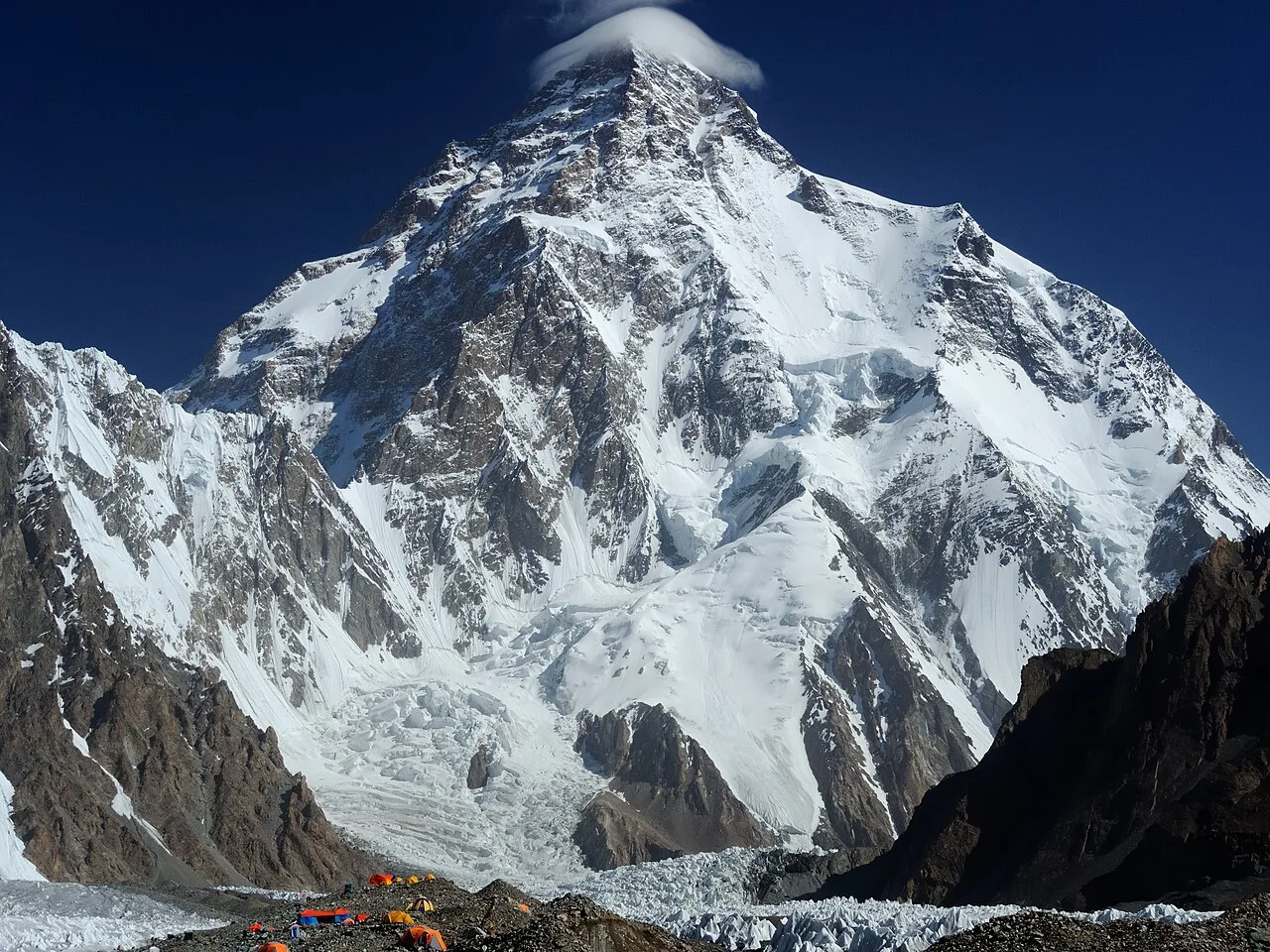
K2 is harder than Everest, more technical than Everest and, over its history, deadlier than Everest. Everest is higher and far busier. That is the short answer, and the rest of this page shows where each claim comes from, so you can judge it yourself.
This page compares the two summit climbs. If you want the two base camp treks, read our K2 vs Everest Base Camp guide instead.
We are a Skardu team and K2 is the mountain above our valley, so we are not neutral. We have tried to lean on sources outside our own site where we can.
Which mountain is higher?
Everest. It stands at 8,849 m and K2 at 8,611 m, so K2 is about 240 m lower.
Height is the least useful number in this comparison. The Wikipedia article on K2 puts it plainly: although Everest's summit is higher, K2 is the more difficult and dangerous climb.
Which is more technical?
K2, and it is not close.
The standard route on K2 is the Abruzzi Spur, used by about three-quarters of all climbers. It is steep and sustained from base camp upward. Our own expedition itinerary names the hard ground in order: House's Chimney, the first hard rock of the route, then the Black Pyramid, then the Shoulder, then the Bottleneck and a traverse under a hanging serac. There is no easy line. Every route on K2 is steep and exposed.
Everest's standard routes are different. Wikipedia's Everest article says the standard route does not pose substantial technical climbing challenges. Its dangers are altitude sickness, weather, wind, avalanches and the Khumbu Icefall. It is a very hard physical and mental test, but the climbing itself is more straightforward than on K2.
If you want the detail on the crux of K2, read The K2 Bottleneck.
Which is deadlier?
Historically, K2. We are not going to restate the figures here. Death-to-summit ratios depend on how and when you count, and they have changed sharply in the last few seasons. Our K2 death rate guide breaks the numbers down by period, with sources, and explains why the historic figure misleads about today's mountain.
What we can say plainly, without a number: - K2's historic ratio is much higher than Everest's. - The ratio has improved in the modern era with satellite forecasts, bottled oxygen and better support. - Improvement does not mean safe. Our own K2 expedition page says K2 turns whole teams back in most seasons and has killed strong climbers who were doing everything right.
Why does the weather matter more on K2?
K2 lies further north than Everest. Storms lasting several days are common, summit windows are shorter and rarer, and the steepness of the mountain makes retreat in bad weather slow.
That is why our K2 itinerary treats waiting as a core part of the plan. Day 18 is called "Weather Window" and the itinerary says: "Waiting. This is most of an 8000m expedition and it is the part nobody photographs." We go up when the forecast says so, not when the calendar does.
What does the climb itself look like on K2?
It is a ladder of rotations. After base camp at 5,150 m, the plan on our itinerary is a first carry to Camp 1 at about 6,050 m, a night at Camp 2 at about 6,700 m after House's Chimney, and a last acclimatisation night at Camp 3 at about 7,350 m over the Black Pyramid. Each time you return to base camp to recover. Then you wait for the window.
The summit push goes to Camp 4 on the Shoulder at about 7,900 m, where most climbers start on oxygen. Summit day is an alpine start into the Bottleneck and the traverse beneath the hanging serac, then the summit snowfields. Our itinerary calls this the most serious ground on the route and says the turnaround time is not negotiable.
How do crowds and rescue compare?
Everest is busy and K2 is not. Wikipedia notes that record numbers of climbers have led to crowding on Everest, and that delays high on the mountain may have contributed to deaths.
K2 has fewer climbers and thinner support. There is no village at K2 Base Camp, and no rescue helicopter overhead at 7,000 m as in Nepal. Effective rescue above Camp 2 mostly means other climbers. That is the safety net you are choosing when you pick K2.
Do both mountains need bottled oxygen?
Most climbers use it on both. On Everest, Wikipedia says most climbers use bottled oxygen. On K2, effectively every climber on our expeditions uses it from the Shoulder upward, and our full-board tier includes an oxygen allocation. If you want to climb without oxygen, tell us at booking. It changes the plan and the risk.
The two mountains side by side
| K2 | Everest | |
|---|---|---|
| Height | 8,611 m | 8,849 m |
| First ascent | 31 July 1954 | 1953 |
| Standard route | Abruzzi Spur, steep and sustained | Southeast Ridge, with the Khumbu Icefall below |
| Technical ground | House's Chimney, Black Pyramid, Bottleneck | Less technical, more crowded |
| Weather | Further north; bad weather more common | Milder, more settled summit windows |
| Crowds | Fewer climbers | Busy, with crowding high on the mountain |
| Rescue | Thin; no helicopter at 7,000 m | More infrastructure |
Which should you choose?
Pick based on what you are really asking:
- You want the highest mountain on Earth: Everest.
- You want the hardest of the 8,000 m peaks: K2, with prior experience.
- You are not sure and want an easier 8,000 m peak first: our own K2 page says that if you want an 8,000er and not specifically this one, Gasherbrum II or Broad Peak are the better start.
K2 is not a first expedition. We ask for your climbing CV before accepting a booking. Prior experience above 8,000 m is strongly preferred, and 7,000 m is the absolute floor. Our Spantik, Pastore and Gondogoro Peak expeditions are the usual ladder. For costs across all of Pakistan's 8,000 m peaks, see the cost of climbing K2 and Pakistan's 8,000ers and the mountaineering hub.
If K2 is the goal, our 55-day K2 Expedition departs on 10 June and 20 June 2027, with a minimum team of four. We do not sell a summit. We sell logistics, a safety system and honest judgement about when to go up and when to go down. Insurance with helicopter evacuation is mandatory for any high-altitude trip we run.
Frequently asked questions
Is K2 harder than Everest?
Yes. Every route on K2 is steep and exposed, the weather is wilder and rescue is thinner. K2 is about 240 m lower, but it is the harder climb.
Is K2 more dangerous than Everest?
Historically, yes. For the figures and the reasons the ratio has changed, see our K2 death rate guide.
Is Everest easier to climb than K2?
Easier technically, yes. It is still a serious mountain, with altitude, weather, avalanches and the Khumbu Icefall. It also has far more infrastructure and far more people.
Can a trekker visit either mountain?
Yes, as a walk to base camp, not a climb. K2 Base Camp is at about 5,150 m on the Baltoro Glacier, with no teahouses. See our trek comparison.
What experience do I need for K2?
Prior experience above 8,000 m is strongly preferred and 7,000 m is the absolute floor. You need to be fast and competent on fixed rope and solid in crampons on sustained steep ground.
Written by Zulfiqar Ali, founder of Karakoram Venture.