
 EN
 العربية
 Deutsch
 Español
 Français
 Italiano
 Polski
 Русский
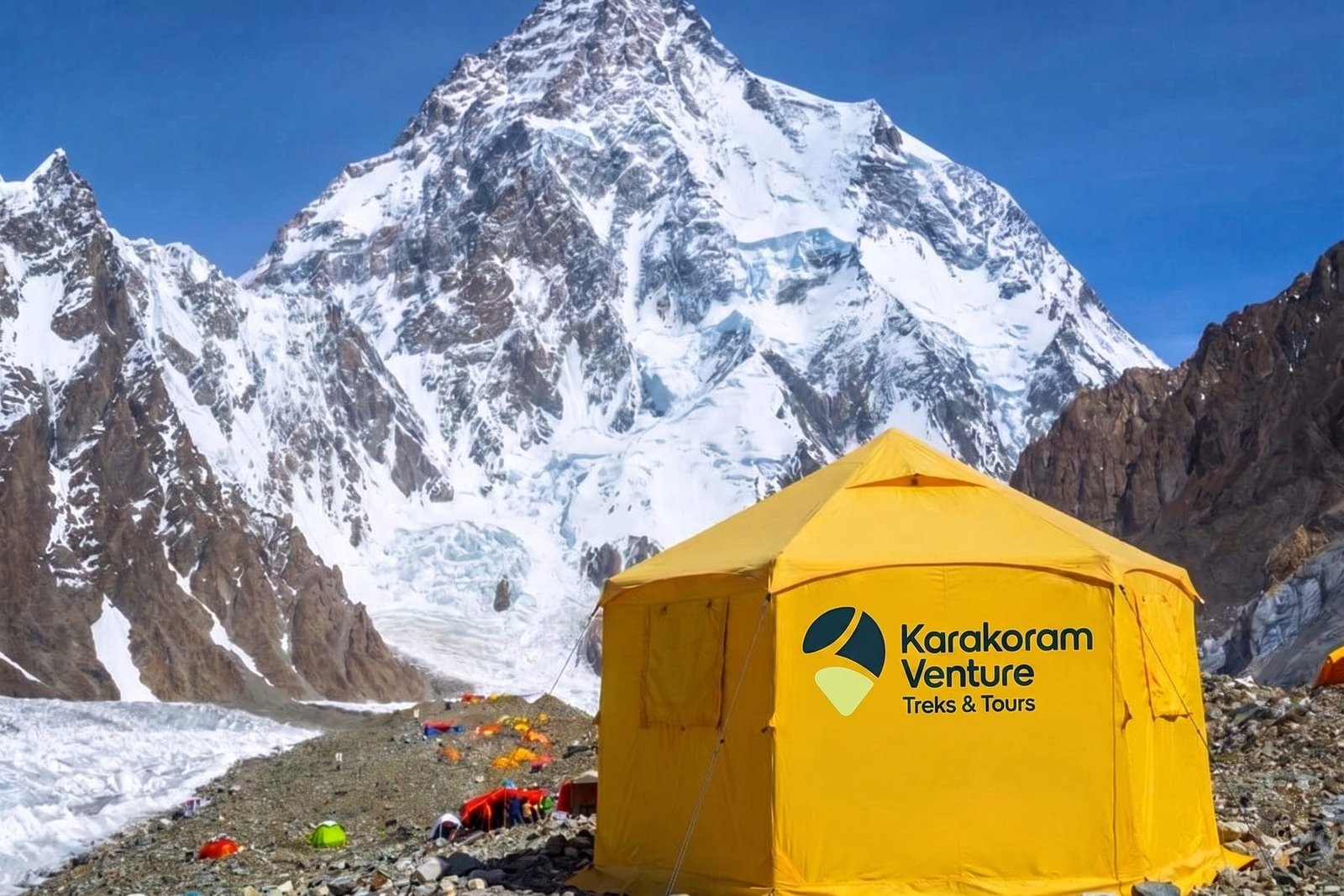
Beginner mountaineering in Pakistan is mostly fitness and patience, plus four skills you can learn in a day or two: walking in crampons, using an ice axe, moving on a fixed rope, and recognising altitude sickness. The first-peak expeditions we run say in their own terms that no climbing experience is required and that skills are taught at base camp. What they do require is strong hill fitness. This guide separates the two: what to work on at home, and what your guide will teach you on the mountain. It is written for someone who has trekked, never climbed, and wants to know what a first 6,000 m peak really asks.
What is mountaineering, and where do beginners fit in?
Wikipedia defines mountaineering as "a set of outdoor activities that involves ascending mountains", and notes that, unlike most sports, it lacks widely applied formal rules or governance. That looseness is useful for a beginner. It means the useful question is not "am I a mountaineer?" but "what will this particular mountain ask of me?"
For the three first-peak expeditions we run, the answer is written on the trip pages. Khosar Gang (6,401 m) is described as "snow slopes and straightforward glacier — no technical rock, no steep ice". Pastore Peak (6,209 m) is described as "a genuine first climbing expedition, not a trek with a photo stop". Gondogoro Peak (5,785 m) is "a steady snow summit". None of them is a rock climb. All of them are long days on snow at altitude, and that is the point of this article: the skills involved are few, and most of them can be learned with a guide beside you.
If you want to compare the three peaks before you read on, our post on the easiest 6,000 m peaks in Pakistan puts them side by side. This post covers the other question, what to learn.
Do you need climbing experience for a first 6,000 m peak in Pakistan?
Not on our three beginner peaks. Each page says the same thing in its own words. Khosar Gang: no previous climbing experience, skills taught at base camp, strong hill fitness required. Pastore Peak: "strong trekking fitness and the patience to acclimatise; crampon and ice-axe basics are taught and rehearsed at base camp". Gondogoro Peak: "strong trekking fitness and ideally prior multi-day trekking at altitude; crampon, ice-axe and fixed-rope technique is taught at Ali Camp and rehearsed on the crossing itself".
Pastore's FAQ adds an instruction worth following: "If you have never worn crampons, tell us at booking — we build the training in rather than pretend it is not needed." Gondogoro's FAQ says the same in nearly the same words. Telling us you are new is the first beginner skill.
Here is how the three pages line up on skills, in their own words.
| Khosar Gang (6,401 m) | Pastore Peak (6,209 m) | Gondogoro Peak (5,785 m) | |
|---|---|---|---|
| Experience asked for | None; strong hill fitness | Strong trekking fitness, patience | Strong trekking fitness, ideally prior multi-day treks at altitude |
| Where skills are taught | Base camp, day 4 | Base camp, climbing period (day 13) | Ali Camp, day 13, then the pass crossing |
| Skills named | Crampons, ice axe, rope work, glacier travel | Crampon, ice-axe and rope work | Crampon, ice-axe and fixed-rope technique |
| Summit day | Alarm at 1 am; about 1,100 m of ascent on snow | Around ten hours of steady snow | Alpine start; steady snow climbing |
What do crampons and an ice axe do, and how do you learn them?
A crampon, according to Wikipedia, is "a traction device attached to footwear to improve mobility on snow and ice", and besides ice climbing it is used for secure travel on snow and ice, "such as crossing glaciers, snowfields and icefields, ascending snow slopes". That second use is the one that matters on a first peak. You are not front-pointing up vertical ice; you are walking up snow in boots with spikes on, which feels odd for the first hour and ordinary by the end of the day.
An ice axe, Wikipedia says, is a multi-purpose tool that in its simplest role "is used like a walking stick, with the mountaineer holding the head in the center of their uphill hand". On a beginner snow peak that is most of its job: a third point of contact on a slope, and a tool to stop a slide.
Both are taught on the mountain in our itineraries. On Khosar Gang, day 4 is a skills day at base camp: "Crampons, ice axe, rope work and glacier travel taught and drilled on real ground. Nobody goes higher until the team moves well." On Pastore Peak, the first climbing day "Crampon, ice-axe and rope work is taught and rehearsed on the slopes above camp". On Gondogoro Peak, the afternoon at Ali Camp (4,800 m) is "spent on crampon, ice-axe and fixed-rope training with our guides and the Hushe rescue team — the rehearsal for both the pass and the peak".
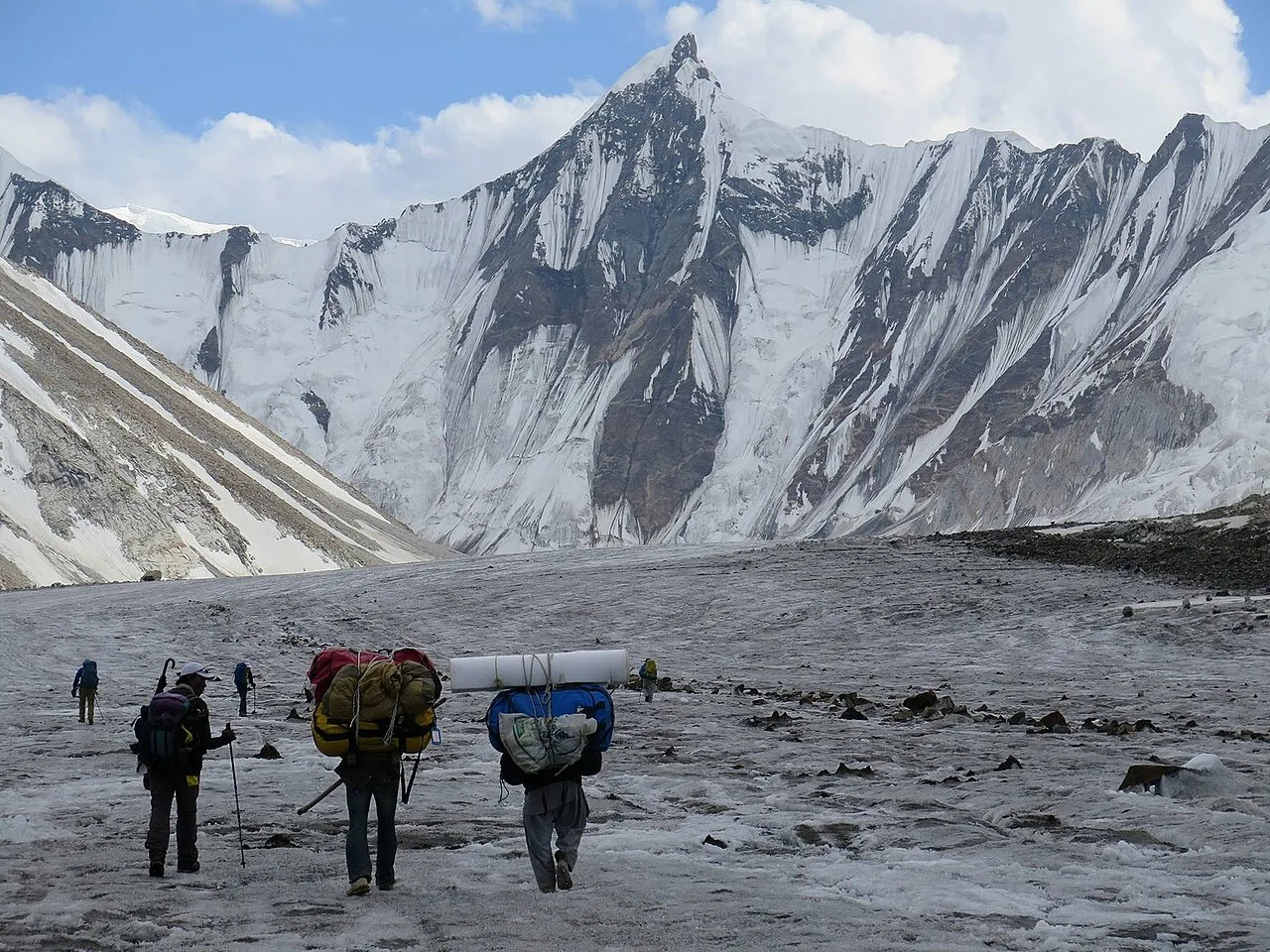
One practical point sits in the cost line, not the skills line. Personal climbing equipment (boots, crampons, harness, ice axe) is not included on Pastore Peak and Gondogoro Peak, and the pages say it is available to rent in Skardu. Khosar Gang says the same for personal kit, and its full-board tier includes group climbing equipment such as rope and pickets. Whether to rent or buy is your decision; our gear list covers what to bring either way.
How does a fixed rope work, and why will you use one?
Wikipedia describes a fixed rope (or fixed line) as the practice of installing "in-situ anchored static climbing ropes on climbing routes to assist any following climbers (and porters) to ascend more rapidly—and with less effort—by using mechanical aid devices called ascenders". Put simply, someone else sets the line first, and you clip on to it as you climb or descend.
You meet fixed rope early on two of our three beginner peaks, because both finish on the Gondogoro La. Pastore Peak's page lists "a fixed-rope pass crossing" as part of what makes it a genuine first climbing expedition, and the crossing is a 2 am start, "roped together to the top of the Gondogoro La (5,585 m)" and then "a careful fixed-rope descent". The Gondogoro Peak page uses the pass as a rehearsal: "the pass crossing itself is the rehearsal". The pages say the group climbing equipment and fixed rope are supplied, with the Hushe rescue team on the pass.
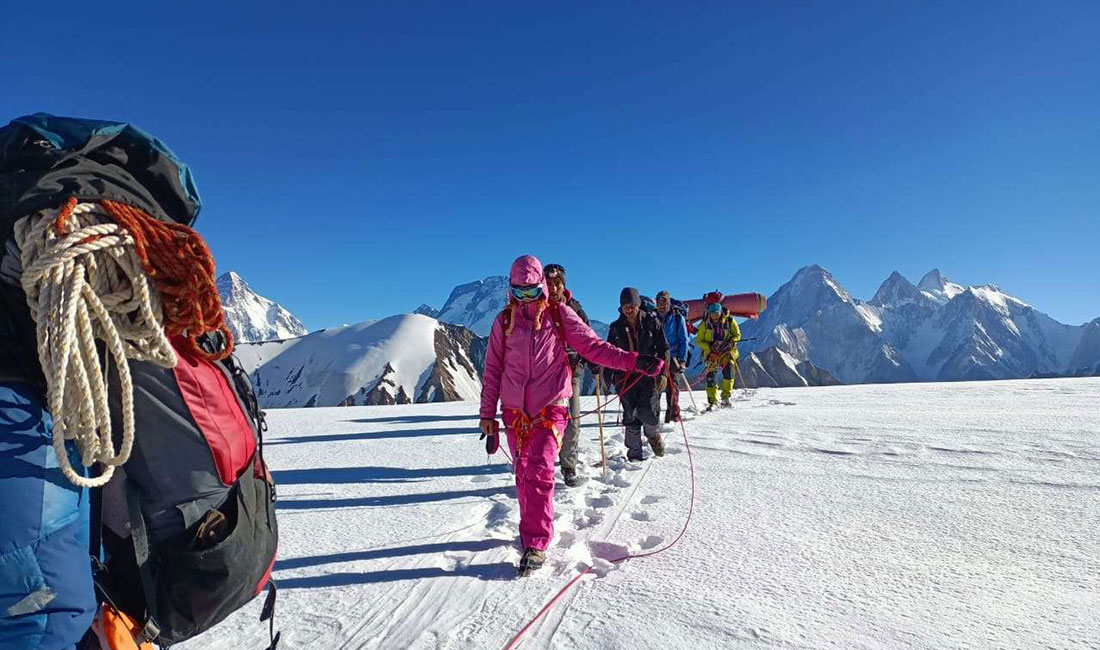
What should a beginner practise at home? Nothing on this list needs a mountain. Be comfortable being clipped to something, comfortable with exposure, and comfortable moving slowly in a line with other people. Beyond that, the specific technique (ascenders, descenders, the order of clipping) is taught at Ali Camp on the day before the crossing, by the people who will be standing next to you on the day.
What is self-arrest, and will you need it?
Self-arrest is the technique that makes an ice axe a safety tool. Wikipedia describes it as one "where a climber who has fallen and is sliding uncontrollably down a snow or ice-covered slope 'arrests' their fall by themselves by using their ice axe and their crampons", and says that practising it is "a core skill set for mountaineers in snow and ice-covered terrain". The same article says it matters most on steeper ground and on glaciers where a rope team member falling into a crevasse could drag the others in, and that it should ideally become instinctive.
Our trip pages do not name self-arrest, so we will not claim it is on every itinerary. What they say is that "rope work" and "ice axe" are taught and drilled at base camp. Ask your guide at the skills day whether self-arrest is part of it, and say that you want to practise it.
What is glacier travel, and why does it need a rope?
Wikipedia says glacier travel involves "traversing (often as a rope team)" a glacier using equipment such as crampons, climbing ropes, harnesses, helmets and ice axes, and that falling into a crevasse is a hazard on many glaciers. That is why "glacier travel" appears on the Khosar Gang skills day, and why Pastore's day 12 crossing of the Godwin-Austen Glacier is described as "reading a line through the crevasse zones as we go". Your guide chooses the line. Your job is to stay on it, keep the rope tension the guide asks for, and walk at a pace that does not pull the person in front of you.
What happens to the body at altitude, and what can you do about it?
The medical name for the mildest form of altitude sickness is acute mountain sickness (AMS). Wikipedia says it is caused by "rapid exposure to low amounts of oxygen at high elevation" and that symptoms may include headaches, vomiting, tiredness, confusion, trouble sleeping and dizziness. It can progress to high-altitude pulmonary edema (HAPE) or high-altitude cerebral edema (HACE). Wikipedia also says being physically fit does not decrease the risk, which is why fitness and acclimatisation are two separate lists in this article.
The best defence, per the same article, is slow ascent. It gives a rule of thumb of climbing no more than about 300 m (1,000 ft) a day to sleep, and describes the "climb-high, sleep-low" approach: go up to a higher camp, return to sleep lower, repeat. You will recognise that pattern in our itineraries. Khosar Gang's day 5 is an "acclimatisation carry to high camp" with a return to sleep at base camp, followed by a full rest day before the move up. Pastore Peak's two-week walk to base camp is, in the page's words, "the acclimatisation for the climb". The one thing a beginner can do at home is learn the symptoms above and tell the guide the moment you notice one. Our acclimatisation guide goes further.
The guide's authority matters here too. Each page says the guide's turnaround call is final.
How fit do you need to be, and what does the 16-week plan say?
Fitness is the one thing you cannot learn at base camp, so this is the part to do at home. We have already published a plan for it, and we will quote it rather than change it.
Our 16-week mountaineering fitness plan is built in five blocks. Weeks 1 to 4 are a base: three steady aerobic sessions, one of them 2 to 3 hours, plus two short strength sessions. Weeks 5 to 8 turn the long day into a hill day of 3 to 4 hours, add a stair or incline session and start a light pack. Weeks 9 to 12 push the long hill day to 4 to 6 hours with 8 to 10 kg. Weeks 13 to 15 are back-to-back long days of 5 to 7 hours with the pack. Week 16 is a taper.
The plan's own advice is worth repeating: the target on the long hill day is "to finish able to walk another hour", and the three checks it gives are whether you can climb the long hill day at a steady pace without stopping to recover, wake the next morning and walk again, and eat and drink well while moving. It also says it is advice from a mountain team, not medical advice, and that anyone with a heart, lung or other health condition should see a doctor before training hard and before booking a high-altitude trip. We repeat that here.
What should you learn at home, and what will your guide teach you?
This is the split the whole article has been building towards.
| Learn it at home | Your guide teaches it on the mountain |
|---|---|
| Fitness: the 16-week plan, quoted above | Crampon walking, ice-axe use and rope work at base camp |
| Walking in your own broken-in boots, in your own layers and pack | Glacier travel and the rope team |
| Eating and drinking on a schedule while moving | Fixed-rope technique at Ali Camp (Gondogoro and Pastore) |
| The symptoms of altitude sickness, and the habit of reporting them | The acclimatisation pattern: carry high, sleep low, rest day |
| The mental routine of very early starts and slow, cold days | The summit plan, set against the daily forecast, and the turnaround call |
Nothing in the left column needs a mountain, and nothing in the right column needs a CV. That is the honest shape of a first peak with us.
Which first peak suits which beginner?
Three peaks, three different asks. These are the details from each page, and each page has its own terms, so read the page you are booking.
| Khosar Gang | Pastore Peak | Gondogoro Peak | |
|---|---|---|---|
| Height | 6,401 m | 6,209 m | 5,785 m |
| Length | 10 days | 25 days | 25 days |
| Price (2027 fixed departures) | $2,200 full-board; $1,400 base camp service | $4,200 per person | $2,750 per person |
| Season on page | June to September | July and August | July to September |
| Deposit | 10% confirms your place and files the peak permit | 10% (minimum $50) | 10% (minimum $50) |
| Balance | Due 45 days before departure | Two weeks before arrival, or on arrival in Islamabad | Two weeks before arrival, or on arrival in Islamabad |
| Insurance (mandatory) | Evacuation cover for trekking and climbing to 6,500 m, arranged by you | Helicopter-evacuation cover valid for climbing to 6,209 m | Helicopter-evacuation cover valid for climbing to 5,785 m |
Two notes on that table. First, the terms genuinely differ: Khosar Gang's balance is due 45 days before departure, while the other two follow the two-weeks-or-on-arrival wording. We quote each page's own terms and have not merged them. Second, the insurance rule is the same in spirit on all three, mandatory evacuation cover valid to the summit height, but the altitude on each certificate is different. Pastore and Gondogoro say they check your certificate before you travel, and say standard travel insurance will not do it. See our insurance guide for what to look for.
Which suits you? The short version, from our own pages: if time is the limit, Khosar Gang fits inside two weeks; if you want the K2 Base Camp trek with a summit on top, Pastore Peak is that trip; and Gondogoro Peak is described as the gentlest summit above a famous circuit. The deeper write-ups are in our Khosar Gang, Pastore Peak and Gondogoro Peak guides. The wider mountaineering hub lists what comes after.
You will also need Pakistan's Trekking & Mountaineering visa, not a tourist visa, for these peaks; the three pages say so, and we provide the letter of invitation. The step-by-step is in our visa and permits guide.
Ready to pick your first peak?
If you are new to all of this, say so when you write to us. For the shortest route to a 6,000 m summit, see the Khosar Gang Expedition. For the K2 Base Camp trek with a summit on top, see the Pastore Peak Expedition. For the gentlest summit above a famous circuit, see the Gondogoro Peak Expedition. Message us on WhatsApp with your hiking experience and your dates, and we will tell you which one fits.
Frequently asked questions
Do I need mountaineering experience for a 6,000 m peak in Pakistan?
Not on our three first-peak expeditions. The pages ask for strong hill or trekking fitness, and say crampon, ice-axe and rope skills are taught at base camp.
What is the first skill a mountaineering beginner should learn?
How to walk in crampons on snow. Wikipedia describes crampons as traction devices used for secure travel on snow and ice, including ascending snow slopes. Our guides teach this at base camp before anyone goes higher.
How long should I train before a first 6,000 m peak?
Our published plan runs 16 weeks, from a base block to back-to-back long days and a taper. Start earlier, and see a doctor first, if you are starting from very little.
Does being fit protect me from altitude sickness?
No. Wikipedia says being physically fit does not decrease the risk of altitude sickness; slow ascent is the main protection. That is why our itineraries build in acclimatisation days and carry-high, sleep-low days.
What insurance do I need for a first peak?
Insurance with evacuation cover valid to the peak height, arranged by you: to 6,500 m for Khosar Gang, 6,209 m for Pastore Peak and 5,785 m for Gondogoro Peak. Pastore and Gondogoro say they check your certificate before you travel.
Can I rent crampons and an ice axe in Skardu?
Our Pastore Peak and Gondogoro Peak pages say boots, crampons, harness and ice axe are available to rent in Skardu, and the Khosar Gang page says the same for boots, crampons, axe and harness. Ask us before you buy.
Written by Zulfiqar Ali, founder of Karakoram Venture. General mountaineering and altitude definitions read from Wikipedia on 12 November 2026; trip details are our published 2027 pages.