Pumari Chhish is a 7,492 m peak in the Hispar Muztagh of Gilgit-Baltistan, standing about 4 km east of Khunyang Chhish and north of the Hispar Glacier. It has been climbed exactly once — by a Japanese team in July 1979 — and has had no successful ascent since. Its neighbouring summits, Pumari Chhish South (7,350 m) and Pumari Chhish East (about 6,850 m), were first climbed in 2007 and 2022 respectively, both by hard technical routes. Access is from the Karakoram Highway through Nagar to Hispar village, then up the Hispar Glacier; the climbing window is roughly June to August.
We run trips into the Hispar from our side of the range with our own Balti and Hunza-Nagar team, and we will be straight with you: this is not a mountain you book. Pumari Chhish is one of the least-visited 7,000 m summits on earth, and almost everyone who reads this page will end up walking beneath it rather than up it. That is still one of the great walks in the Karakoram. If you are here as an alpinist with a serious CV, read the history below carefully — it tells you exactly what this peak has cost people.
Key Takeaways
- Height: 7,492 m main summit; Pumari Chhish South 7,350 m; Pumari Chhish East about 6,850 m.
- Where: Hispar Muztagh, north of the Hispar Glacier, roughly 4 km east of Khunyang Chhish (7,852 m).
- Ascents: the main summit has one recorded ascent — 1979, Hokkaido Alpine Association, via the north ridge.
- South summit: first climbed 12 June 2007 by Yannick Graziani and Christian Trommsdorff, 2,700 m south face, alpine style, six days.
- East summit: first climbed 29 June 2022 by Christophe Ogier, Victor Saucède and Jérôme Sullivan — "The Crystal Ship", awarded a 2023 Piolet d’Or.
- Access: Karakoram Highway to Aliabad/Karimabad, jeep to Hispar village via Nagar, then the Hispar Glacier on foot.
Where Pumari Chhish is, and why it matters
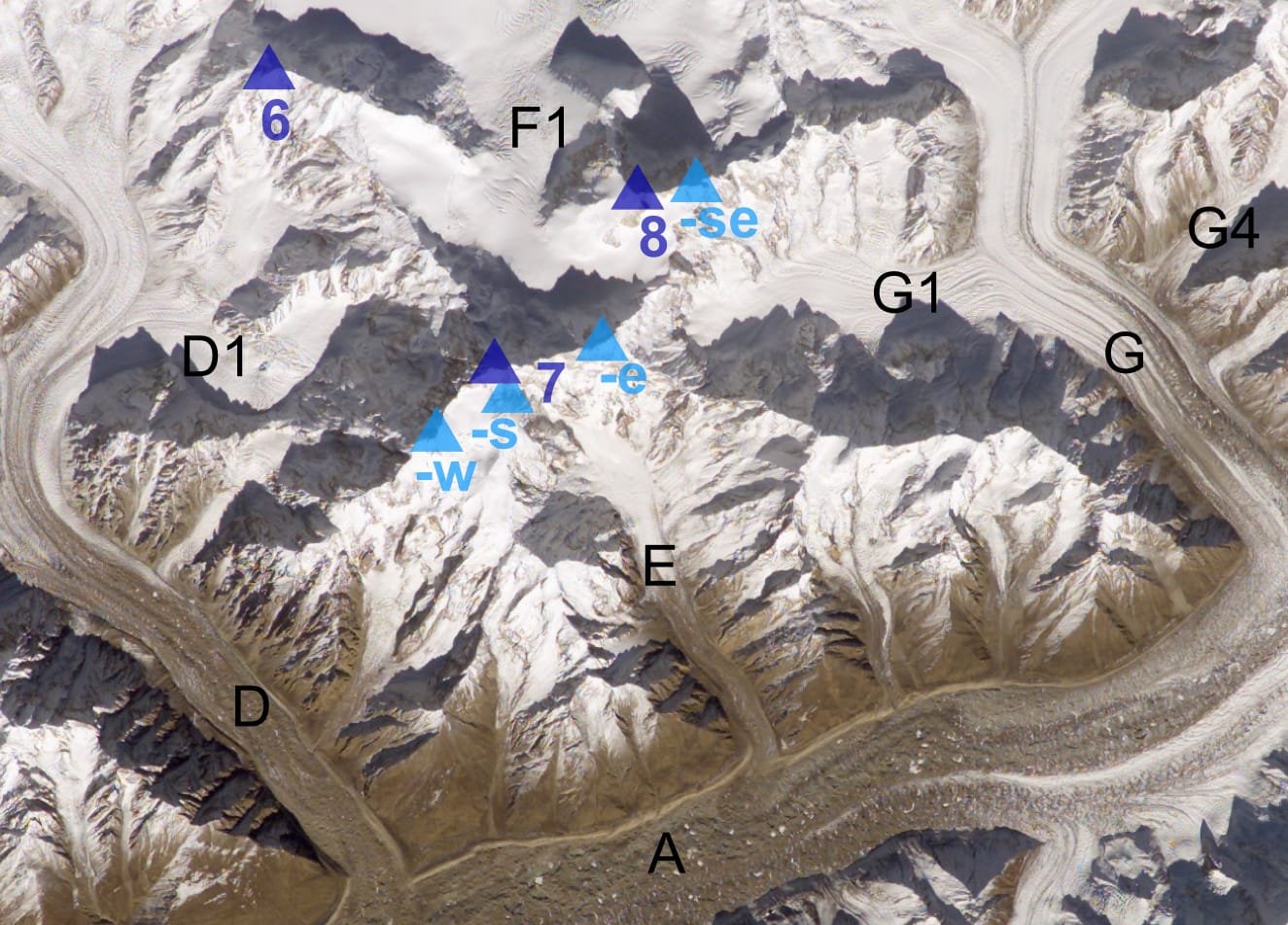
The Hispar Muztagh is the sub-range that walls off the north side of the Hispar Glacier. It carries some of the highest and least-climbed mountains in Pakistan: Distaghil Sar at 7,885 m, Khunyang Chhish at 7,852 m, Kanjut Sar at 7,760 m, Trivor at 7,577 m. Pumari Chhish sits in the middle of that company at 7,492 m, four kilometres east of Khunyang Chhish, with the Yazghil Glacier draining its northern side toward Shimshal.
It matters for a simple reason. In a range where the giants have been climbed dozens of times, this one has been climbed once. Not because it is higher — it is not — but because every side of it is defended: long glacier approaches, objectively dangerous ground below the ridges, and a summit block that has turned back strong parties for fifty years.
How the Hispar Muztagh giants compare
Getting there: the route to the foot of the mountain
There is no road to Pumari Chhish and no flight that shortens it. Every approach starts on the Karakoram Highway and ends on ice.
- Islamabad to Hunza. Two days by road on the KKH, or fly to Gilgit and drive up. Buffer days matter here — mountain flights cancel for weather.
- Karimabad or Aliabad. Base yourself here to finish permits, food and porter arrangements. This is the last place with reliable supply.
- Nagar to Hispar village. Roughly six to seven hours by jeep on a rough, narrow track. This is the last village and the last mobile signal.
- Hispar village onto the glacier. The Hispar Glacier runs about 49 km east toward the Hispar Pass and Snow Lake. Expedition parties break off north into the side glaciers below the peaks.
- Base camp and above. The 1979 ascent came in from the Khunyang Glacier to the west, crossed a significant col onto the upper Yazghil Glacier, then followed the north ridge. Modern attempts on the South and East summits have gone instead at the south faces from the Hispar side.
Schematic approach profile
The climbing history: one summit, fifty years
The record here is short enough to list in full, and that is the point.
1974 — Austrian attempt. The first serious try approached from the north and failed to climb or bypass the Yazghil Glacier.
1979 — the only ascent. A Japanese party from the Hokkaido Alpine Association, led by Takao Sasaki and joined by an officer of the Pakistan Army’s Corps of Signals, took a long line starting from the Khunyang Glacier well west of the peak. They crossed a significant col to reach the upper Yazghil Glacier and then climbed the north ridge to the top in mid-July. According to the Himalayan Index, no one has repeated it.
1999 and 2000 — Clyma and Payne. Julie-Ann Clyma and Roger Payne made two unsuccessful attempts on the South summit.
2007 — Pumari Chhish South. On their third trip across two seasons, Yannick Graziani and Christian Trommsdorff climbed the 2,700 m south face in pure alpine style over six days, summiting on 12 June 2007. They graded it ABO 5.10 M6 A1. It became the lead article of the 2008 American Alpine Journal.
2022 — Pumari Chhish East. After five previous attempts from the south, Christophe Ogier, Victor Saucède and Jérôme Sullivan climbed a 1,600 m line up the south face, "The Crystal Ship" (M7, 6b, A2), topping out on 29 June 2022. It was honoured with a 2023 Piolet d’Or.
Three summits in the group. Three first ascents in fifty years, and no second ascent of the main peak. That is the honest measure of this mountain.
When to go
The Karakoram climbing season is short and the Hispar is no exception. Snow conditions on the approach glaciers, not summit temperatures, usually decide your dates.
| Months | Conditions | Verdict |
|---|---|---|
| April – May | Deep snow low down, jeep track to Hispar often still blocked or unreliable | Too early for most parties |
| June | Track open, glaciers still well covered, cold nights — the 2007 and 2022 first ascents both fell in June | Strong technical window |
| July – August | Warmest, longest days, most settled spells; also the most rockfall and crevasse exposure on melting ice | Peak season for expeditions and glacier trekking |
| September | Cooling, clearer air, shorter days, weather turns fast | Good for trekking, tight for climbing |
| October onward | Cold, unsettled, high passes closing | Not recommended |
How hard it is — honestly
We are not going to soften this. The main summit of Pumari Chhish is expedition-grade alpinism at the top end: multi-week commitment, a long unsupported glacier approach, and a route that has defeated everyone who has tried it since 1979. The South and East summits are harder still in pure technical terms — sustained rock, mixed and ice ground at and above 6,400 m, climbed alpine style with bivouacs. If you have to ask whether you are ready, you are not.
What is realistically open to fit, experienced trekkers is the Hispar Glacier approach — walking in beneath these faces, camping on the moraine, and getting the view that almost nobody has. That is a serious glacier trek in its own right: crevassed ground, no evacuation road, and altitude that demands proper acclimatisation. Come with real hill fitness, a tested kit list, and a tolerance for cold and discomfort. If you want a shorter high-altitude objective in the same district first, Rush Lake is the sensible warm-up.
Getting there and what it costs
Most people fly into Islamabad, then either drive the KKH to Hunza over two days or fly to Gilgit and continue by road. From Karimabad or Aliabad it is a jeep day through Nagar to Hispar village, and from there you are walking.
On cost, we keep pricing personal rather than posting a number that goes stale the moment porter rates, permit fees or fuel move. Tell us your dates, group size and objective — glacier trek or expedition — and we will quote you properly: fair price, no corners cut on guides, food or safety kit. What we will not do is quote you cheap by leaving the sat phone at home.
Frequently asked questions
How high is Pumari Chhish?
The main summit is 7,492 m. Pumari Chhish South is 7,350 m and Pumari Chhish East is about 6,850 m.
Has Pumari Chhish been climbed?
Yes, once. A Japanese party from the Hokkaido Alpine Association, with a Pakistan Army officer, climbed the north ridge in July 1979. According to the Himalayan Index there has been no successful repeat of the main summit since.
Where exactly is Pumari Chhish?
In the Hispar Muztagh of Gilgit-Baltistan, Pakistan — north of the Hispar Glacier and about 4 km east of Khunyang Chhish, with the Yazghil Glacier on its northern side.
Can I trek to see it without climbing?
Yes. The Hispar Glacier approach from Hispar village puts you beneath the Hispar Muztagh faces. It is a committing, crevassed glacier trek rather than a stroll, but it does not require technical climbing.
What is the best time of year?
Roughly June to August. Both modern first ascents in the group — the South summit in 2007 and the East summit in 2022 — were made in June.
Plan it with a local team
We are a local Balti team based in Skardu, not a broker who hands you to someone else at the airport. Our guides come from these valleys, our expeditions carry a satellite phone and a rescue plan that actually exists, and we price fairly because we run our own logistics.
WhatsApp: +92 312 9921574 · Email: info@karakoramventure.com
Tell us your dates and objective and we will come back with a real plan. Local hands, real safety, fair price.
Sources & attribution: elevations, climbing history and first-ascent details from Wikipedia (Pumari Chhish, Hispar Muztagh), the American Alpine Journal, Piolets d’Or and PlanetMountain reporting. Images: Theprotrekker (CC BY-SA 4.0) and Yousaf Feroz Gill (CC BY-SA 4.0) via Wikimedia Commons; NASA / ISS derivative by Rupert Pupkin (public domain) via Wikimedia Commons. Altitudes are the commonly cited values and should be treated as approximate.