Broad Peak Central is the middle summit of the Broad Peak massif on the Baltoro Muztagh, on the Pakistan–China border above the Godwin-Austen Glacier, and it stands at roughly 8,011–8,016 m — only about 40 m below Broad Peak Main, and by some pairs of published figures as little as 31 m. It is not one of the fourteen eight-thousanders, because it rises barely 200 m above the saddle linking it to the main summit and the Karakoram convention asks for 500 m of prominence. Reaching it means the same approach as Broad Peak itself: a jeep to Askole, about seven days up the Baltoro to base camp near 4,900 m, then a serious snow-and-ice climb in June to August. It is harder and far less travelled than the main summit, and its first ascent in 1975 killed three of the men who made it.
We run the Baltoro out of Skardu with our own Balti team, and we will be straight with you about this one. Broad Peak Central is not a product you book off a shelf. Almost nobody climbs it, there is no fixed-rope highway to it, and the honest route to standing under it is the trek to Concordia and Broad Peak base camp — which is a magnificent trip in its own right. What follows is the real picture: where it sits, what the numbers mean, what happened in 1975, and what we can and cannot organise for you.
Key takeaways
- Height: about 8,011 m, with sources quoting 8,011–8,016 m — treat the figure as approximate.
- Not an eight-thousander: its prominence is only around 200 m, well under the 500 m the Karakoram list requires.
- Where: the Broad Peak massif, Baltoro Muztagh, Gilgit-Baltistan, on the border with China’s Xinjiang.
- First ascent: 28 July 1975, a Polish team — five reached the top, three died on the descent.
- Season: June to August, with July the working window, same as Broad Peak and K2.
- Realistic trip: trek to Concordia and Broad Peak base camp (about 14–16 days round trip from Skardu); a climbing attempt is a full expedition with a mountaineering permit.
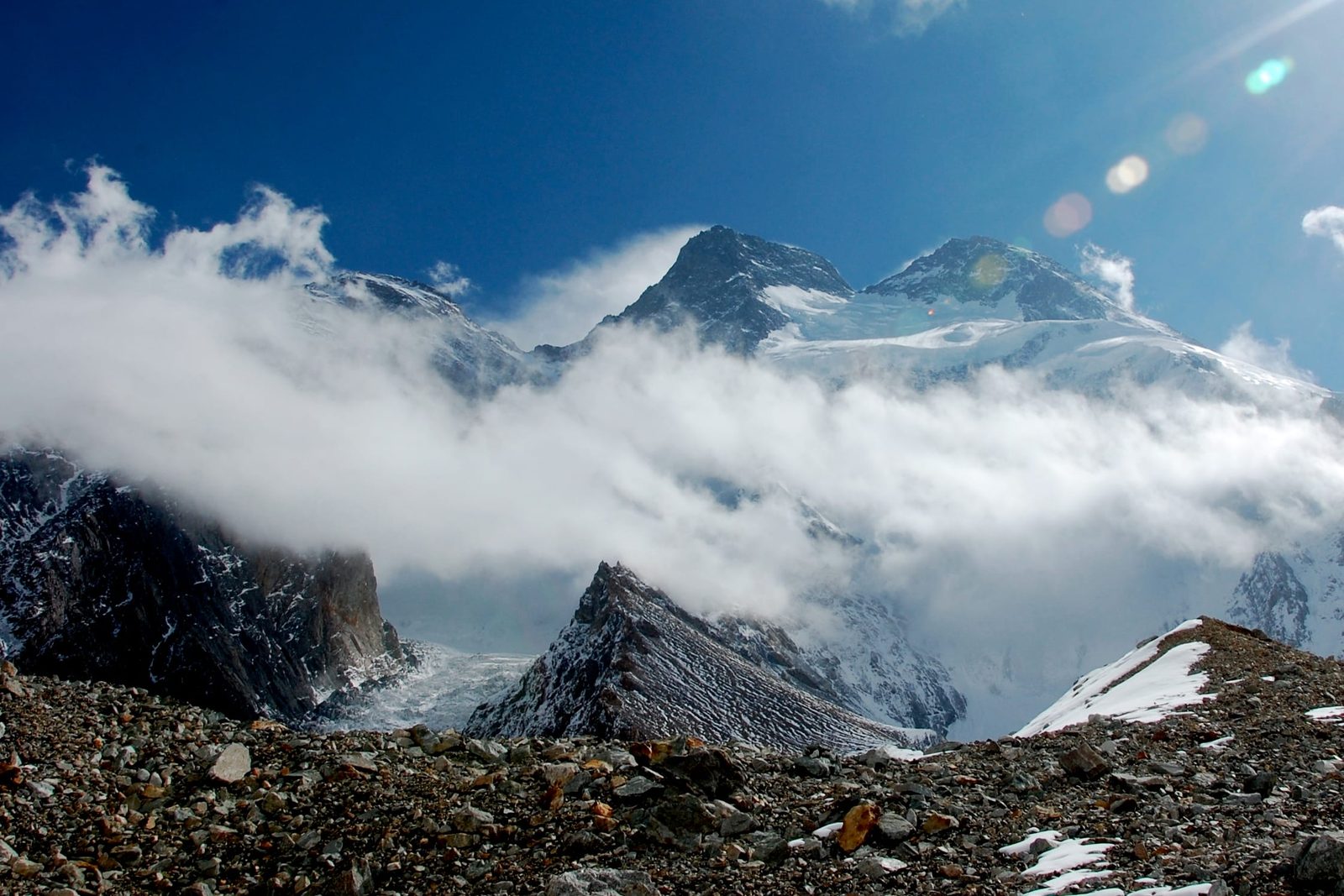
Where Broad Peak Central is, and why people argue about it
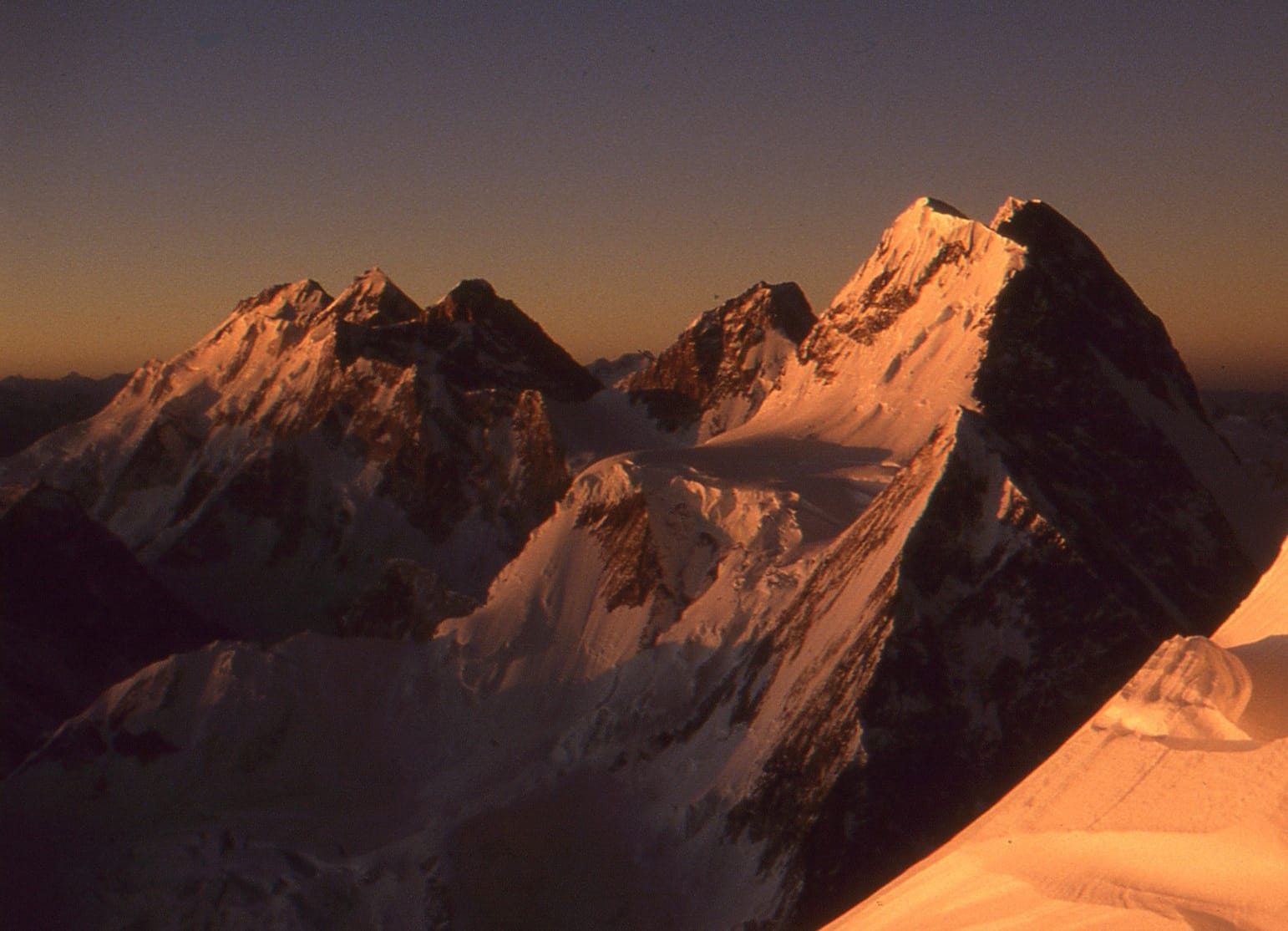
Broad Peak is not one summit. It is a long, high wall of a mountain with three tops strung along a ridge above the Godwin-Austen Glacier, directly across from K2. From south to north you have the Main summit at 8,051 m (some references give 8,047 m), then the Central summit at roughly 8,011 m, then the North summit at about 7,490 m — a figure sources disagree on, with some putting it nearer 7,550 m. The whole massif sits on the frontier between Gilgit-Baltistan and the Chinese side of the range, which is why a 1992 expedition could reach the central summit from the east, out of the Shaksgam.
The argument is about bookkeeping, not mountaineering. A summit joins the list of fourteen eight-thousanders only if it is independent enough, and in the Karakoram the working rule is 500 m of topographic prominence — the drop to the lowest saddle connecting it to a higher peak. Broad Peak Central drops only about 200 m to the col between it and the main summit. Published prominence figures range from roughly 180 m to 350 m depending on the survey; every one of them is far short of 500 m. So it has been called the fifteenth eight-thousander for decades, and it has never been counted as one.
Stand at Concordia and the argument looks silly. The thing is enormous. It just happens to be attached to something marginally bigger.
The numbers: how Central compares to its neighbours
Here is the neighbourhood, drawn to scale from 7,000 m upward so you can actually see the differences. These are the giants you walk beneath on the Baltoro Glacier.
Depending on which published figures you pair up, somewhere between 31 and 40 metres separate Central from Main. For comparison, Gasherbrum IV misses the 8,000 m mark by 75 m and nobody argues it is a minor peak. Height is not the same thing as status, and status is not the same thing as difficulty.
The 1975 first ascent, and what it cost
Broad Peak Main was climbed in 1957 by an Austrian team — Hermann Buhl, Kurt Diemberger, Marcus Schmuck and Fritz Wintersteller — without bottled oxygen, without high-altitude porters and without outside support. The central summit waited another eighteen years.
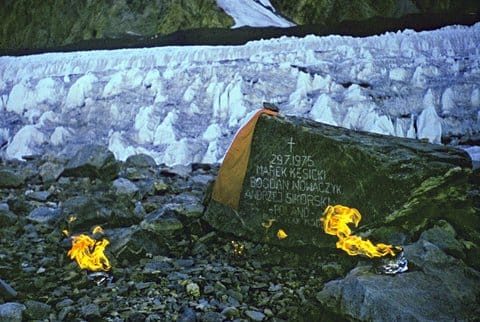
On 28 July 1975 a Polish expedition went for it from Camp III at around 7,200 m. Six men set out: Roman Bebak, Kazimierz Głazek, Marek Kęsicki, Janusz Kuliś, Bohdan Nowaczyk and Andrzej Sikorski. Bebak turned back shortly below the top. The other five summited.
Then the mountain took it back. Nowaczyk disappeared in a snowstorm on the descent. The others searched, could not find him, and were forced to bivouac near the summit — a night above 7,900 m that nobody plans for. They searched again the following morning, without success. Lower down, Kęsicki, Kuliś and Sikorski slipped. Kęsicki and Sikorski were killed. Of the five men who stood on Broad Peak Central that day, two came home.
The summits that followed
The summit was reached again in the years that followed, and in 1984 Jerzy Kukuczka and Wojciech Kurtyka made the first traverse of all three Broad Peak summits, going up the west ridge to the North top in mid-July and continuing along the crest. Then on 4 August 1992 a Catalan team — Òscar Cadiach, Enric Dalmau, Lluís Ráfols with Italy’s Alberto Soncini — reached Central from the Chinese east side after bivouacking near 8,000 m, the first ascent of anything in the Gasherbrum group from the Shaksgam. Kurt Diemberger, who had been on the 1957 first ascent of the main summit, took part in the reconnaissance trips.
Read the ascent list for any of these summits and the pattern is the same one you see on K2: the summit is halfway. The descent is where people die.
The route to it, step by step
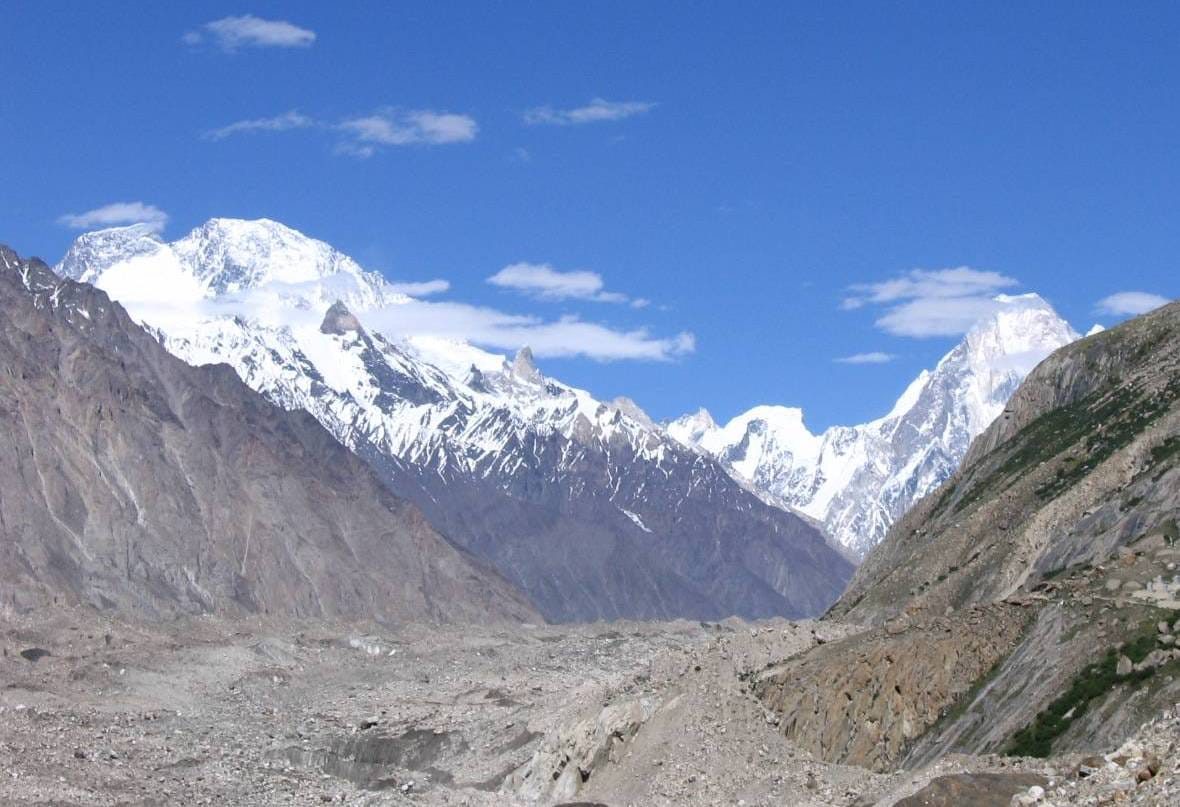
The approach is the Baltoro approach. It is identical to the one for a Broad Peak expedition, and for the first week it is identical to the K2 base camp trek. Days are indicative — load-carrying, weather and acclimatisation all move them.
- Islamabad to Skardu — by air when the weather allows, otherwise two long days by road. See how to get to Skardu.
- Skardu to Askole (about 3,050 m) — roughly 7 to 9 hours by 4×4 jeep on a rough, exposed road. Last village, last signal, last shop.
- Askole to Jhola (about 3,200 m) — a long, hot valley day over the Biafo snout.
- Jhola to Paiju (about 3,450 m) — the last trees and the first full view of the Trango group.
- Paiju to Urdukas (about 4,050 m) — onto the Baltoro ice itself, then up to the grassy terraces at Urdukas.
- Urdukas to Goro II (about 4,300 m) — a full day on the glacier, camping on bare ice.
- Goro II to Concordia (about 4,650 m) — the junction where the Godwin-Austen meets the Baltoro, and K2 finally stands up in front of you.
- Concordia to Broad Peak base camp (about 4,900 m) — a short day up the Godwin-Austen Glacier. This is as far as a trekking party goes.
- Climbing camps — an expedition then works up the west side to roughly Camp I near 5,800 m, Camp II near 6,300 m and Camp III near 7,000–7,200 m, with repeated rotations for acclimatisation before any summit push.
- The summit ridge — from the col, Central lies south along a corniced, exposed crest. This is the part that is not like Broad Peak Main.
The approach to Broad Peak Central, in profile
When to go
The Baltoro has one real season, and it is short. The table below is for the trek to base camp and for climbing attempts alike; see our fuller notes on the Baltoro climbing season.
| Months | Conditions | Verdict |
|---|---|---|
| April – May | Jeep road to Askole often still blocked or damaged; deep snow high on the glacier; cold camps. | Too early for the Baltoro. |
| June | Road usually open, glacier travel good, expeditions arriving and establishing base camp. | Good for the trek; the start of the climbing window. |
| July | Warmest and most settled spell. This is when summit pushes happen on Broad Peak and K2. | The best month — and the busiest. |
| August | Still workable, weather turning less reliable, expeditions packing out by late month. | Fine early, thinning out late. |
| September – October | Cold nights, short days, high camps unsupported, nobody on the mountain. | Trek only, and only with a strong team. |
| November – March | Winter. Road closed, glacier in full winter conditions. | Not commercially run. |
How hard it is — the honest version
Two entirely different trips get confused here, so let us separate them.
The trek to Broad Peak base camp
Hard but achievable for a fit, determined walker with no technical climbing skill. You are on glacier for days, camping on ice, carrying nothing heavier than a daypack while porters move the loads. The real difficulties are altitude (you sleep around 4,650–4,900 m), cold, rough glacial ground that twists ankles, and the sheer length of the days. Train for consecutive long days with elevation, not for a single big one. Our acclimatisation guide covers the altitude side properly.
A climbing attempt on Broad Peak Central
This is a serious, under-travelled 8,000 m objective and we will not dress it up. It demands prior experience at 7,000 m or above, competence on steep snow and ice, self-sufficiency high on the mountain, and acceptance of a corniced summit ridge with little traffic and no rescue infrastructure above base camp. There is no fixed-rope infrastructure to it of the kind that now exists on the main summit route, and there is no queue of other teams to break trail. If you have not already climbed an 8,000 m peak, this is not the one to start on — look at Spantik first, then Broad Peak Main.
The risk, named plainly
The 1975 first ascent of this summit killed three men, all on the descent. On the trek side, the serious hazards are altitude illness, rockfall and icefall on the glacier, and the Askole jeep road. Above base camp, add avalanche, cornice collapse and storms that pin people down for days. Every expedition and trek we run carries a satellite phone, we hold established helicopter-rescue contacts for the Baltoro region, and we require proof of insurance that covers helicopter evacuation above 5,000 m — see our insurance guide. Helicopters here are weather-dependent and never guaranteed; the plan exists so that when flying is possible, no time is lost arranging it. Any operator who will not tell you their evacuation plan does not have one.
Permits and visa
Trekking the Baltoro to Concordia and Broad Peak base camp falls in an open zone and does not require a mountaineering permit, though a registered operator, a licensed guide and standard registration apply. Climbing Broad Peak Central is different: it needs a mountaineering permit issued through the Gilgit-Baltistan authorities, with royalty, a liaison officer and an approved expedition plan — months of lead time, not weeks. Separately, you need a Pakistani Trekking and Mountaineering visa, not an ordinary tourist visa, and it must be applied for with an invitation from a licensed operator. Our Pakistan visa guide for trekkers walks through it. Because the massif straddles the Chinese frontier, approaches from the east are a separate matter entirely and not something we arrange.
Getting there, and what it costs
You fly to Islamabad, then to Skardu when the weather cooperates — it is a short, spectacular flight and it cancels often, so build buffer days in. The road alternative is two days up the Karakoram Highway and over to Skardu. From Skardu it is jeeps to Askole and then your own two feet.
On price: we keep pricing personal rather than posting a number that goes stale the moment permit royalties, porter rates or fuel move. Tell us the dates, the group size and whether you want the base camp trek or an expedition attempt, and we will send a full costing with nothing hidden in the footnotes — fair price, no corners cut on guides, food, or safety. A base camp trek and a permitted climbing expedition are an order of magnitude apart, so a single headline figure would mislead you either way.
What you are buying from us is a Balti team from the valleys below these mountains: our own guides, our own cooks, our own porter relationships in Askole. Not a booking passed to a third party in Islamabad. Local hands, real safety, fair price.
Frequently asked questions
Is Broad Peak Central an eight-thousander?
By height, yes — it stands at roughly 8,011–8,016 m. By the accepted definition, no. The list of fourteen eight-thousanders requires a summit to be sufficiently independent, and in the Karakoram the working threshold is 500 m of topographic prominence. Broad Peak Central rises only around 200 m above the col joining it to Broad Peak Main, so it is classed as a subsidiary summit. It has been called the fifteenth eight-thousander for decades, but it has never been counted among them.
How high is Broad Peak Central exactly?
Sources give between 8,011 m and 8,016 m, and you will see both quoted as authoritative. The honest answer is that it is about 8,011 m and the figure is approximate, like most Karakoram elevations outside the handful of peaks that have been resurveyed with modern instruments. The main summit is 8,051 m by the most common figure, 8,047 m in others.
Can I trek to Broad Peak Central without climbing it?
You can trek to Broad Peak base camp at about 4,900 m on the Godwin-Austen Glacier, which sits directly beneath the massif, and from there and from Concordia you get the full view of all three summits. That is a roughly 14 to 16 day round trip from Skardu and needs no technical climbing. Going any higher is mountaineering and needs a permit, a team and real experience.
Why do so few people climb it?
Three reasons. It gives no eight-thousander tick, so the commercial demand that built infrastructure on Broad Peak Main never existed here. The summit ridge is corniced and exposed, which makes it harder than the normal route to the main top. And its history is grim — the 1975 first ascent cost three lives on the descent, which has kept its reputation intact among people who read the records.
What is the best month for the Baltoro?
July. The jeep road to Askole is reliably open, glacier travel is at its best, and it is when summit attempts happen on Broad Peak, K2 and the Gasherbrums. June and early August both work well for the trek. Outside June to August you are looking at a cold, committed trip with nobody else on the glacier.
Talk to the team that lives here
Tell us your dates and whether you want the trek to Broad Peak base camp or a serious look at a climbing permit, and we will give you a straight answer about what is realistic — including when the answer is no.
WhatsApp: +92 312 9921574 · Email: info@karakoramventure.com
A local Balti team based in Skardu, not a broker — our own guides, our own logistics, from Askole to Concordia.
Planning more widely? See Gasherbrum I & II, Skil Brum and the best treks in Pakistan.
Sources & attribution: elevation, prominence, first-ascent and 1992 east-side details from Wikipedia (Broad Peak Central; Broad Peak; Eight-thousander) and the American Alpine Club Journal accounts of the 1992–95 Shaksgam expeditions; eight-thousander prominence convention per the UIAA-recognised list. Elevations for Broad Peak Central and Broad Peak North are approximate and differ between sources. Images: Maria Ly — CC BY-SA 2.0; Svy123, crop by Rupert Pupkin — CC BY 3.0; Adha65, derivative by Rupert Pupkin — CC BY-SA 3.0; A. Skoczylas — CC BY 2.5. All via Wikimedia Commons.